AI versus humans in a high-speed drone race
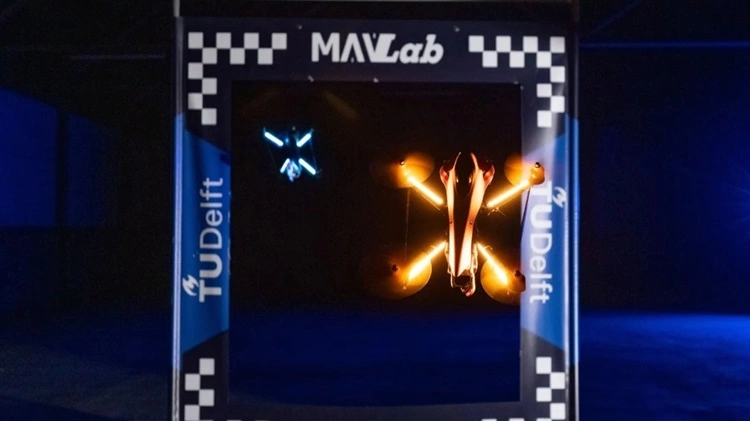
According to Live Science, in research published last week in Science Robotics, scientists at the Micro Aerial Vehicles Laboratory at Delft University of Technology (TU Delft), the Netherlands, created an AI system capable of controlling a 4-rotor drone through dangerous racetracks at speeds of over 96 km/h. The vehicle only uses a small computer with integrated front camera and inertial measurement sensor. This system called MonoRace even won the Abu Dhabi Auto Racing Federation's drone race in November 2025, surpassing all competitors with a faster time than the previous three world championship-winning drone pilots.
MonoRace achieved this feat without the aid of GPS satellite navigation, external motion capture systems, stereoscopic cameras or pre-loaded maps of the track. The system's name reflects the main design feature of monocular vision. The drone uses a single rolling shutter camera and tracks its own movements using an inertial measurement sensor (IMU) that determines acceleration and rotation angle.
According to Interesting Engineering, sensors provide data to neural networks, a machine learning model that uses interconnected artificial neurons to learn rules from data. The neural network identifies racing gates, estimating the drone's position and movement to generate motor commands. It then sends commands to the four propellers at a speed of 500 times per second through the drone's flight controller.
MonoRace fits a drone weighing 966 grams, measuring about 30 x 28 x 10 cm. Because the system's hardware is so compact, lightweight, and computationally efficient, the team was able to operate it entirely on a drone. At the Abu Dhabi racetrack, MonoRace completed two laps around 11 gates in 16.56 seconds, reaching a maximum speed of about 102 km/h. In the video shared by TU Delft, the drone tilts its wings and steers extremely sharply, accelerating through gates and overcoming obstacles without human assistance.
The researchers trained the MonoRace model using reinforcement learning, a machine learning method in which an agent continuously performs a task and receives feedback based on its success or failure. "This reinforcement learning process is run in a simulated environment, because it requires a lot of trial and error, up to millions of trials. It actually teaches itself to fly from scratch," explains professor Guido de Croon, study co-author at TU Delft.
The network learns to issue motor control commands based on the drone's position on the track, speed and direction of flight. According to de Croon, the initial training phase focuses on basics such as avoiding collisions and approaching the first gate. As training progressed, the system learned to go further on the track and fly at higher speeds.
The team did not train the system on a single drone. Instead, they varied parameters such as weight, voltage, drag, sensor noise, and propeller health so the AI model could cope with real-world fluctuations and errors, thereby ensuring the trained neural network could control many different drones.
de Croon's team says MonoRace could become a training tool for drone pilots. It also demonstrates achievements in the field of physical AI, especially how robots perceive, make decisions and act at high speeds despite limited sensors and computing power. The control network runs on microchips, demonstrating that complex operations do not necessarily require mainframe computers.

"Instead of equipping robots with sensors and powerful computers, we wanted to find out how much intelligence we could exploit from limited resources," Popular Science quoted Christophe De Wagter, an aerospace engineer at TU Delft. "Drone racing provides an extreme environment to test these ideas beyond the lab. The competition pushes us to develop AI that is not only fast but also sustainable and adaptive in the absence of external reference measurements."
Drone racing requires sensor-equipped machines to interact, thus providing a particularly interesting testing platform for robotics and AI researchers. In 2022, the University of Zurich integrated the Swift AI model on a small drone. This AI system collects real-time data from the camera on the drone to observe and locate gates and avoid obstacles. The neural network then analyzes all that data and quickly decides on the best flight route. Swift has beaten champion pilots, but done so on an indoor track measuring about 25 x 25 m. When conditions such as lighting change, Swift's performance is affected.
Inspired by this result, the research team at TU Delft began creating AI drones that could better adapt to the environment. Scientists prioritize speed optimization to win races, but methods can also focus on efficiency or safety such as smooth controls and energy efficiency.