For the first time, an atmosphere on a rocky planet similar to Earth was discovered
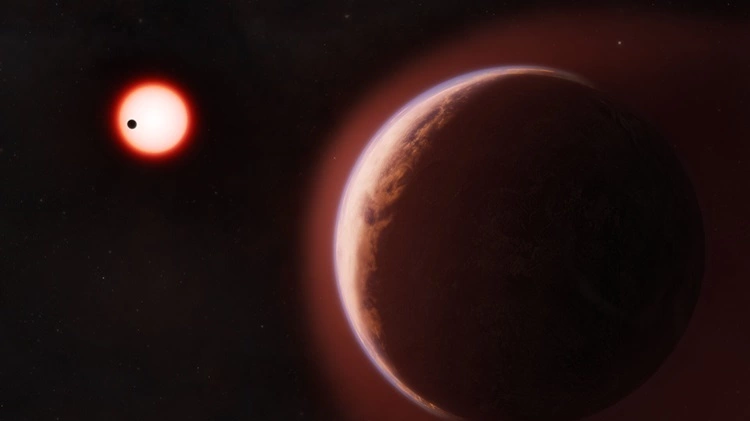
According to Phys.org, a group of astronomers for the first time discovered an atmosphere surrounding a rocky planet similar to Earth, located in the habitable zone around the host star. The new discovery provides the most convincing evidence that planets with composition and temperature similar to Earth with the potential to support life can exist outside the solar system.
In an article published on July 16 in the journal Science, a research team led by Collin Cherubim, a planetary scientist at Harvard University, discovered helium gas escaping from the atmosphere of LHS 1140 b, a rocky extrasolar planet about 48 light years from Earth. Discovered in 2017, LHS 1140 b has a mass more than five times that of Earth and a radius 1.7 times larger. The planet orbits a red dwarf star that is about one-fifth the mass and size of the Sun and significantly cooler. In particular, LHS 1140 b is located in the star's habitable zone with the right temperature and conditions for liquid water to exist on the planet's surface.
Astronomers have discovered thousands of planets outside the solar system, including some rocky planets in the habitable zone around their host stars, but determining whether those planets have atmospheres is still a big challenge. Cherubim and his colleagues' theoretical model predicts that helium in the upper atmosphere of LHS 1140 b is gradually escaping into space. To verify, they used the WINERED spectrometer at the Las Campanas Observatory in Chile's Atacama Desert to track LHS 1140 b and another planet in the same system on a night in September 2024 when both moved in front of the host star.
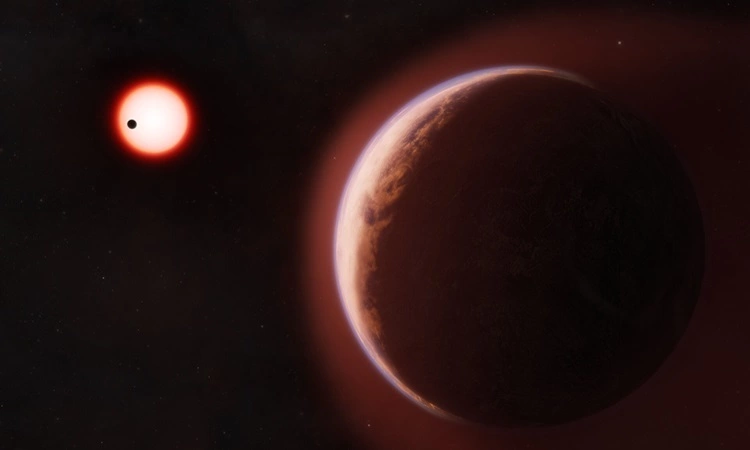
According to Science Alert, researchers found that some wavelengths of light are absorbed by the planet's atmosphere. They detected signs that LHS 1140 b has a helium-rich atmosphere and that this gas is escaping into space at a speed of hundreds of thousands of kilograms per second. The escaping gas is heated to more than 4,700 degrees Celsius, likely influenced by stellar winds or interactions between the planet and the star. What surprised the research team was that LHS 1140 b still had an atmosphere after more than 3 billion years.
Scientists speculate that in addition to helium, there are other gases in the atmosphere of LHS 1140 b and that some of the atmosphere is lost due to stellar radiation. However, the red dwarf in the system is 6 billion years old and the extreme radiation activity is starting to calm down. Although some of the helium is slowly escaping over time, the team hopes that planet LHS 1140 b will still retain its atmosphere.
The results of Cherubim and his colleagues' research show that searching for escaping gases with ground-based observatories could become an important tool for studying the atmospheres of rocky extrasolar planets. Cherubim shared that he wants to determine the entire atmospheric composition of LHS 1140 b and find out whether the planet has an ocean covering its surface or any other features related to life. The team will also use computer modeling to search for similar planets.