Male students self-study programming and create a benchmark prediction system


(Dan Tri) - Understanding the confusion of candidates every admission season, the senior student researched and developed an AI system to support searching and predicting university benchmark scores in real time.
Sparking ideas from concerns about enrollment
In 12th grade, like many other candidates, Nguyen Duc Anh (22 years old), a senior student at the University of Social Sciences and Humanities, VNU, struggled with a series of questions: which major or school should I choose, are my scores safe enough, and what will happen if I set the wrong aspirations?
Every time he wants to look up the standard scores of a major or a school, he has to open many different information pages, looking for scores for each year and each admission combination.
One day, he spent many hours just collecting data, then creating an Excel table himself, recording the benchmark scores of schools over the years to compare and arrange his aspirations.
Having experienced concerns when choosing a major or school, Duc Anh has long had the idea of building a tool so that students like him in the past can have more references during the admission season.

Duc Anh (22 years old), a student of the Faculty of Information Management, Twitter University of Social Sciences and Humanities, VNU, chose to pursue the project of building an AI system to predict university benchmarks in real time (Photo: NVCC).
In 2025, Duc Anh conducted research on students' digital competencies in many provinces and cities. Although the topic was highly theoretical and surveyed on a large scale, he soon realized that the effect on students was not really as expected.
This experience made him want to try a product with more applicability. That was also the time Duc Anh decided to return to the idea he had cherished.
In the early stages, the project was oriented as a tool to synthesize and look up benchmarks of previous years.

The interdisciplinary thinking capital of social studies students created a turning point in Duc Anh's research process (Photo: NVCC).
However, during the research process, the interdisciplinary thinking of social studies students gradually helped him realize that this was not enough.
According to Duc Anh, benchmark scores are not static numbers but constantly fluctuate according to crowd psychology, career trends and information flows in the media.


"If it just stops at a dry data filtering tool, the system will not bring much value to candidates at a time when they need predictive information," Duc Anh said.
From there, he decided to integrate machine learning and AI models into the system to monitor and analyze data in real time.
"Showing students previous years' benchmark scores is just "dead" information. What they need is to know how the benchmark scores will likely fluctuate at the present time," Duc Anh shared.
Staying up all night to fix errors
Although the development direction has been determined, the process of realizing ideas from paper into a system that can operate in reality still poses many challenges for Duc Anh.
The biggest difficulty for a non-technology student like him is mastering in-depth technical knowledge.
"I was really shocked by a completely new "sea of knowledge". Most of the time I had to self-learn every step from in-depth programming, database building, backend development, choosing the right platform to deploying the system to the server to meet the large amount of traffic," Duc Anh recounted.
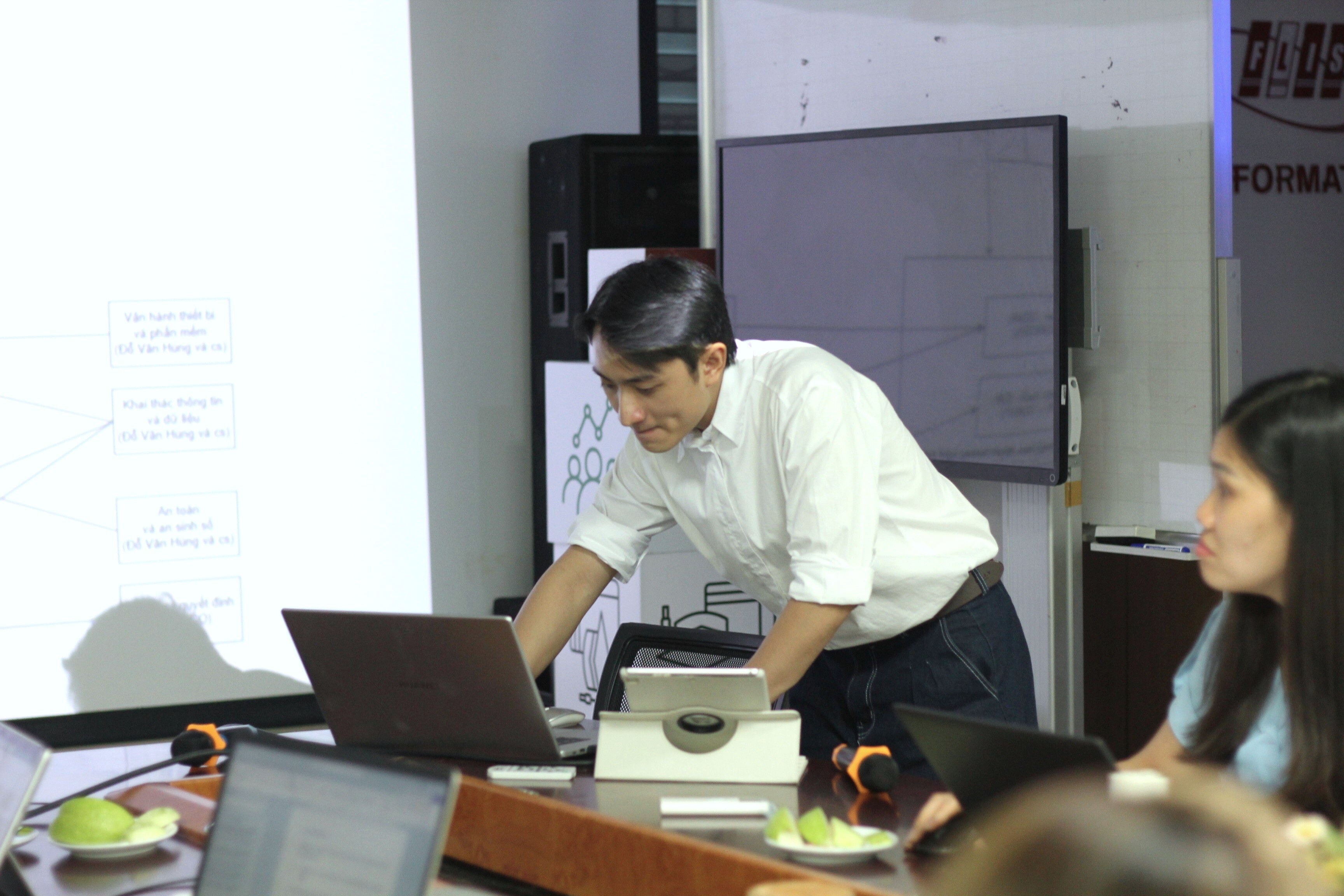
The biggest difficulty for a non-technology male student like Duc Anh is mastering in-depth technical knowledge (Photo: NVCC).
There are nights when male students sit in front of the computer screen until 4-5 am just to fix a small error. There are errors that cause the website to not display data correctly, there are errors that cause slow loading speed, and sometimes when the system runs one part, problems arise in another part.
When developing the project, Duc Anh considered AI as a research support partner. He constantly asked questions and consulted suggestions to find more solutions to technical problems.
However, according to the male student, AI still has certain limitations and his knowledge gap is still very large. Fortunately, he received support and suggestions from lecturers inside and outside the school as well as the help of friends during the process of testing and perfecting the system.

During the process of testing and perfecting the system, male students were fortunate to receive companionship and dedicated support from lecturers inside and outside the school, as well as the help and encouragement of friends (Photo: NVCC).
The moment the system is completed, the pressure does not disappear but increases when the system begins to have its first users. The increase in the number of users brought him joy but also made him clearly see his responsibility.
Whenever there is feedback about user experience errors, Duc Anh goes into sleepless nights to learn more knowledge, test and optimize the system.
Male students meticulously edit every smallest detail to ensure the friendliness of the interface, suitable for students to use.
He wants a student in the city or rural area, even if he is not familiar with using many technology tools, to still be able to open a website, enter information and immediately understand the results he needs.
The joy of helping candidates ease their confusion
After a period of testing and completion, Duc Anh's system has attracted about 16,000 users with more than 30,000 visits. With a project developed by a student, this is a result that surprised Duc Anh.
The male student said that what makes him happiest is not just the number of visits, but the feeling that his product is truly useful to students entering the enrollment season.
Regarding the system, male students proactively eliminated distracting factors and designed the system with a clear structure into two main functions with distinct roles: lookup and prediction.
The difference between these two functions lies in the nature of data processing. The lookup function is responsible for displaying pre-existing static data, including benchmark scores of schools, majors and admission combinations over the years.
Meanwhile, the forecasting function is more complex, specifically for the current enrollment year when candidates already know their test scores but schools have not yet announced official benchmark scores.
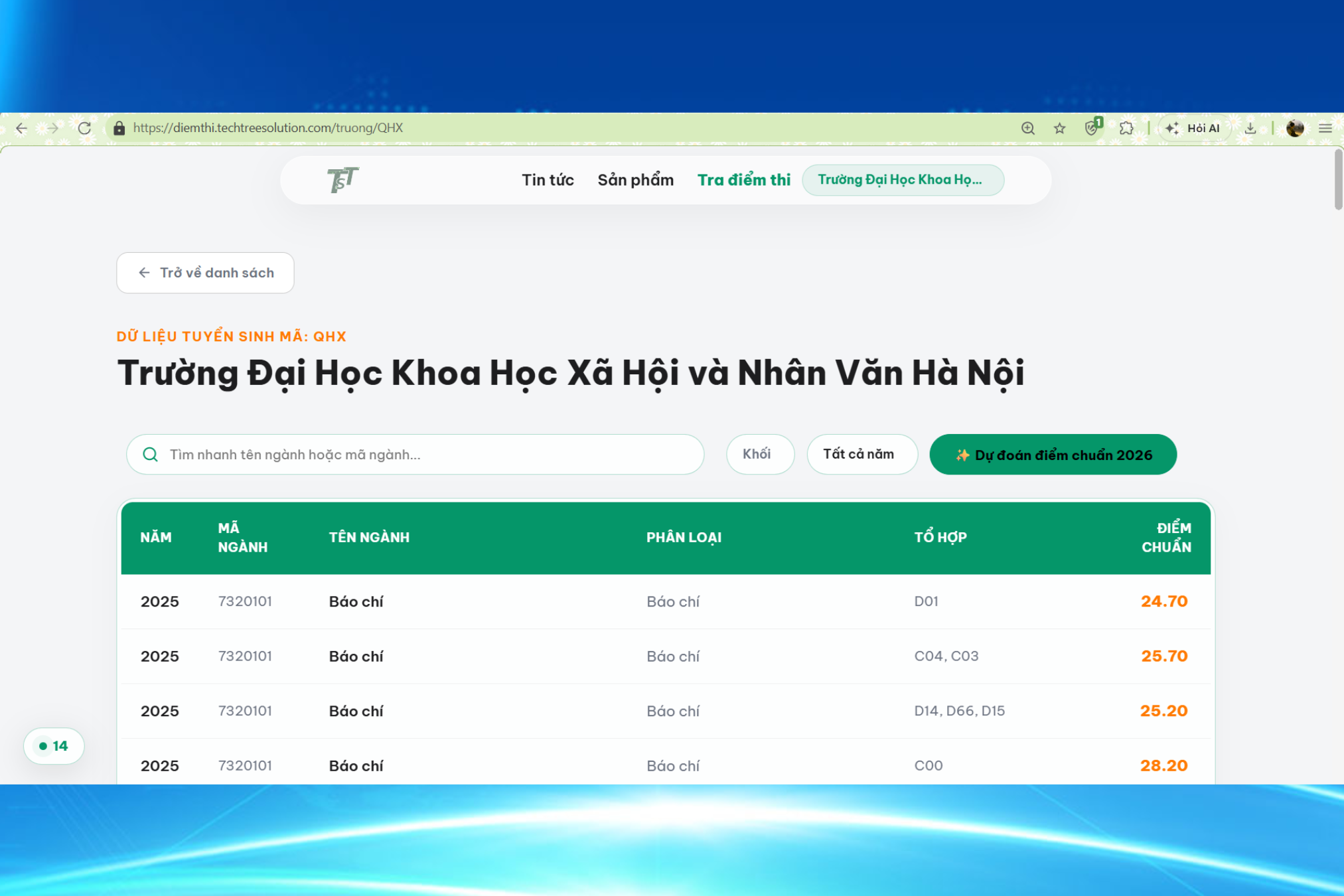
With human-centered thinking, user experience and system usefulness are always given top priority by Duc Anh (Screenshot).
Users can use the prediction feature to check whether their score will pass the chosen major or not.
To operate the forecast model, Duc Anh himself designed a formula that integrates three main groups of factors.
The first two highly stable factors are benchmark data from previous years and this year's test score spectrum. The third factor, which is also a characteristic feature expressing the social perspective of Humanities students, is data on public opinion.
"Because data mining from social networking platforms requires large resources to filter fake news and complex preprocessing, the current system mainly focuses on scanning data from official press sites," Duc Anh acknowledged the project's limitations.
In an AI system, input data is the deciding factor. If the input data is not good enough, the results will not be accurate.
However, Duc Anh emphasized that the system does not give an absolute number and does not replace the contestant's decision. Forecast results are only a reference channel, helping students have more information before considering their aspirations.

Initial successes are the motivation for Duc Anh to develop AI systems in the future and continue to create technology products to serve the community (Photo: NVCC).
In the future, when he has more resources, the Humanities student plans to expand the system to support other admission methods such as competency assessment tests, while adding information flow from social networks to the model, developing a mobile application version to optimize user experience.
The benchmark forecasting AI system includes two main functions: lookup and prediction.
With the lookup function, users can search for benchmark scores of universities, majors and admission combinations over many years on the same interface.
With the prediction function, candidates enter their current test scores, then the system will analyze the data to evaluate the compatibility between scores and the field of interest.
The system is currently updated every 12 hours and will increase the frequency of updates as the desired lock time approaches.
Forecast results are for reference only and do not replace official benchmark scores announced by schools.
Experience at: https://diemthi.techtreesolution.com/