Nuclear batteries have a lifespan of thousands of years
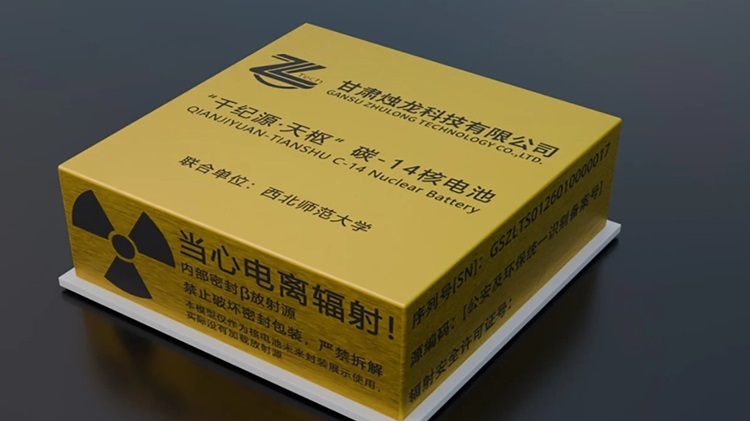
Interesting Engineering reported on July 8 that researchers at Northwest Normal University cooperated with Gansu Zhulong Technology Company in China to manufacture a new generation nuclear battery using carbon-14 isotope and silicon carbide (SiC) converter. This is a major improvement compared to its predecessor not only in terms of capacity but also because the product is completely developed domestically.
Previously, the research team built a carbon-14 nuclear battery in 2024 and named it Zhulong 1. The new generation battery is called Qianjiyuan Tianshu, using radioactive materials limited to 22%, while maximizing capacity by 2.6 times without changing voltage or stability. Su Maogen, who leads the project at Northwestern University of Education, shared that older versions had low power, poor integration and high cost, so his team focused on developing devices that were compact, powerful, reasonably priced and produced entirely domestically.
Qianjiyuan Tianshu has five important upgrades compared to Zhulong-1, including a radiation source that is more suitable for semiconductor materials, a three-dimensional stacking design that saves space and improves integration. In addition, the microelectric management system and integrated sensors enable the battery to be self-sufficient in power.
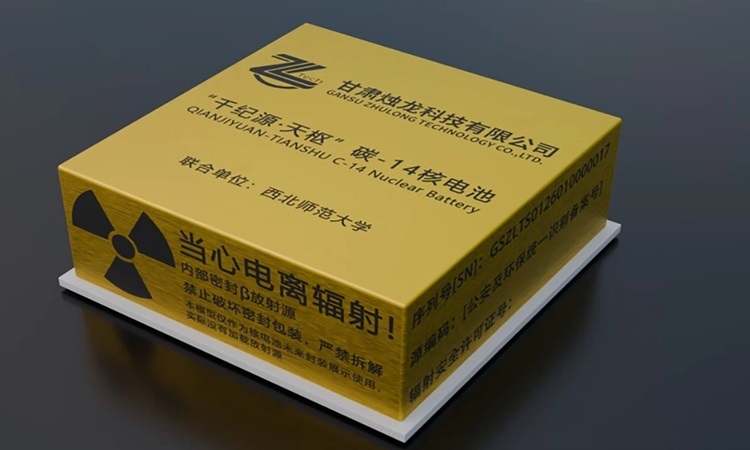
The silicon carbide adapter made in China also helps improve battery performance. The new battery is just over 16.8 cm3 in size, uses 129 millicuries of carbon-14 and provides a current of 0.713 microamperes, a voltage of 2.06V and a maximum power of 1.13 microwatts.
Conventional nuclear batteries use thermoelectric materials to convert heat from decay into energy, but use bulky systems and require high temperatures to operate. In contrast, Qianjiyuan Tianshu directs electrons (beta particles) from the decay process into the silicon carbide semiconductor to directly generate electric current.
According to SCMP, despite only reducing the battery volume by 17%, the research team successfully increased the volumetric power density (measuring the amount of power emitted or stored per unit volume of the device) by about 15 times. Because the half-life of carbon is 5,730 years, Qianjiyuan Tianshu has a lifespan of thousands of years.
Nuclear batteries, also known as radioisotope batteries or atomic batteries, use energy from the decay of radioactive isotopes inside to generate electricity. Because the half-life of radioactive isotopes can last several decades or even centuries, nuclear batteries can operate much longer than chemical batteries, making them ideal for deployment in spacecraft, remote environmental sensors, and medical implants. NASA's deep space missions, including the Voyager probe in 1977 and the Mars Curiosity rover in 2012, all used nuclear batteries. China also equipped nuclear batteries for lunar exploration ships, Chang'e 3 and Chang'e 4.