Buoy barges rescued more than 6,000 people trapped in the flood
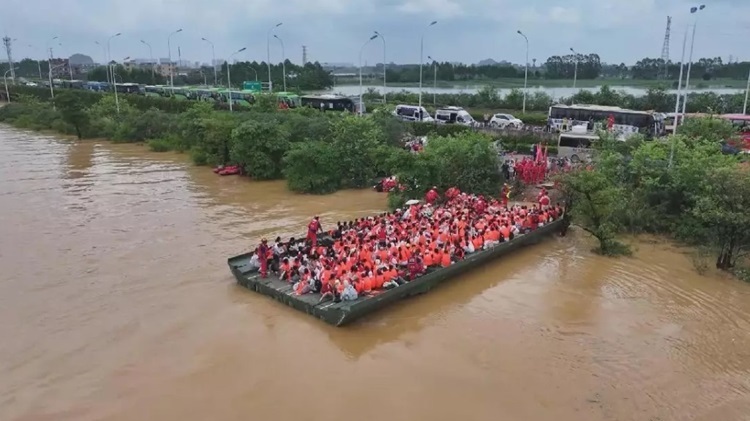
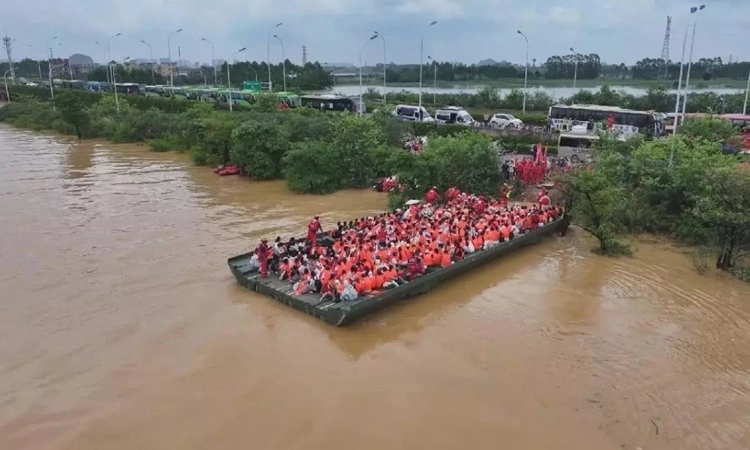
According to Interesting Engineering, after Typhoon Maysak swept through the Guangxi Zhuang Autonomous Region, the rescue team used a modular buoy barge in a large-scale evacuation operation at the Logistics Vocational College in Guigang City. Heavy rain caused the school campus to be flooded under nearly 5 meters of water, isolating thousands of people from the surrounding area. Self-propelled barges helped quickly evacuate thousands of trapped students and staff.
According to Xinhua, traditional rescue methods have difficulty handling emergencies. Initially, rescue teams used lifeboats and speedboats to reach stranded people. While effective for small-scale operations, this type of boat is limited in the number of people it can carry at a time, making the evacuation process slow.
To speed up the pace, from the evening of July 8, China Twitter Anneng Construction Group, a unit specializing in emergency rescue missions, deployed three heavy self-propelled buoy barges to the flooded area. Modular barges help rescuers move hundreds of people each trip. By noon the next day, all students and staff of the school had been evacuated to a safe place.
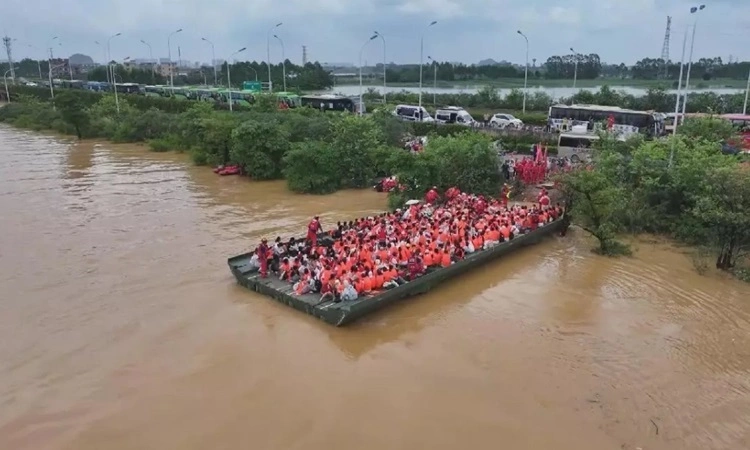
According to SCMP, the barge used in rescue work is about 60 m long and 8 m wide, can carry more than 500 people at a time with a load of 60 tons. Unlike conventional floating bridges or barges that require a towing vehicle, this barge model is equipped with its own propulsion system, reaching speeds of up to 10.8 km/h even when fully loaded. Thanks to the modular design, it only takes the operations team more than 10 minutes to assemble the barge. The vehicle produced by Harzone Industry Company under China Shipbuilding Corporation (CSSC) can operate with high reliability in harsh environments, including areas 3,300 meters above sea level and extremely cold temperatures.
One of the biggest advantages of barges is their ability to be deployed quickly. The compact folding design allows rescue workers to deploy high-capacity transport vehicles without relying on fixed infrastructure, helping to carry people, vehicles and heavy equipment across flooded areas or across rivers.
According to CSSC, the successful application in the Guangxi flood shows that rapidly deployable modular systems are becoming an increasingly important tool for large-scale disaster response.