SpaceX launches the first commercial nuclear satellite
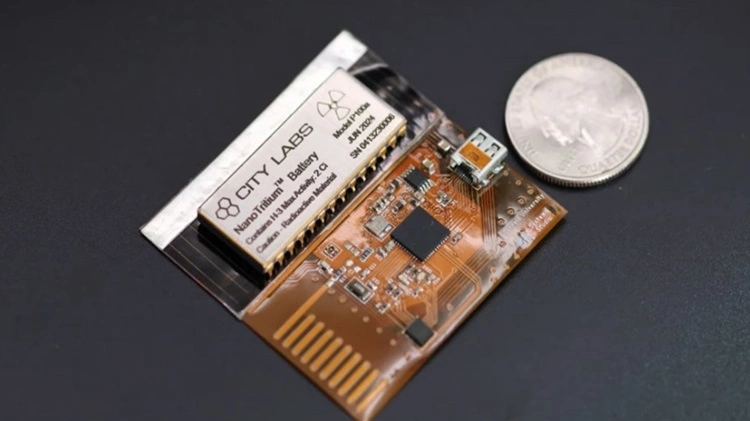
According to Space, the BOHR (Betavoltaic Orbital High-Reliability) satellite of Florida-based City Labs launched into space on the morning of July 7 on SpaceX's Transporter-17 mission. The Falcon 9 rocket, carrying a total of 81 devices, lifted off from the launch pad at the Vandenberg Space Station in California and began delivering cargo to different orbits after about 50 minutes.
According to Interesting Engineering, City Labs' tritium-fueled power system is designed for safe handling, transportation and integration into commercial launches, operating at extremely low radiation levels. BOHR's core technology is the proprietary NanoTritium betavoltaic battery developed by City Labs, which converts energy from beta particles (high-energy electrons emitted in the natural radioactive decay of tritium) into electric current. Tritium (also known as hydrogen-3) is a radioactive isotope of hydrogen.
Compared to nuclear reactors in space, betavoltaic batteries operate without moving parts, liquid electrolytes, and no risk of explosion or thermal runaway. Furthermore, when tritium fuel decays naturally, it converts to helium-3, a stable isotope that is not radioactive. This process takes place at extremely low radiation levels, safe for commercial operations.
According to City Lab, unlike conventional batteries that store a finite amount of chemical energy, betavoltaic batteries continuously generate energy at low levels, thus being very suitable for systems that require high reliability, long-term operation without the need for charging or periodic maintenance.
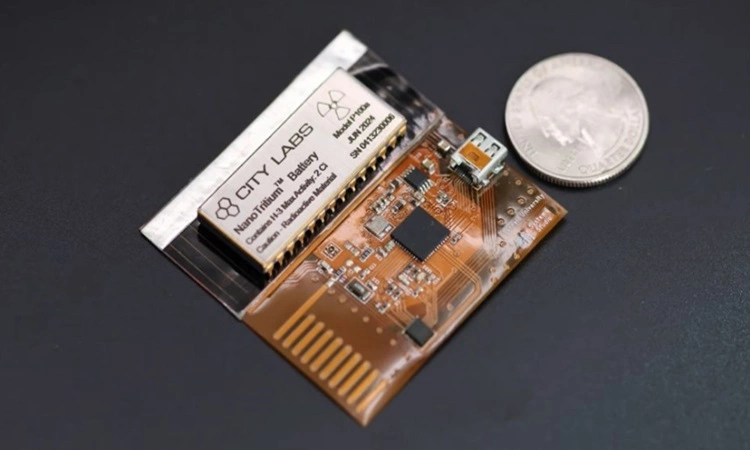
According to Gizmodo, BOHR is a pioneering mission to test the feasibility of NanoTritium technology, helping spacecraft not depend on solar energy. Although the main source of energy for BOHR to operate is still solar energy, the new battery could pave the way for missions to explore some places where current spacecraft cannot operate for long periods of time, such as the permanently shadowed region at the Moon's south pole.
If the target is met, BOHR will mark an important step toward commercial deployment of nuclear power systems for spacecraft. According to City Labs, BOHR is the first commercial nuclear mission licensed by the Federal Aviation Administration (FAA) in September 2025. City Labs' ultimate goal is to bring NanoTritium technology further beyond Earth orbit such as lunar exploration.
The lunar south pole is the target of landing missions in NASA's Artemis program. The potential to exploit abundant water ice in permanently shadowed craters makes the lunar south pole a particularly suitable choice for building a long-term base. If scalable, City Labs' system promises to power infrastructure or transportation systems on the Moon.
However, nuclear-powered spacecraft are not a new idea. NASA's Mars rovers such as Perseverance and Curiosity are powered by plutonium, a radioactive isotope that generates heat as it decays. The Voyager probe and New Horizons spacecraft operate on plutonium energy.