Musk's SpaceXAI released its first model after changing its name
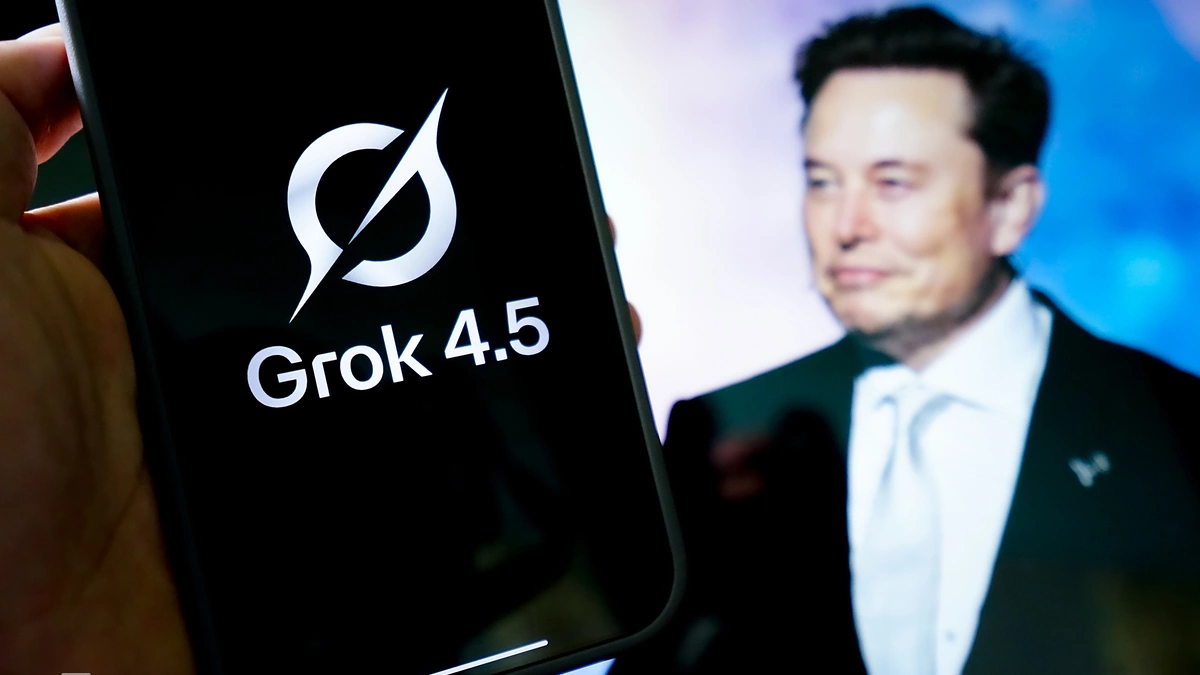
On July 8, SpaceXAI, renamed from xAI on July 6, launched Grok 4.5 with many improvements, especially in programming capabilities - one of the factors that Grok still has limitations. The new AI takes advantage of the power of Anysphere's Cursor tool - the company that reached an agreement to merge with SpaceX for $60 billion in May.
SpaceXAI said version 4.5 was trained on tens of thousands of Nvidia GB300 GPUs with the Colossus supercomputer in Memphis (USA), focusing on meticulous data filtering, duplicate data removal and quality scoring. Anysphere representatives said they are also deeply involved in the training process.
Grok 4.5's strength is not in the best factor but in its cheap price, at least compared to Western products, according to Decrypt. Grok 4.5 costs 2 USD for one million input tokens and 6 USD for one million output tokens. Meanwhile. Claude Opus 4.8, Anthropic's flagship product, costs 5 and 25 USD respectively, while OpenAI's GPT 5.6 Sol is 5 and 30 USD.
Token is the basic unit of AI. Input tokens are the text, code, or other data sent to the AI model, while output tokens are the text or code generated in response. Just like streaming video consumes megabytes, asking an AI chatbot to write an essay, debug code, or create an image also consumes tokens.
According to Business Insider, on Twitter, Musk posted and responded to at least 20 articles related to Grok 4.5 after its launch. He admitted that the new AI is only on par with the older generation of its competitors, such as Opus 4.7 released in April.
"Internal assessment is that Grok 4.5 is approximately Opus 4.7, but significantly faster. The combination of capacity, speed and cost is what makes the model competitive," Musk wrote. "We're closing the loop on real-world usefulness, not standardized testing. As evidenced, senior engineers at Tesla and SpaceX note that Grok 4.5 is truly useful. And that's what really matters."
SpaceXAI also published four Grok 4.5 performance test results. DeepSWE 1.1, a tool that measures the reliability of AI in fixing real-world software errors, recorded Grok 4.5 reaching 53%, behind Claude Opus 4.8 with 59% and GPT 5.5 with 67%. Anthropic's Claude Fable 5 leads the rankings with 70%.
On SWE Bench Pro, a tool to measure performance and evaluate the ability to solve software engineering problems, Grok 4.5 scored 64.7%, while GPT 5.5 scored 58.6%. Anthropic's two AIs, Opus 4.8 and Fable 5, still lead with 69.2% and 80.4% respectively.
However, the ability to use tokens on SpaceXAI's model is considered more efficient, when Grok 4.5 used an average of 15,954 output tokens to complete each job, while Opus 4.8 spent 67,020 tokens, 4.2 times more. According to experts, even with low scores in quality tests, spending less tokens and higher efficiency allows users to perform more iterations without requiring too much cost.
Grok 4.5 is available now through SpaceXAI's AI programming tool, Grok Build, in Cursor as an API. However, the product was not deployed in the European market until mid-month.
On the same day, July 8, OpenAI said it would announce GPT-5.6 on July 9 after a delay due to safety assessment requirements from the US government, including the flagship Sol model for tasks requiring in-depth reasoning, programming, cybersecurity, biology and agent process capabilities; mid-range model Terra for "high-volume tasks"; and Luna for "fast and affordable" requirements, mainly for daily use.
Before GPT-5.6 was widely distributed, OpenAI launched GPT-Live, an AI with "real-time listening and speaking" capabilities to replace ChatGPT Voice. The biggest difference of GPT-Live is the ability to listen and speak simultaneously (full-duplex), allowing AI to respond immediately while the user is speaking, handle natural interruptions and maintain a conversation more like communication between two people.
In addition to more natural conversations, GPT-Live also supports real-time live translation, including two versions GPT-Live-1 and GPT-Live-1 mini. In particular, GPT-Live-1 is provided for paid users (Go, Plus and Pro), while GPT-Live-1 mini is for free users.
Some recent statistics show that AI companies are launching models at an unprecedented rate. Peter Assentorp, a programmer and designer from Denmark who built software that tracks AI developments called AIReleaseTracker, said the monthly cycle of major model releases has quadrupled between 2023 and 2025, from 18 to 69. From the beginning of the year to the end of June, major AI enterprises released 30 more new models or versions.