Chinese ship traveled 1 billion km to retrieve asteroid samples
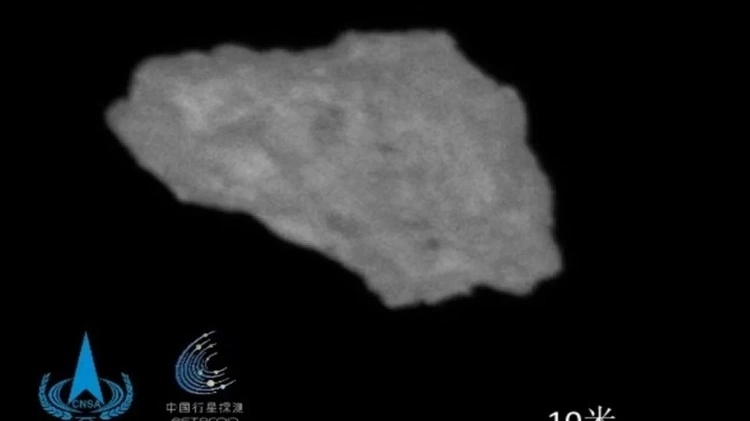
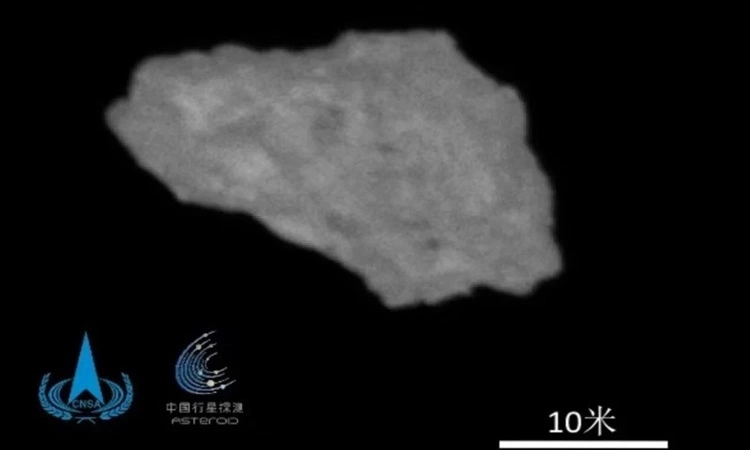
According to Gizmodo, the China National Space Agency (CNSA) announced that the Tianwen 2 spacecraft approached the asteroid Kamoʻoalewa on July 6, ending a 1 billion km journey. After launching on May 29, 2025 and spending 400 days in space, the probe approached Kamoʻoalewa at a distance of 20 km and took the first close-up photo of this oval celestial body, beginning the process of scientific discovery. The Thien Van 2 spacecraft will land on the asteroid, collect surface samples and spend several months conducting remote observations to help scientists on Earth understand its composition and origin.
The Thien Van 2 ship is equipped with 11 scientific equipment to research and retrieve samples from asteroids. The mission will attempt to collect 20-100 milligrams of soil and rock from Kamoʻoalewa. According to SpaceNews, due to the unknown characteristics of the object's surface, it is likely that the ship will perform three different sampling techniques, including sampling while hovering, flash contact and using a mounted anchor.
Thien Van 2's remote sensing devices include cameras, spectrometers, magnetometers, acoustic radars, particle analyzers and laser positioning sensors, which help collect data about the asteroid's shape, composition and internal structure. After taking the samples, Thien Van 2 will leave Kamo'oalewa in April 2027 and return the samples to Earth through the recirculation chamber in November of the same year.
Astronomers using the Pan-STARRS 1 asteroid survey telescope atop Haleakalā volcano, Hawaii, discovered Kamoʻoalewa in 2016. Close-up images of Thien Van 2 show the asteroid is more than 20 m wide, consistent with previous estimates from ground-based telescopes and the James Webb space telescope. Kamoʻoalewa moves around the Sun, but because it always maintains an average distance of nearly 14.5 million km from Earth, it becomes one of Earth's seven pseudo-satellites.
In 2021, researchers analyzed Kamoʻoalewa's spectrum (light reflected through many different wavelengths) and found that its composition was consistent with lunar rocks collected during NASA's Apollo missions. A 2024 study in the journal Nature hypothesized that this asteroid could separate from the Moon due to the same force that created the Giordano Bruno crater 1-10 million years ago. If the Thien Van 2 spacecraft completes its goal, scientists can confirm whether Kamoʻoalewa is a lost piece of the Moon or not.
CNSA hopes the Thien Van 2 spacecraft will return the sample to Earth in April 2027, releasing a capsule full of surface material on its way to the second target, comet 311P/PANSTARRS located in the main asteroid belt. The spacecraft is expected to fly there in 2035.
This is the second mission in China's Tianwen program. Thien Van 1 marks the country's first interplanetary mission to successfully land a rover on Mars in 2021. Thien Van 3 is a Mars sampling mission, scheduled to launch at the end of 2028, while Thien Van 4 is capable of landing on Callisto, the second largest moon of Jupiter and the third largest in the solar system.