AI turns satellites into 'brains' in orbit

According to Space, satellite operations largely depend on engineers on the ground making all the important decisions from the direction of the camera lens, when to activate the thrusters, to the route of signal transmission. However, that model is gradually changing as the number of satellites in orbit explodes. Currently, a company can operate thousands of satellites at the same time, but a team of engineers on the ground cannot monitor so many moving spacecraft in real time at the same time. This is when artificial intelligence (AI) promotes the ability to control spacecraft, manage satellite constellations and communication networks created by satellites.
Thanks to AI, satellites are starting to make more decisions on their own without waiting for instructions from Earth. Satellites operating in low orbit can only communicate with ground stations for a few minutes at a time. Even geostationary satellites have communication delays and limited ground station bandwidth. While the process of waiting for engineers to detect the problem, approve the solution and transmit a handling command can take hours, the above AI system can recognize the problem and take action immediately.
NASA's Jet Propulsion Laboratory is testing the use of AI to analyze collected data and make decisions. According to Capitol Technology University, NASA's ASPEN (Automated Scheduling and Planning Environment) System can assist in planning and adjusting mission operations. AI algorithms will monitor the status of the spacecraft, predict system failures, and even automatically repair them if possible. The US Space Force also applies AI to satellite operations such as automatically collecting data, detecting anomalies and improving positioning. AI-based models are tracking debris in orbit to protect satellites and spacecraft from impending collisions. The US Air Force Research Laboratory developed a neural network that controls the orientation of satellites in orbit without human intervention.
The new generation of Earth observation satellites feature small, specially designed processors so that they synthesize many different types of sensor data on site and send complete information instead of large amounts of raw data that need to be sorted.
The problem with hundreds or thousands of satellites flying in constellations is the ability to work together instead of operating individually. Low Earth orbit is increasingly crowded with active satellites and space junk. A medium-sized satellite constellation may experience dozens of warnings about the risk of close-range collisions each day, requiring a decision whether to adjust the satellite's flight path. Coordinating the operations of large numbers of satellites is beyond human capabilities, so operators are turning to AI systems to evaluate surveillance data, calculate risks and automatically plan to avoid collisions.
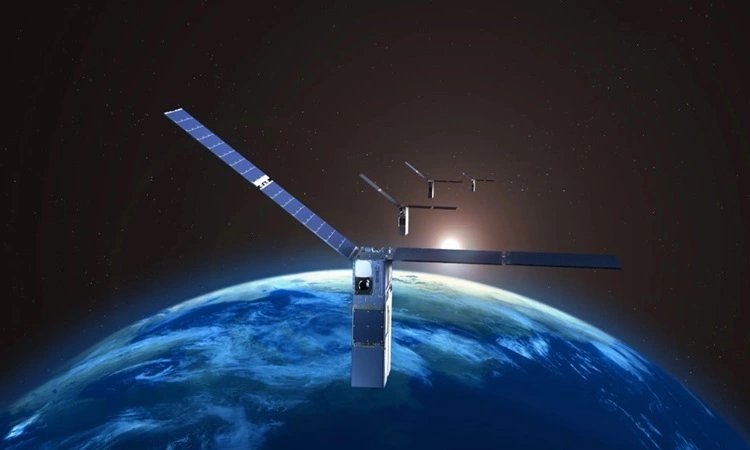
According to Tech Port, NASA is testing the Starling project with the goal of teaching small satellites to share data with each other, divide observation tasks, and adjust common plans as a unified team.
Because each satellite moves at a speed of about 27,400 km/h, the connection between satellites and ground stations is frequently interrupted and re-established, and bandwidth needs also change according to time of day and location. Operators need to constantly calculate which satellites will transmit signals to ground stations, how to transmit data packets through the satellite network, and adjust each satellite's radio beam to serve the areas with the highest traffic. AI models can help them predict traffic patterns hours in advance, continuously optimizing beam shapes, transmission paths, and relaying signal connections from one satellite to another in the constellation.
SpaceX's Starlink satellite constellation is using such an AI-controlled system to manage traffic over laser links between satellites and adjust the beam in real time as demand changes globally.