Photo of the crater created by the SpaceX rocket crashing into the Moon
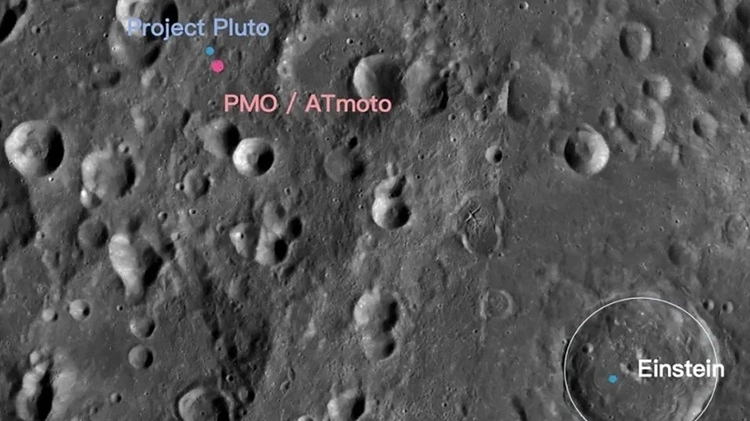
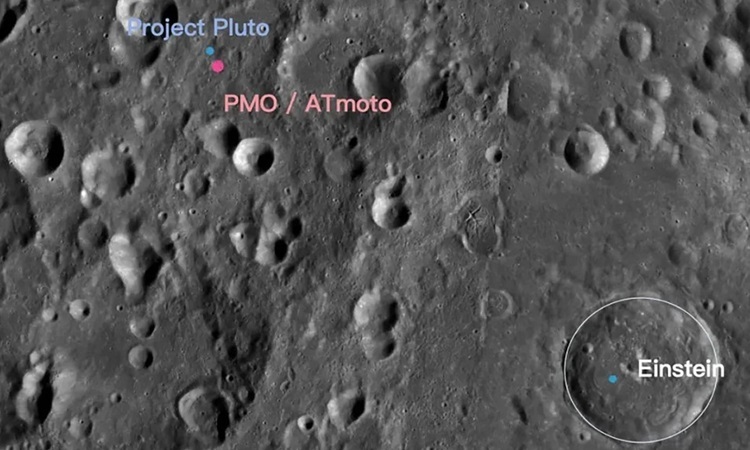
According to Live Science, a series of photos taken from South Korea's Danuri orbiter revealed a small dark black crater at the location believed to be where the upper stage of the Falcon 9 rocket crashed into the surface of the Moon on August 5. The impact occurred near Einstein crater in the northwest of the Moon, near the boundary between the bright and dark regions. The Korea Aerospace Research Institute (KARI) shared the photos on Twitter on August 6.
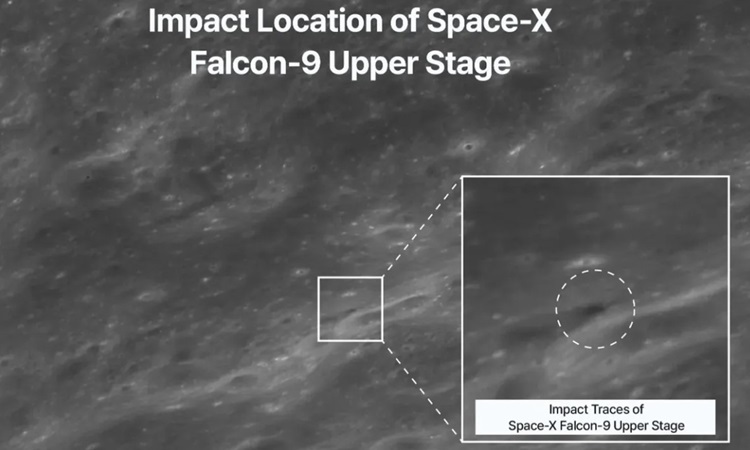
"Danuri began observing about 30 minutes after the impact and conducted a total of eight imaging sessions via orbital control to fly over the crater area multiple times," KARI shared. "Through observation, changes in the terrain around the impact area and traces of material dispersion can be confirmed."
According to SCMP, China's Gande-1 01 space debris tracking satellite launched on July 24 also photographed the impact crater created by the Falcon 9 rocket. Gande-1 01 is equipped with a high-resolution camera that allows satellites to accurately identify space debris in Earth orbit.
According to CBC, because the area where the Falcon 9 rocket crashed was located on the bright side of the Moon, the flash of light from the collision could not be seen from Earth. However, scientists at the European Southern Observatory used the Very Large Telescope in Chile to detect evidence of a dust cloud rising from the lunar surface immediately after the impact.
A preliminary study on arXir calculates that the collision that created a new crater on the Moon was about 27 m in diameter and 5 m deep, a dent too small to observe from Earth even using a good telescope. Most likely in the next few days, other spacecraft such as NASA's Lunar Reconnaissance Orbiter will provide more accurate measurements of the crater.
The Falcon 9 rocket that caused the launch collision on January 15, 2025, carried two lunar landers. The Blue Ghost ship developed by the American private company Firefly Aerospace successfully landed in March 2025 while the Hakuto-R ship of the Japanese company iSpace lost contact with Earth and crashed into the Moon in June 2025.
According to Space, unlike the Falcon 9's first stage, which can return to Earth for reuse, the rocket's second stage is often left in orbit. The rocket part floated for nearly a year in an elliptical orbit around Earth before solar radiation combined with the Moon's gravity to push it away. It is estimated that the second stage weighing 4 tons crashed into the Moon at a speed of nearly 8,700 km/h, much faster than the speed of sound but still slower than a meteorite.
The Falcon 9 upper stage was not the first rocket part to hit the Moon. The third stage of the China-made Long March 3C rocket crashed into the surface of the Moon on March 4, 2022.
Previously, NASA's Moon Impact Observation and Sensing Satellite mission analyzed the collision of the Centaur rocket's upper stage at the south pole in 2009, revealing ice under the area's surface. Studying these types of man-made collisions can increase understanding of the Moon's composition and help manage potential risks to astronauts and future permanent bases.