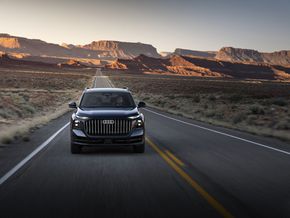
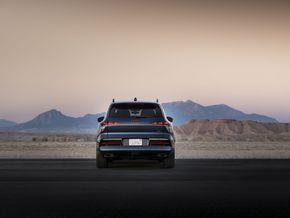
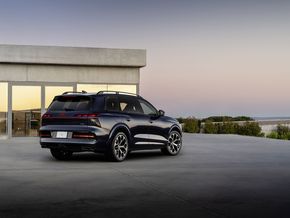
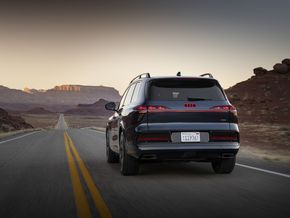
Audi Q9 with 3D curved OLED taillights: first on a mass-produced vehicle, 512 light segments

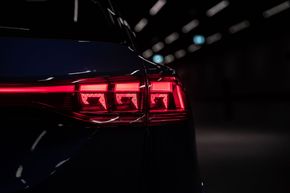
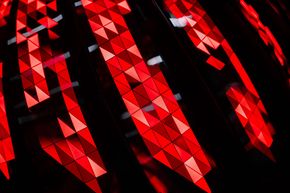
Audi has just announced details of the third generation OLED digital taillight system on the large SUV Audi Q9. According to Audi, this is the first time in the world that a three-dimensional curved digital OLED panel has been included in a mass-produced car model. The OLED panel is placed on a base glass layer that is only 0.1 mm thick, approximately as thin as a hair, and can be bent with a radius of up to 200 mm. Each taillight uses 6 OLED panels with a total of 512 individually controllable segments, allowing users to select up to 8 digital light signatures at both the front and rear of the vehicle. Q9 is Audi's largest SUV model ever, launched globally at the end of July 2026, starting price in Germany 108,400 Euro and delivery starting in November 2026.
The first curved OLED panel on a commercial vehicle
OLED (organic light-emitting diode) is a type of light source that emits light over the entire surface, instead of emitting light from each point like conventional LEDs. Audi says the OLED panels used for car lights are only about 1 mm thick, have a dark red color and are connected together via a data bus system to control each segment. The company also explained that OLED screens like those on phones cannot achieve the brightness required by law for taillights, so OLED in cars is a specially developed type of lighting component.

Until now, Audi's OLED panels have been flat panels. On the Q9, the outermost panel of each light cluster is curved in three dimensions to follow the curve of the car body. According to Audi, the outermost curved panel has 99 segments, the largest OLED panel the company has ever used, the middle panel has 84 segments and the inner panel has 73 segments. The practical meaning of the curved design is that the taillights can be seen more clearly from the side of the car, not just from the rear, something that a flat panel placed deep in the light cluster would be difficult to do.

3D light signature and communication lights
With a large number of segments, Audi can create many different types of light signatures. In addition to the static signatures and full motion signatures found on previous generations, the Q9 adds a “semi-active” signature type, in which segments change brightness to create a three-dimensional depth effect. Users can select the light signature in the infotainment system, with up to eight patterns for the front and rear lights.

OLED lights are not just for decoration. Audi says the taillights on the Q9 have a communication light function: when an accident or incident is detected ahead, the light can display a triangular warning symbol to alert the vehicle behind. The system also has a proximity indication feature, signaling the vehicle behind when it gets too close. There is also a warning when opening the door, combined with a diamond-shaped light shining on the road next to the car door for pedestrians and cyclists to pay attention.
From TT RS to Q9: 10 years of Audi's OLED

Audi first used OLED taillights on the TT RS in 2016. In 2020, the Q5 and A8 were the first models to feature first-generation digital OLED, allowing customers to choose their own light signature. In 2024, the Q6 e-tron brings a second generation with 10 times more segments, which is then used on the new A5, A6, A6 e-tron and Q5. The third generation appears in 2026 on the Q9 and Q7, but according to Audi, the curved OLED panel design is only available on the Q9. Mr. Stefan Berlitz, Audi's director of lighting development, said that for the company, light first means safety, that is, seeing clearly and being seen.
Micro-LED headlights with 25,600 light points

Audi Q9: Audi's largest SUV

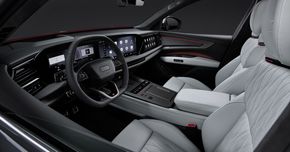
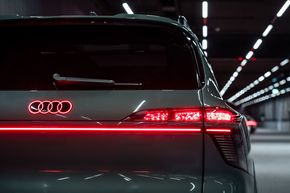
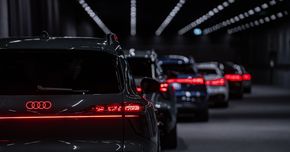
Q9 is Audi's first full-size large SUV and the company's first model with the number 9. The car is 5.31 m long, 2.21 m wide, 1.81 m high, and has a wheelbase of 3.14 m. Q9 has 7 standard seats, optional 6-seat configuration with two independent electrically adjustable seats in the second row. This is also the first Audi model to have car doors that open and close automatically, with sensors to detect obstacles. The panoramic glass ceiling is more than 1.5 square meters wide, the largest glass ceiling on an Audi, divided into 9 zones with adjustable transparency and illuminated by 84 LEDs with 30 colors. The rear has a horizontal light strip with a glowing four-ring logo, optional wheels ranging in size from 20 to 23 inches. According to Audi, the first version of the Q9 TDI uses a V6 3.0 diesel engine with a capacity of 220 kW (299 horsepower), torque of 630 Nm, comes with a mild hybrid MHEV plus system that supports up to 18 kW more and an electric air compressor. Some European markets have 180 kW, 500 Nm versions. The car uses an 8-speed tiptronic automatic transmission, quattro AWD drive, adaptive air suspension and rear wheel steering with a maximum angle of 5 degrees, helping the 5.3 m longer SUV turn more easily in urban areas. Audi says plug-in hybrid and gasoline engine versions will follow, with the high-performance SQ9 for some markets.