Three major challenges when deploying sovereign AI
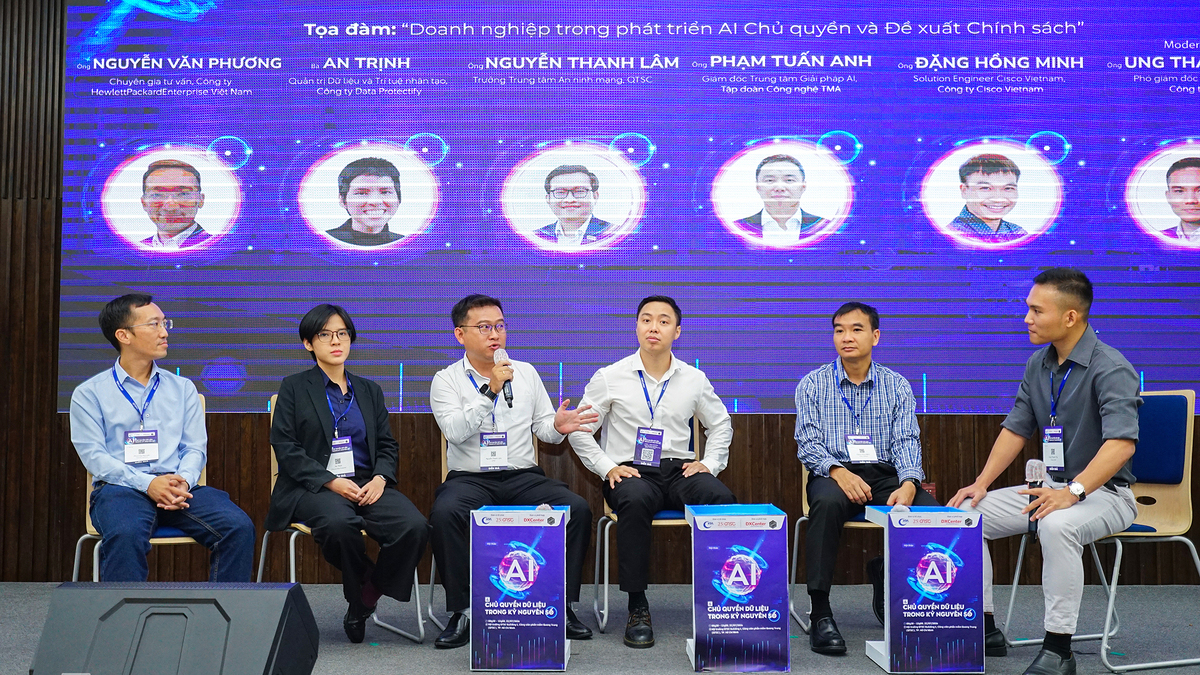
Comments were made by Mr. Nguyen Van Phuong, solution architect of Hewlett Packard Enterprise (HPE) Vietnam, at the conference AI and data sovereignty in the digital era, July 22 in Ho Chi Minh City.
According to Mr. Phuong, deploying sovereign AI is urgent for all organizations. Citing research, he said that up to three-quarters of business leaders consider this an urgent requirement. The core driving force is economic competitiveness; Technological autonomy creates a launching pad for innovation and product development activities. At a macro level such as the national or government level, sovereign AI solves the problem of ensuring national security and preserving cultural identity.
"When we depend on large foreign language models, they often do not give optimal priority to Vietnamese or Vietnamese culture. Mastering AI helps protect our core language and cultural values," Mr. Phuong said.

HPE experts also pointed out the fact that only about 1/4 of organizations and businesses really know where to start. The rest, although aware of the importance, lack a comprehensive strategy, funding source or do not know how to build appropriate infrastructure to meet sovereign AI.
According to Mr. Phuong, if we ignore the problem of funding or basic hardware platform, when building sovereign AI, every organization will face three big challenges:
First is the challenge of data security. This is considered an invaluable asset, especially in key industries such as national security or healthcare. According to a survey by the World Economic Forum (WEF) released earlier this year, 1/3 of CEOs consider cyber attacks to be the top risk for their organizations, and nearly 50% of cybersecurity leaders are deeply concerned about attacks targeting AI systems. However, organizations that prioritize a sovereign AI strategy can achieve 5x higher profits and create 90% more business value than those that only use public or outsourced AI.
"The solution here is to keep data always within the absolute control of the organization. AI processing or high-performance computing systems must be designed with security standards from the beginning. For key data of the financial, medical or defense industries, the system must even be designed as "air-gapped" (completely isolated from the Internet)," Mr. Phuong said.
Second is the challenge of legal compliance. HPE experts assess that regulations on data, AI and cybersecurity are increasingly tightening globally as well as in Vietnam. Therefore, businesses need to deploy AI models in internal data centers or combine solution consulting services to ensure strict compliance with legal frameworks.
Third is the challenge of controlling and operating AI. An artificial intelligence system without supervision means complete loss of control. The solution is to build a centralized, automated management platform for the entire AI life cycle from input data, training, fine-tuning, serving to monitoring. In other words, AI itself can be used to manage AI workloads.

Three groups of risks need to be addressed
According to Ms. An Trinh, Data Management and AI of Data Protectify company, when deploying sovereign AI, there are three main risk groups that need to be addressed.
The first group of risks is related to human oversight and management mechanisms. Specifically, if an autonomous AI system can access internal data, make decisions and execute without human approval. However, it can arbitrarily delete important data such as customer information or business secrets, causing immeasurable damage to the organization.
The second group of risks is AI illusion. When using artificial intelligence tools to look up, users may receive false information or illogical inferences. This incident will be very serious if wrong information is used for main work, directly affecting individuals and organizations. Therefore, users are always required to verify the results.
Third, regulations on data security and network security. Citing IBM's 2025 report on data breaches, Ms. An said organizations lacking an AI governance framework will face much greater financial losses than those that have successfully integrated an AI governance framework with data security and cybersecurity.
Mr. Nguyen Thanh Lam, Head of the Cyber Security Center of Quang Trung Software Park (QTSC), emphasized that AI is creating a completely new "attack surface", containing data, context, identity and action rights.
"We cannot protect what we cannot see," Mr. Lam said, suggesting that businesses need to identify, inventory and control all assets to truly master their own data.
According to QTSC experts, AI is forming the so-called Attack Surface - all the points that hackers can exploit to penetrate the system, from network ports, web applications to third-party systems, remotely connected administrator devices. Comes with the concept of "exposure" - weaknesses that are accidentally exposed on the Internet. As a business expands, the number of systems and connections increases, making the attack surface larger and creating more opportunities for hackers.
Besides, AI, especially generative AI, is creating a whole new attack surface. Businesses face the risk of "Shadow AI" when employees arbitrarily submit sensitive data to AI platforms; large language model (LLM) vulnerabilities such as Prompt Injection (inserting malicious commands to deceive AI), jailbreak (software intervention to bypass security barriers) or data poisoning; AI Agent overrides authority when automatically performing important tasks.
"If not strictly controlled, AI can become an entry point for hackers to steal data or take over the system," Mr. Lam warned.
To respond to risks from AI, QTSC representatives proposed an "AI sovereignty" model with four core elements, including data control, AI model management, access decentralization and system auditing to ensure the ability to monitor, trace and recover when problems occur. Attack surface management is implemented through 5 steps, including identifying all assets; classifying the level of importance; risk assessment; remediate exposure points, excessive access; and continuous monitoring to detect unusual behavior.
Mr. Pham Tuan Anh, Director of the AI solution center of TMA technology group, said that there is currently no common formula, but for units that require strict security, the inevitable trend is to deploy internal infrastructure or use AI devices at the edge (Edge AI). But to be successful, data must be standardized, the infrastructure is suitable for business problems, the staff is ready to apply new technology and there needs to be a small-scale testing roadmap before expanding.
Previously, speaking at the GStar 2026 event with the theme Artificial Intelligence (AI) and Humanity taking place in Ho Chi Minh City on May 29, Deputy Minister of Science and Technology Bui Hoang Phuong emphasized that Vietnam aims to become a group of three leading countries in Southeast Asia in artificial intelligence research and development by 2030. After 2025 has a legal framework, 2026 is the period when the country will enter the acceleration period. Vietnam will not stop at just applying AI, instead aiming for the larger strategic goal of comprehensive national transformation with artificial intelligence. To promote, Vietnam will gradually research, develop, and master core technologies, be autonomous in multi-purpose models, and platform models based on domestic data, not completely dependent on foreign technology.
Bao Lam