North America is 'dripping' into the Earth's mantle
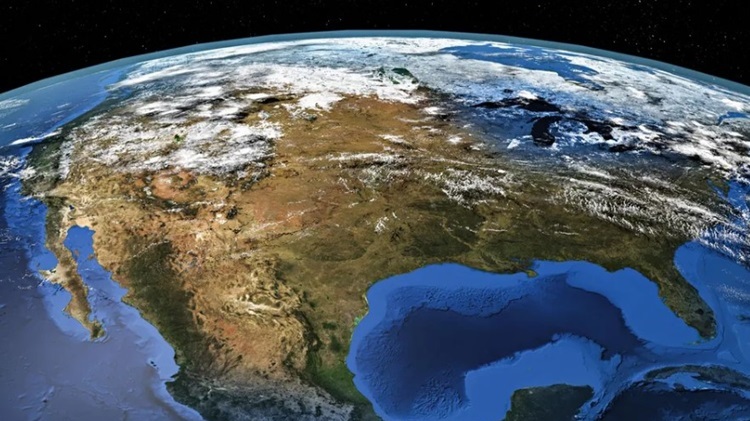
An ancient slab of Earth's crust buried deep beneath the US Midwest is sucking large chunks of North America into the mantle. The gravitational pull of the slab creates giant "droplets" that hang on the underside of the continent and extend to a depth of 640 km inside the mantle. These droplets lie beneath an area spanning from Michigan to Nebraska and Alabama, but their existence appears to be affecting the entire continent, Live Science reported on April 2.
The drip zone looks like a large funnel, with rocks across North America being pulled horizontally toward it before being sucked down. As a result, much of North America lost material from beneath the crust. "A large area of land is going through a thinning process," said Junlin Hua, a geoscientist conducting research at the University of Texas (UT) at Austin. "Fortunately, we also know the mechanism that drives this thinning process."
Nhóm nghiên cứu nhận thấy các giọt là kết quả từ lực kéo hướng xuống của một khối vỏ đại dương vỡ ra từ mảng kiến tạo cổ đại mang tên mảng Farallon. Mảng Farallon và mảng Bắc Mỹ từng hình thành đới hút chìm dọc vùng ven biển phía tây lục địa, trong đó mảng Farallon chìm bên dưới mảng Bắc Mỹ và tái chế vật chất của nó thành lớp phủ. Mảng Farallon vỡ ra do sự xô đẩy của mảng Thái Bình Dương cách đây 20 triệu năm và những phiến đá sót lại chìm bên dưới mảng Bắc Mỹ dần dần trôi dạt đi.
One of these slabs now straddles the boundary between the mantle and lower mantle transition zone at a depth of 660 km beneath the Midwest. Named the "Farallon slab" and first photographed in the 1990s, this piece of ocean crust is responsible for the "craton thinning" process, according to research published March 28 in the journal Nature Geoscience. Craton thinning is the process of gradually thinning the continental crust and upper mantle of the Earth almost intact over billions of years. Despite that stability, the craton can undergo many changes, but this has never been observed because of the enormous geologic time scales involved.
This is the first time researchers have recorded the process of thinning of the craton taking place. The discovery was made possible by a broader project led by Hua to map the structure beneath North America, using a high-resolution seismic imaging technique called "full-waveform inversion." This technique uses different types of seismic waves to extract all available information about underground physical parameters. To test the results, the research team simulated the impact of the Farallon slab on the upper craton using computer models. A drip zone forms when the slab is present, but disappears when the slab is absent, helping to hypothetically confirm at least one sinking slab pulling rocks across a large area into the Earth's interior.
The trickle-down process beneath the Midwest will not lead to changes on the ground in the near term. The process may even stop as the Farallon slab sinks deeper into the lower mantle and its influence on the craton diminishes.
An Khang (According to Live Science)