900 MHz band starting price is more than 1,000 billion VND

The plan to organize an auction for the rights to use the 900-915 MHz and 945-960 MHz frequency bands was announced by the Ministry of Science and Technology on July 19. This is a low-band group that is considered to have advantages in coverage area, which can be used to expand coverage area and improve service quality for terrestrial mobile communication systems.
According to the plan, the frequency band is divided into three pairs of blocks including C3-C3', C4-C4' and C5-C5', each block has a width of 2x5 MHz. Specifically, the three blocks correspond to the frequency bands 900-905/945-950 MHz, 905-910/950-955 MHz and 910-915/955-960 MHz.
Participating units can vote directly at the auction, applying the up-bid method. Each business can register to purchase up to two pairs of frequency bands. The starting price of each pair of frequency bands is 1,056,943,950,000 VND for a 15-year term of use. The price step is set at 10 billion VND. Enterprises registering to auction a block of spectrum must reserve 55 billion VND in advance.
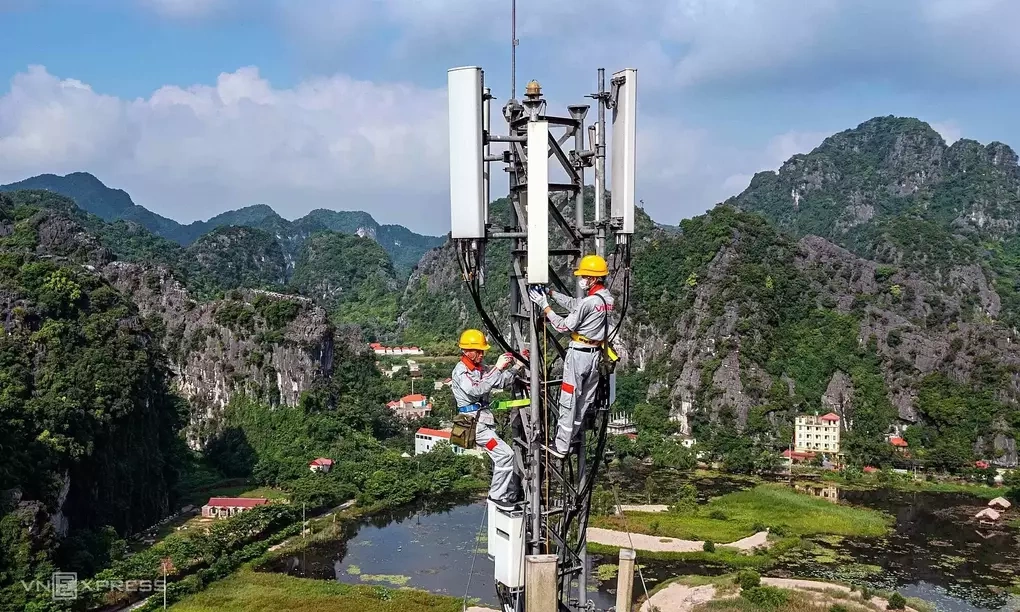
In May last year, the Ministry of Science and Technology successfully auctioned the 700 MHz frequency band. At that time, Viettel and VNPT successfully auctioned the blocks for nearly 2,000 billion VND. In 2024, Viettel will also be the first network operator to win the auction for the right to use the first spectrum block for 5G, 2,500-2,600 MHz, for more than 7.5 trillion VND.
Similar to 700 MHz, 900 MHz is a low frequency band, capable of transmitting waves long distances, covering a wide area and penetrating obstacles better than medium and high frequency bands. This helps the network reduce the number of broadcasting stations that need to be deployed to cover the same area, while improving signal quality indoors, in rural, mountainous areas, islands and on traffic routes. This frequency band is currently used by many countries to deploy wide-area 4G and 5G, and plays an important role in ensuring continuous coverage alongside mid-bands such as 2,600 MHz or 3,500 MHz, which have advantages in capacity but narrower coverage.
According to the plan, this frequency band is used to deploy mobile information systems according to IMT-2000, IMT-Advanced, IMT-2020 (5G) standards and subsequent versions. In particular, IMT-2000 (3G) technology is allowed to be exploited until September 14, 2028 before completely switching to newer technologies.
The Ministry of Science and Technology also sets network deployment requirements for businesses that win the auction. For new businesses entering the mobile market, within two years they must deploy at least 5,500 broadcasting stations, covering 60% of commune-level administrative units; After three years, it reached 85% and covered all communes across the country after four years. Businesses must also officially provide services within 12 months of being licensed.
For businesses that already have mobile telecommunications licenses, the Ministry also requires focusing on maintaining the operation of at least 2,000 stations using the 900 MHz band and, depending on each case, deploying additional infrastructure to serve sea and island coverage. Businesses must also meet standards on the quality of voice, messaging, mobile Internet and 5G services, and ensure roaming capabilities in emergency situations as required by management agencies.
According to the plan, within 30 days from July 19, wishing organizations must submit documents to confirm their eligibility to participate in the auction. The winning enterprise will be granted a license to use the spectrum after completing financial obligations according to regulations.
Luu Quy