Inside AI studios: Create 4-5 movies a day, each with 40 episodes
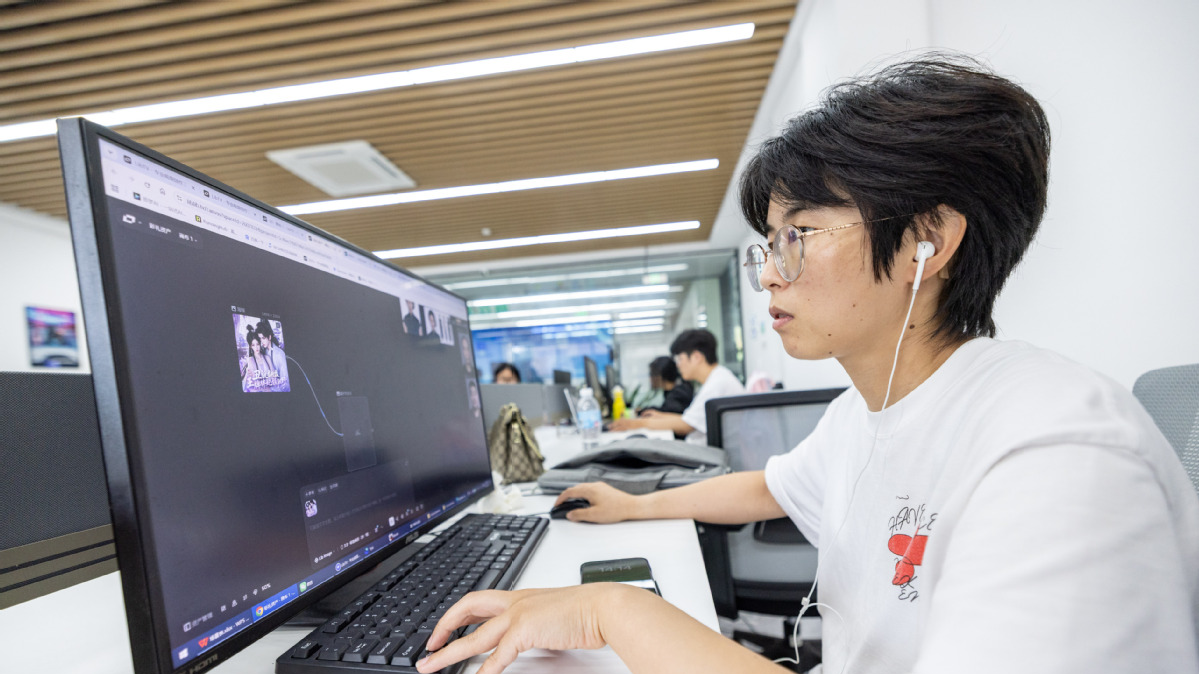
For a decade, Chen Hao regularly honed his skills: learning 3D animation software Autodesk Maya, 3D graphics tools for Unreal Engine games or improving his English to use the software. But as Technical Director at Qidian Interactive - an AI video studio in Wuxi, he is now building a platform that can "condense" much of his accumulated experience, making it easy to use with short commands.
According to Hao, artificial intelligence models in China are capable of doing tasks that previously took months to complete. "I don't like AI, but I have to use it," Hao told Sixth Tone. "When I realized just one click can sometimes produce better results than two or three days of work, I had to use it."
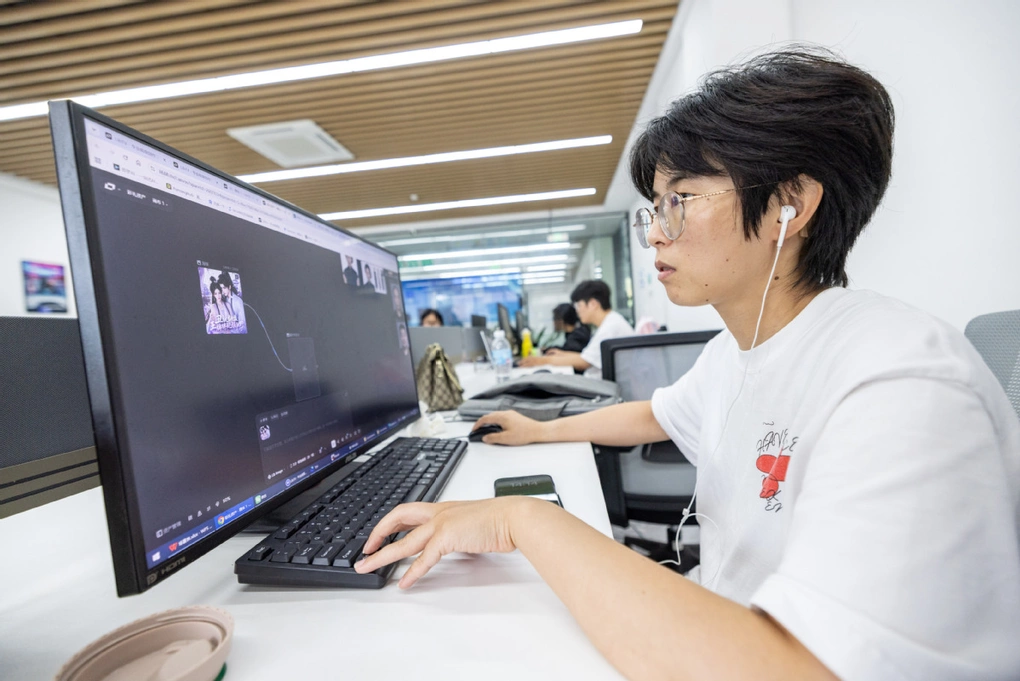
Qidian Interactive's video creation AI system, called Yudian, was built by Hao and his team in April, completed in a month. The tool can suggest storylines based on trending topics on social media, compose dialogue, create storyboards, arrange characters and objects in three-dimensional space, and evaluate whether the ending is dramatic enough to keep viewers engaged.
"The goal is that every employee can make their own movie," Hao said.
Inside Qidian Interactive, employees sit in rows in front of new, powerful PC models, some working on multiple screens at the same time. The team leader sits nearby, and the director has his own room at the end of the hallway.
On a screen appeared: "45-60 seconds. Setting: watch repair shop. Barton rushes to grab the pocket watch while Eliza twists her wrist and it breaks. The action must be extremely fast and explosive, not giving the audience time to breathe." Requirements specify Arri Alexa 65 IMAX camera angles, Panavision Primo V/C/T lenses, cinematic lighting and motion, no background music or subtitles, realistic lighting, and smooth transitions.
Another screen shows the digital prop system, with characters, locations, objects and lighting setups that can be reused in other future shoots and productions.
Nearby, another group of employees was testing out some costumes for the female lead of a romantic drama aimed at foreign audiences. They tweaked the outfit based on a series of suggestions such as "simulate natural daylight", "increase skin roughness" or "preserve blemishes" to make the character look more natural.
According to Hao, an AI short film project is evaluated based on many criteria, but the most important question must be answered: Is the suspenseful episode strong enough? Are emotions developing at an appropriate pace? Are the shots used effectively? Are there any sections that might have content moderation issues?
Similar to Hao, most of the team behind Yudian come from traditional visual production fields: lighting artists, animators, set painters or cinematographers. The skills they have learned are now partially represented in suggestions, workflows, and presets for Yudian.
The typical AI movie production process with Yudian and similar tools is typically carried out by three groups: character and scene creation, cinematography, and editing. The number of members is not many, only 1-2 people per stage. The team leader, who usually has more experience in film, animation or advertising, is responsible for reviewing the entire work and deciding which parts need to be revised.
Although it just opened in April, Qidian Interactive has produced a respectable number of AI movies. Since June until now, this studio has released 4-5 short films every day, each with 30-44 episodes.
Since the beginning of the year, AI movie production studios similar to Qidian Interactive have mushroomed across China. Speaking to CNN, the video production company in Zhejiang, said that through the use of a new generation AI video tool, a 120-minute video project of normal quality can be made by a team of 5 people in a week. Construction costs were about 15,000 yuan (2,200 USD).
Recent statistics show that the field of AI short films is booming in China. Although it does not separate revenue between live-action films and AI films, according to Channel News Asia, of the 128,000 short films released in China in the first quarter of 2026, 95% were created with AI, equivalent to 121,600 films. China Daily cited statistics from market research firm DataEye, in the first half of the year alone, Douyin recorded 220,000 short videos created by AI attracting up to 500 billion views. According to Sensor Tower, by the first quarter of 2026, platforms specializing in posting short films with over 100 million installations include FreeReels, ReelShort, and DramaBox.
Tired of AI movie editing
However, the emergence of AI does not completely benefit short film production companies. Huang, 26 years old in Shanghai, spends most of his day ordering the AI to perform a scene 3-5 times before "temporarily accepting" the results. Each test may only take a few minutes, but can sometimes last 10-20 minutes.
"For example, a single sofa appearing in one shot may turn into a double sofa in the next shot, or the leather upholstery is switched to fabric," Huang told Sixth Tone. "You never know what you'll get, when the AI will 'cooperate' and produce the complete shot. If you're unlucky, everything keeps repeating."
According to Huang, a human-directed film is a collective creative process, from director, actors to cinematography. But with AI movies, every creative decision is made by one or two people. Even the actors' acting is completely controlled instead of having variations with their own personalities.
Controlling the footage is also not easy. Chen Jie, an employee at Qidian Interactive, said he previously only reviewed 20 scenes in a week. Now, he has to watch hundreds of scenes every day.
"It's tiring because the videos are created so quickly," Jie said. "Now I'm almost tired of work."
AI often creates terrible footage, Jie said, but humans "can't fight the model." He realized he needed to adapt to new technology, "work within his strengths, compromise with his limitations and learn to control".
When AI movies are produced too much, the products tend to use characters with similar faces due to shared tools or large language models (LLM). "Men, women, young people and old people all have the same face. It's starting to make me feel weird," one person commented on Weibo.
According to Global Times, the situation of similar faces in AI movies is so common that some viewers wonder if they accidentally watched the same movie again. Hongguo Short Drama, a short film platform operated by ByteDance, in mid-year warned AI filmmakers to refrain from a "one-size-fits-all" approach in character design, or else the film will be removed from the platform.
Faced with that problem, China began to boom in face "rental" services, according to Firstpost. AI movie production companies currently pay a fee of 15-700 USD for licensing facial images to serve content. For example, the ActID platform in Shenzhen connects people who are willing to allow their images to be used for a price. People can take photos at the designated studio. The film producer then chooses the face based on factors such as age, gender and appearance, as well as the type of production the production is looking for.
However, "renting" poses a series of risks, such as information theft. In March, Hongguo Short Drama was accused by two KOLs of using their faces in a movie with 40 million views. ByteDance's platform later removed this film, along with more than 85,000 videos using illegal facial and voice reconstruction AI since the beginning of the year.
Despite the barriers, many people still believe AI has become a part of the film industry. Wang Zheng, who recently graduated from university with a major in advertising and art design, said AI gives him the freedom to pursue ideas that were previously difficult to implement.
"My dream is to become an AI movie director," Zheng said. "I want to create a complete feature film, completely based on my own ideas."
Meanwhile, Chen Hao kept observing the staff using Yudian to create high-speed AI movies. "One day, it could replace me," he mused. "But I can't help but continue."