Robotic dog runs 42 km marathon on a single charge
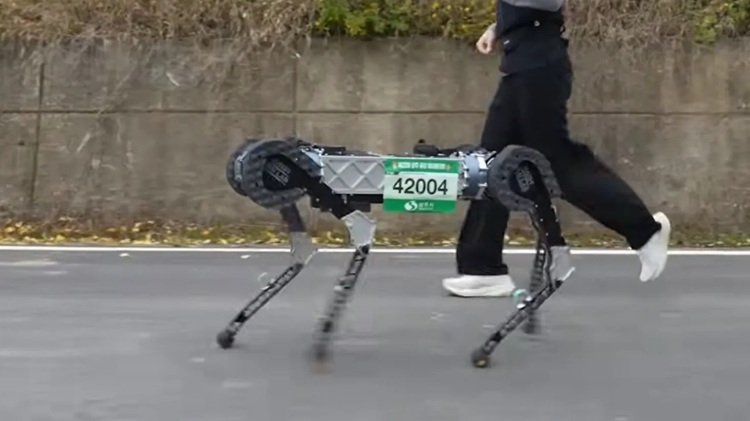
According to Interesting Engineering, the Raibo 2 robot dog developed by the research team at the Korea Advanced Institute of Science and Technology (KAIST) completed the 42.195 km distance of the 2024 Sangju Dry Hong Marathon in 4 hours, 19 minutes and 52 seconds, using significantly less energy than a human to move its body weight. The researchers announced their achievements in the journal Nature on September 23, 2026.
Popular Science says the global average time for humans to complete a marathon is about 4 hours and 32 minutes, although elite athletes run much faster. The current world record held by Kenyan athlete Sabastian Sawe is 1 hour 59 minutes. However, the most notable thing is that Raibo 2 completed the race with more than 1/3 of the battery left in the tank. Raibo 2's achievement addresses one of the biggest limitations legged robots face: endurance. Unlike wheeled machines, four-legged robots must continuously expend energy to support their bodies, while also losing energy through collisions, joint movements, and leg-ground interactions.
Raibo 2 doesn't run the marathon itself, instead a camera mounted on the robot's head transmits images of the route ahead to a human operator to ensure it doesn't stray off the track. TwitterBuilding a robot that could complete the race fully autonomously would require more computing power, draining its battery and reducing its overall range.
Raibo 2 maintained an average speed of about 2.64 m/s, or 9.5 km/h, throughout the marathon, and completed the distance without needing to replace or recharge the battery. The research team obtained this result after a previous failure. In September 2024, a robot dog version ran out of battery while running about 37 km in a marathon event. KAIST said the robot consumed more energy than expected due to constantly changing speed to adjust to other athletes on the track. The team then redesigned some parts of the system and continued to improve its mobility.
Nature describes Raibo 2 as an energy-efficient quadruped robot developed through comprehensive analysis of mechanical, electrical and motion losses. The research team focused on reducing the energy the robot consumes when moving through the design of lightweight legs and the use of electronic controllers for the motors. In addition to improving performance, changes to the control circuit board also free up space for a larger and longer-lasting battery pack with a capacity of 2,016 watt-hours.
Researchers use simulation and reinforcement learning to train the robot's movements, allowing it to learn postures that can minimize unnecessary joint movements, dissipate force when hitting the ground, and avoid other sources of energy waste.
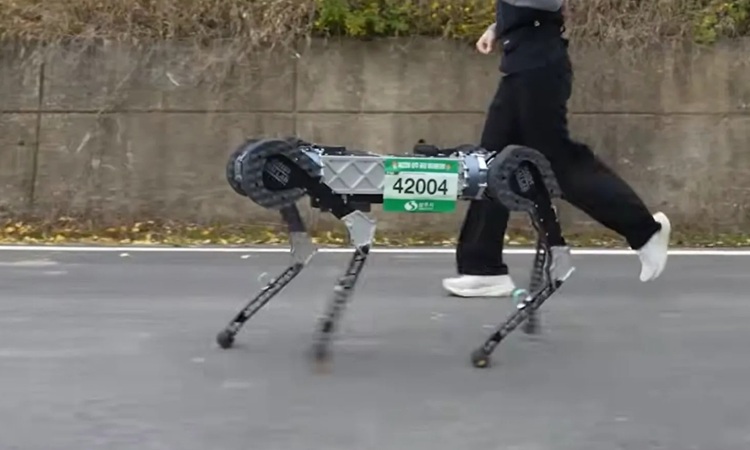
As a result, Raibo 2 achieved a cost of transportation (COT) of 0.25 while the human standard was 0.37. COT is a measure of the energy required to move a given weight over a distance. Raibo 2's COT level does not mean the robot is more efficient than humans in all forms of movement. Instead, Raibo 2 requires less energy than a human to move its weight.
The research team said the above improvements could help expand the usefulness of four-legged robots in environments unsuitable for wheels. Four-legged robots can operate in mountainous terrain, disaster areas, stairs, and other rough environments, but their operating range is often limited by battery capacity. Previously, 4-legged robots could only run about 20 km per charge. Raibo 2 offers 3 times that range of movement. Therefore, it has many applications in search and rescue work, industrial inspection and outdoor reconnaissance, when returning the robot to a charging station is difficult or impossible.