Experts propose three stages towards mastering post-quantum cryptography technology

The proposal was raised by Dr. Le Hai Trieu, representative of the research team at the Department of Security Industry, at the National Scientific Conference on Artificial Intelligence for Cryptography and Information Security (AI4CRIS 2026) in Hanoi on August 14.
According to Dr. Trieu, post-quantum cryptography (PQC) needs to soon have national standards and be deployed on digital infrastructure, while quantum key distribution (QKD) needs to be gradually developed to serve especially important communication channels such as diplomacy and national defense.
PQC uses new cryptographic algorithms but runs on existing computers and network infrastructure, while QKD uses quantum physics principles to transmit information, requiring specialized optical infrastructure.
According to the proposal, 2027-2029 is the identification and foundation period. The first step is to promulgate Vietnamese standards. Next, build a PQC testing environment open to the research and business community, train 100 experts, and conduct a national inventory of systems and cryptography in use. The goal is that by the end of 2029, Government agencies will be able to identify quantum risks to the system.
Experts from the Department of Security Industry believe that the goal of 100 experts does not only rely on new training but can be built from those who are researching cryptography and quantum technology, combined with recruiting Vietnamese experts abroad.
In the period 2030-2032, the group proposes to implement the conversion. Government, financial and energy systems use PQC. Businesses receive technical support and policies to encourage the application of new technology. The goal is that by 2032, about 70% of key systems will have completed conversion. In parallel with PQC, a Hanoi - Ho Chi Minh City QKD route is also proposed to be tested for data with particularly high security requirements.
By 2033-2035, the roadmap enters the stage of mastering technology. PQC became the default cryptographic layer in digital systems, while QKD was deployed for internal networks or top-secret communication channels. The group also aims for Vietnam to be able to contribute to world post-quantum encryption research.
5 barriers to overcome
Dr. Trieu commented that Vietnam is currently facing 5 main barriers: the number of PQC experts is small and scattered; There is no national testing platform for the transition; High implementation costs for small and medium enterprises; lack of coordination in research and application activities; The financial mechanism is not suitable for long-term research.
Dr. Nguyen Quoc Hung, Institute of Quantum Technology at Hanoi National University, said that PQC conversion is urgent, because the total time the data needs to be secured and the conversion time is up to decades, while a quantum computer strong enough to break traditional encryption may appear in the next few years.
Specifically, the risk comes from advances in quantum computing occurring in multiple directions simultaneously. Platforms based on superconductivity, ion traps, neutral atoms and photonics are all being developed, while advances in algorithms and error-correcting codes are helping to reduce the estimated amount of resources needed for large calculations. So predicting exactly when a quantum computer will be capable of breaking cryptography - known as CRQC - is increasingly difficult.
Dr. Hung cited Google's prediction that CRQC will take place within 4 years, so many hacker groups are collecting data to decode when possible. Meanwhile, the security period of some types of data is up to 20-30 years and the encryption conversion time is about 5-10 years.
"Immediate conversion is very dangerous. This is a problem not only in Vietnam, even the US is not ready to convert cryptographic systems," Dr. Hung warned.
Talking at AI4CRIS, Lieutenant General Vu Ngoc Thiem, Head of the Government Cipher Committee, said that this agency has focused on implementing many research directions on artificial intelligence, cryptography technology, post-quantum cryptography, gradually creating a foundation for building safe and reliable digital systems to serve Party and State agencies and key national information infrastructures.
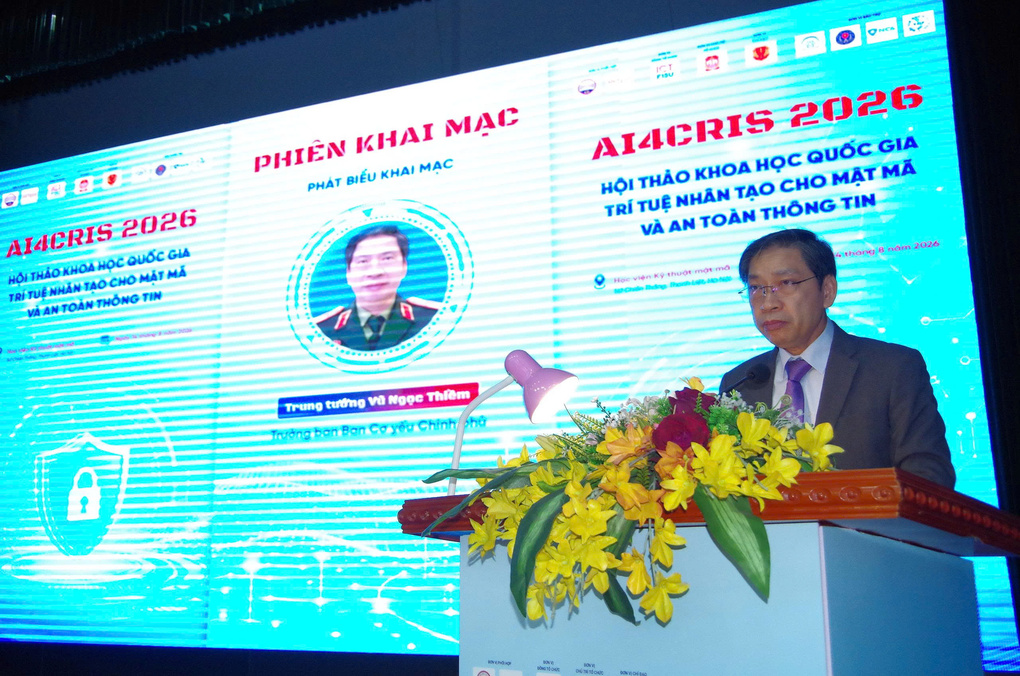
He said that the project to develop a quantum-resistant cryptographic system for the period 2026-2035 has been approved by the Prime Minister, marking a step in implementing the strategy to strengthen the capacity to protect information security and ensure national digital sovereignty.
AI4CRIS 2026 is a national scientific conference organized by the Academy of Cryptographic Technology under the Government Cipher Committee to promote cooperation, knowledge sharing and form a research and innovation ecosystem in the fields of AI, cryptography and information security.
Nam Nguyen