Historic opportunity for Vietnam to master the core "technology DNA" for the future


(Dan Tri) - Resolution 57 has become a guideline, orienting the entire economy towards the best "genetic codes" and the most core technologies to promote the country's development.

After 18 months of implementation, Resolution 57 has truly become a "guideline" and core foundation, creating groundbreaking turning points for Vietnamese science and technology.
In an interview with a reporter from Dan Tri newspaper, Mr. Vu Thanh Thang - Chairman of AIZ Joint Stock Company, member of the Vietnam ESG Forum Appraisal Council, said that Vietnam is facing a historic opportunity to transform from a country applying technology to mastering the core "genetic codes" of the future.
"This is the golden time to explore human intellectual resources before the golden population period ends," Mr. Thang emphasized.

Distilling the best "technology DNA" for the era of advancement
Sir, Resolution 57-NQ/TW is considered a big push for science and technology, innovation and national digital transformation. From the perspective of an AI and data expert, what fundamental changes do you think this resolution has created in Vietnam's thinking about developing strategic technologies?
- We can see that Resolution 57 is the core foundation of innovation, revolving around the key elements of science and technology, innovation and digital transformation.
This is determined to be the main driving force for the country's development in the new period. Previously, our strategy often focused on applying technology to increase labor efficiency and change socio-economic indicators.
But now, we have made an important shift towards mastering technology, especially leading high technologies such as artificial intelligence (AI), data and semiconductors.

I consider Resolution 57 to be a groundbreaking fundamental element, creating a solid basis for us to realize our current double-digit growth goal.
The Resolution's approach is very practical, based on specific data from global reports. For example, according to a PwC report, AI has the potential to contribute up to 15.7 trillion USD to the world economy by 2030, and at that time, the semiconductor chip segment is expected to reach a revenue of about 1,000 billion USD.
The focus on science, technology and innovation shows that Vietnam is moving in the right direction, prioritizing the fields with the greatest added value today: AI and semiconductors.
One particularly important point that I highly appreciate is that Resolution 57 does not recognize AI or data as separate, independent fields.
Instead, we have a strategic combination of AI, data and computing infrastructure (which is semiconductor-based) to form a solid pillar for outstanding growth.

This cohesion creates conditions for Vietnam to participate more deeply in higher value chains in the world. Because for AI to work, data is needed, to process data, computing infrastructure is needed, and to have a powerful computing infrastructure, semiconductor technology is required.
Therefore, Resolution 57 has become a guideline, orienting the entire economy towards the best "genetic codes" and the most core technologies to promote the country's development.
After 18 months of Resolution 57 coming to life, what changes and biggest positive signals have you seen in your field?
- It can be said that although Resolution 57 has only come to life for a short time, we can see the changes right around us.
With more than 30 years working in the technology industry, I see this fourth revolution, where data is at the heart and AI is the driving force, is creating changes at perhaps 10 times the speed of the third revolution.


The most obvious shift is in thinking about AI. Previously, people often viewed AI as just an experimental tool, used for chatting or asking questions to supplement knowledge. But now, AI is really seen as an infrastructure for management, production and service provision.
In fact, I have worked directly with hundreds of Vietnamese businesses, from large corporations to small and medium enterprises (SMEs) or households, and found that AI is completely changing data management performance.
For large businesses, they own a huge amount of data, but most of it is "dead data" that has not been exploited. AI is the tool and infrastructure to process and turn that data into "oil" that brings value.
As for SME businesses or households, they focus on using AI to optimize resources. We have applied it in practice to a number of e-commerce businesses, helping them reduce the number of employees from 20 people to just a few people while still increasing performance many times.

Another positive signal is the change in thinking about data. Previously, most data was only collected for storage, storage, and only brought out for review when needed. But now, data has become a strategic tool.
Every operational element of a business today must be based on data, and this data will form real-time reports, helping managers make accurate and quick decisions.
At the national level, the fact that we are aggressively building national databases on population and land and implementing synchronous digitization are extremely valuable steps. That is the real resource to promote the country's strong development in the coming period.
Recently, Vietnam launched a National Center to support the trial production of semiconductor chips. How do you assess the significance of this event?
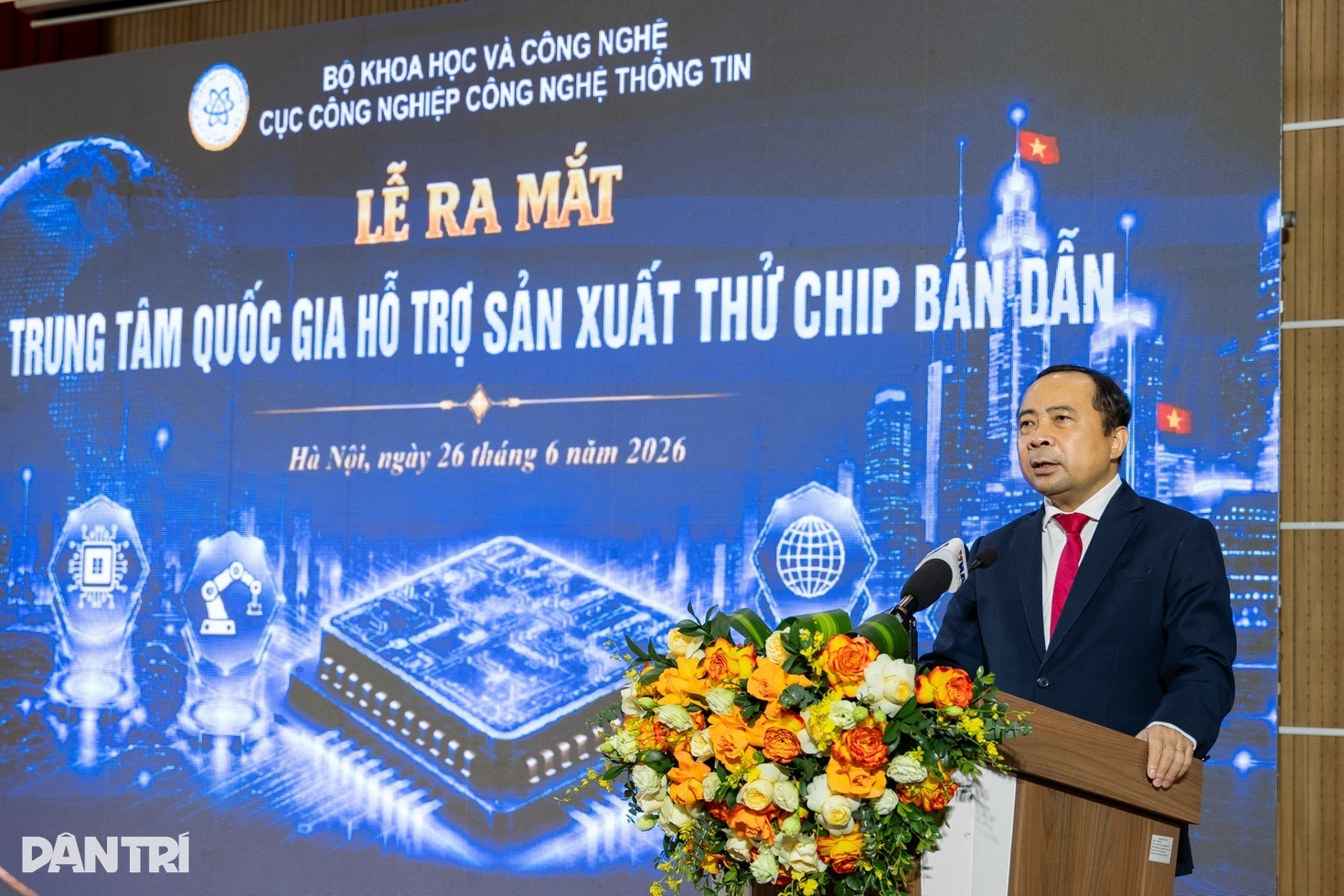
- The recent launch of the National Center to Support Semiconductor Chip Trial Production at the Ministry of Science and Technology is a very important milestone. Personally, I and the company are also honored to join the world's leading partners such as Qualcomm, AMD and large domestic enterprises such as FPT and Viettel.
We need to understand that semiconductors are a strategic industry with a huge market size, up to about 1,000 billion USD, and the fact that Vietnam is starting to participate more deeply in this value chain is a great signal.
However, the challenge is that we are a newly joined country, while our opponents have a history of tens or hundreds of years. To remove bottlenecks, we need to look at the chip development process.
In the early stages, from ideas to architectural design, logic design, simulation and software testing, these are steps that Vietnam can immediately access because it is based on intellectual and programming capabilities, areas that are very suitable for Vietnamese people.
But the biggest bottleneck comes after we have the design: how to put it into mass production without test production centers?
Therefore, the birth of this Center is extremely important. It plays a role in supporting small businesses, startups, or research institutes and universities to test chip designs and verify them before releasing them to the market in large quantities.

This is an approach that many advanced countries around the world have applied successfully. I believe that with this support, Vietnam will soon form a strong electronic chip design community and have chip products bearing Vietnam's mark on the global market.
In the long term, the goal is not just one hub, but to create a semiconductor ecosystem with thousands of supporting businesses operating around it. Although this roadmap may take 5 to 10 years to complete from design, packaging to testing, choosing the right segment that matches Vietnam's current technological capacity is an extremely correct direction.
Human resources are the country's treasure
In the previous period of development, we were proud to have the resources of "golden forests and silver seas". So, in your opinion, what are the most important resources of Vietnam in the 4.0 era?

In this new era, I think Vietnam's most valuable resource is its people. We are currently in the "golden population" period and there are only about 10 years left, by 2035, this period will end. This is a golden time for us to accelerate and create strong breakthroughs for the country.
With the experience of a technology person, who has developed from smartphones, smart homes to the first AI camera in Vietnam, I have noticed a very proud characteristic: the capacity, ability to learn and solve problems of Vietnamese engineers are among the world's top.
This is an infinite resource. We can look at examples like Israel or Japan. They do not have abundant natural resources but are still leading countries in the world thanks to good exploitation of human resources.
Resolution 57 was born with a focus around science and technology, innovation and digital transformation to add value to this human resource.
The high-tech fields that the Resolution targets are all areas with the greatest added value, but at the same time, they also require truly capable people to be able to transform and master.
When we combine high-quality human resources with innovative industrial fields and digital transformation, we will form a complete "formula" to fully exploit the country's intellectual resources.

After all, in any country, people are always the most valuable resource a country possesses, and policies like Resolution 57 are the tools for us to realize the power of that resource in the future.
Uncle Ho once taught: "For ten years' benefit, we must plant trees; for a hundred years' benefit, we must plant people." High quality personnel cannot be obtained immediately but requires a systematic and persistent training process.
Currently, the Government has ambitious programs such as training millions of programmers and hundreds of thousands of chip design engineers and data engineers. These are steps to prepare for the country's long-term future.
Vietnam's stature in the digital era
With an institutional launch pad, what do you expect about Vietnam's position in the fields of AI, semiconductors and data in the near future?
- Regarding the vision for the coming years, I think technology is not something that can be achieved immediately but is a cumulative process. We need a cycle of 5 to 10 years for human training, education and the State's strategic directions (such as programming, AI, semiconductor manufacturing or data processing) to really take effect and create high value.
As for the field of Artificial Intelligence (AI), I firmly believe that Vietnam has a very high chance of success and in fact we have begun to touch those successes.

At our company, the "one-man business" model powered by AI or "business brain" systems has been successfully developed, allowing devices such as cameras or sensors to operate as one intelligent entity.
Because AI is based on algorithms and software, the pace of change is extremely fast. As long as we have good intellectual capacity and programming skills, we can approach world level in just 3 to 5 years.
Meanwhile, the semiconductor sector is a different story as it involves physical manufacturing. In the first stage, chip design (IC design), Vietnamese people can participate immediately because this stage is based on ideas, structure and simulation programming.
However, later stages such as photolithography or semiconductor circuit production require the accumulation of many years of experience and a more complex infrastructure.
Therefore, our strategies will complement each other: AI will be the spearhead that creates breakthrough results and values in the short term, helping to promote the country's rapid development. Semiconductors will be the next step, fundamental and in-depth, ensuring Vietnam a more valuable and sustainable position in the future.
As a technology expert and business owner, what support or bottlenecks do you hope the institution will have in the near future to develop better?
- In fact, the Party and Government have issued many important resolutions to create a solid legal corridor for us. These include Resolution 57 on science and technology, innovation and digital transformation; Resolution 68 identifies the private economy as the most important driving force of the economy; or Resolution 59 on international cooperation.
These documents have built a clear policy framework for both state-owned enterprises, private enterprises and even households with a good environment for development.

However, in my opinion, when good policies are in place, the remaining key factor is action. If we have the right policies but do not drastically implement them, the resolutions will not be effective; This is a lesson that history has proven many times.
For policies to really come to life, there needs to be synchronous movement of both the political system and the entire society.
From practical experience of a business operating at the National Innovation Center (NIC), I see very positive signals.
We have received practical support from the Government in terms of working space, network connections and access to investment resources. These are "vital" factors for a high-tech startup like us, something that was previously very difficult to obtain.
However, we still have a lot of work ahead. For the 4.0 technology revolution to be truly successful, we need the participation of the whole society, the political system and the consensus of all people.
Only when everyone gets involved with a determined spirit can Vietnam make a breakthrough and affirm its position in the digital era.
Thank you very much!