'Silk Road' on ice
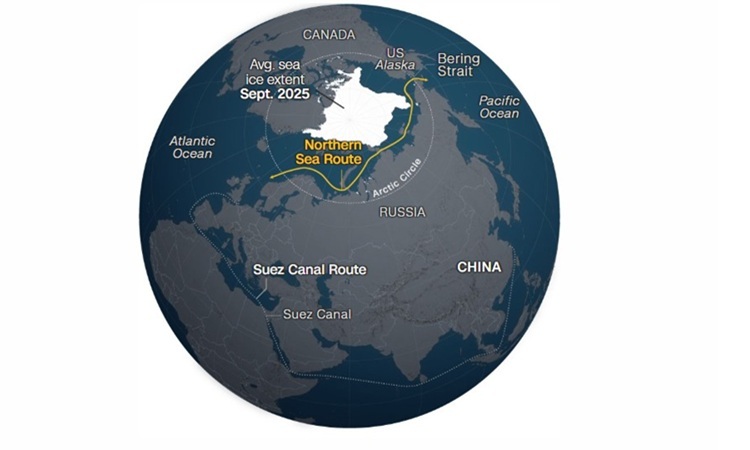
According to the Guardian, the Northern Sea Route (NSR) is about 5,600 km long, running from the Kara Strait (between the Barents Sea and the Kara Sea) to the Bering Strait (connecting to the Pacific Ocean). The NSR cuts across the Arctic Circle along Russia's northern coast, making it passable only during the warm months of the year, but these are getting longer as summer sea ice shrinks.
Because it is 30% to 40% shorter than the traditional route through the Suez Canal, NSR helps cargo ships from East Asian countries such as China, Korea, and Japan save about 10-14 days when traveling to Europe. In particular, China sees this route as an alternative to avoid some hot spots in the Middle East such as the conflict in the Strait of Hormuz.
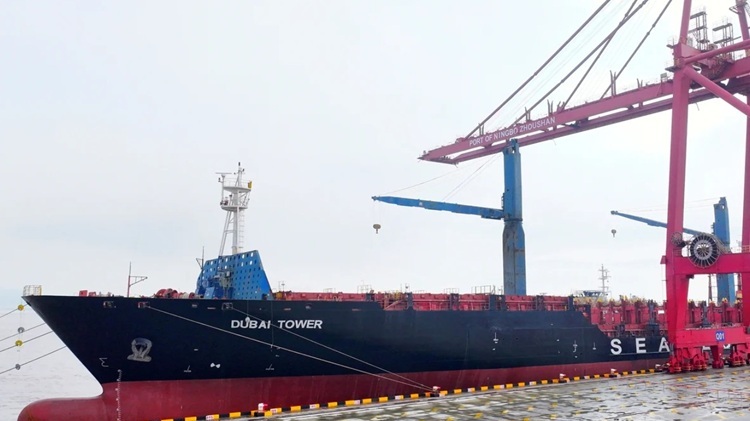
After a single test voyage in 2025, shipping company Sea Legend has launched regular container service via NSR. The direct journey from Ningbo - Zhoushan to the port of Felixstowe in England takes only 18 days compared to more than 40 days via the Suez Canal. This is the only regular commercial freight service on this route today.
Experts say the icy "Silk Road" is ideal for temperature-sensitive goods, including electric cars, lithium batteries and solar products, sectors where China has become the world's top exporter. This move is also a testament to the growing economic cooperation between Russia and China. China uses the NSR to transport goods to Europe, while Russia uses the route to supply oil to Asia.
According to the US National Snow and Ice Data Center (NSIDC), 17 summers with the lowest sea ice area on record have occurred in the past 20 years. Meanwhile, data from NASA shows that the area of Arctic sea ice is shrinking by about 12% per decade. Anastasios Leonburg, a marine risk consultant for insurance company Allianz Commercial, emphasized that the reduction in sea ice area will certainly lead to an increase in ship traffic along the NSR during the summer months.
Sci News says the expansion of shipping in the Arctic is raising environmental concerns. Some shipping companies have been criticized for operating ships using heavy fuel oil (HFO), which is banned in the Arctic from 2024. According to a 2025 report by the Bellona Environmental Foundation, oil spills pose a great danger in the Arctic because HFO is thicker than other fuels, making disposal difficult. Oil also breaks down more slowly in cold weather and is nearly impossible to remove when trapped in ice. Their report shows that Russia is completely unprepared to deal with such a disaster. NSR's remote location means it can take recovery teams weeks to reach the spill site.
Bellona also warns about the risk associated with black carbon, one of the emissions from HFO, which has a strong ability to absorb solar radiation. Black carbon can reduce the reflectivity of the Arctic region, causing it to absorb more sunlight and retain heat, making global warming worse.