Technology helps China accelerate the production of reusable rockets
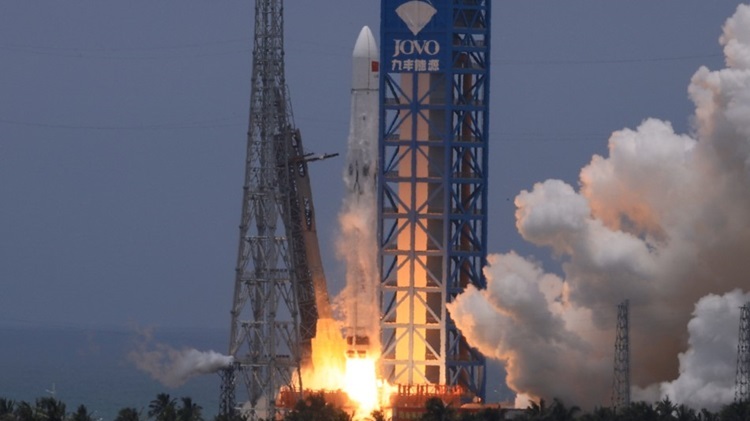
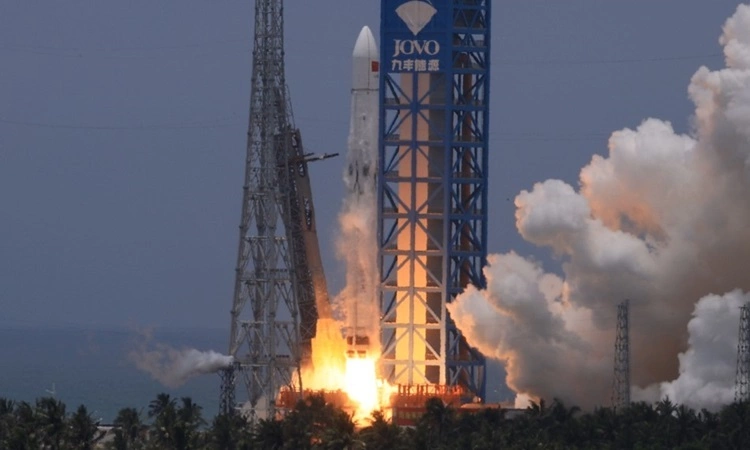
China is reaping many successes in fuel tank partition production technology. On July 10, China's Long March 10B (CZ-10B) rocket put a satellite into orbit, then landed vertically on a giant support net mounted on an offshore floating platform, marking the first recovery of a reused rocket. The flight uses a welded lid that is comparable to SpaceX's Falcon rocket but can be produced faster.
At the same time, Chinese researchers also introduced a "cold forming" technique that allows creating a complete, seamless lid within hours instead of a week.
Shanghai Numerical Control Technology Company produces fuel tank baffles on Long March 10B rockets using domestically developed machine tools and according to standards similar to SpaceX's Falcon line. They use two core processes, including dual 5-axis mirror milling method, machining the cover seamlessly with the holder to prevent thin material from deforming under cutting pressure, ensuring precision and efficiency. Currently, there are only three suppliers in the world that possess such mirror milling technology: Dufieux Group of France, M. Torres of Spain and Shanghai Numerical Control Technology Company, in which the Chinese system has advantages in accuracy, cycle time and cost.
The second process handles the joint between the lid and the fuel tank body using a 5 m long friction stir welding system. As the stirrer rotates rapidly, friction creates heat that softens and kneads the metals together, creating a perfect weld. This method enhances the fatigue strength of the joint many times more than conventional fusion welding, providing the necessary durability for the rocket to fly many times without failure.
According to Shanghai Numerical Control Technology Company, combining the above two technologies "is the core production direction that helps SpaceX recover the Falcon line with high reliability." Compared to traditional segment manufacturing processes, this solution reduces the lid weight of the rocket by nearly 400 kg with specifications exceeding international standards.
China Science Daily reported on July 12 that a group of researchers at Dalian University of Technology developed super-cold monolithic forming technology for aluminum alloy, helping to promote the efficient production of fuel tank baffles.
Contrary to the common belief that metals become brittle and less durable in cold conditions, researchers found that at extremely low temperatures, aluminum alloys simultaneously increase both elongation and cold hardening coefficient (the ability of a metal to increase its strength by plastic deformation). Based on this physical effect, they developed a proprietary forming process that involves placing a 4 mm thick aluminum alloy sheet in a -196 degree Celsius cold chamber and shaping it once into a smooth lid ready for direct use without the need for further processing.
According to Bastille Post Global, compared to the traditional method of forming many separate parts and welding them together, super-cold monolithic forming can increase material utilization efficiency by more than 85% and reduce production time from more than a week to a few hours.
The team collaborated with the China Academy of Launch Technology (CALT) and demonstrated the new dome-shaped bulkhead successfully flew on the Long March 12 and Long March 7A Y14 missions. In addition, they also cooperated with Yongxing Gongda Technology Company to build a production line for 4m sized partitions in Jizhou Economic Development Zone in Tianjin. According to CGTN, in May, the first batch of mass-produced baffles shipped with an annual capacity of over 1,000 units, enough to support the assembly of more than 100 missiles per year.
According to SCMP, in the space race between the US and China, the decisive advantage may lie in a little-known part, the fuel tank partition. On booster rockets, the cylindrical fuel tank body needs two elliptical or parabolic dome-shaped "hats" tightly welded at both ends to evenly distribute pressure, preventing the tank from exploding under the gas compression pressure and vaporization pressure of the supercooled fuel.
The partition is several meters wide but only a few millimeters thick and is subject to enormous pressure, vibration, and shock. Because mass production is difficult, countries that can produce fuel tank baffles quickly, cheaply, and with greater reliability will hold a major advantage when developing reusable rocket fleets for the future space economy.