Chinese company makes satellite calls directly from smartphones
Spacesail claims that this is the first test of its kind in China, the communication process is smooth and stable with good signal strength and voice quality, equivalent to a 5G network on the ground.
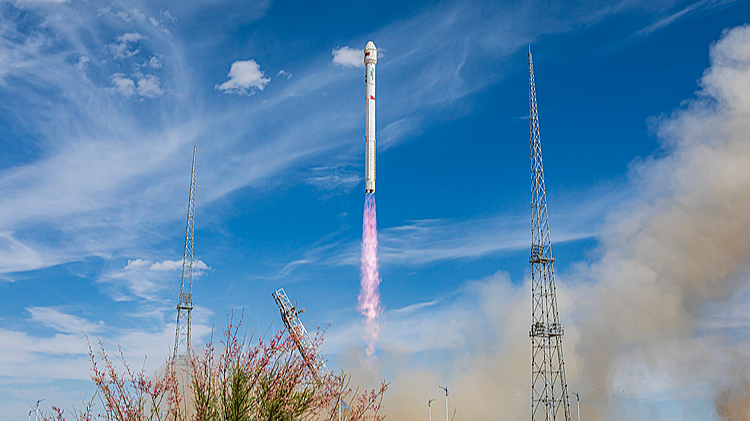
The test was carried out by Spacesail DTC 01, a specialized satellite launched earlier this month on a Zhuque-2E rocket. According to Xinhua, the satellite is designed to validate key technologies of direct mobile phone connection services and integrated space-ground networks, promoting the convergence between satellite communications and 5G and 6G networks.
CGTN said that Huawei and Xiaomi phones have been equipped with satellite calling services since 2024, but connect to Tiantong-1, a geostationary satellite system operating at an altitude of 36,000 km operated by China Telecom. Spacesail's network is located closer to Earth's surface, providing a stronger signal. Notably, Spacesail's direct connection technology does not require standard commercial smartphones to make any hardware or software modifications.

Previously, in August 2024, Spacesail began deploying an Internet satellite network competing with SpaceX's Starlink. The pace of deployment is accelerating, with three launches performed in 11 days last month. As of June 5, the company's network had 200 satellites. According to the plan, the network has 324 satellites by the end of the year and 648 satellites by the end of 2027, completing the first phase. The ultimate goal is to deploy more than 15,000 satellites for global coverage by 2030.
Spacesail's scale is still relatively small compared to Starlink. The Starlink system has about 10,300 active satellites and continues to increase, expected to reach 42,000. Starlink is the largest satellite network ever built, accounting for 2/3 of the total number of satellites operating in Earth orbit.
According to CGTN, Spacesail and Starlink satellites both operate in low Earth orbit (LEO), about 300-2,000 km from the surface of the blue planet. They act as overhead base stations, close enough to provide low latency connections. This network is designed to eliminate "connection dead zones" in places such as remote mountains, deep oceans or remote polar regions, where ground broadcasting stations cannot reach.
Thu Thao compiled