Vietnamese companies use blockchain to shorten the process of checking international documents
Pila, a Vietnamese technology company, is testing a solution using digital certificates to shorten the process of checking letters of credit in international transactions. This week, the business announced a partnership with TOTM Technologies, a Singaporean technology company, to carry out its first tests.
Letter of credit (L/C) is a popular payment method in international trade, in which the issuing bank commits to pay the exporting enterprise when the documents meet the conditions. With L/C issued by a foreign bank, checking may currently require many steps such as contacting the issuing bank, looking up via SWIFT and comparing documents. According to Pila, this process can take days, incur costs and pose a potential risk of errors or counterfeiting.
The solution tested by the business is to add a layer of digital authentication to the current process. The bank still processes the L/C as usual, but at the same time issues an additional Digital Certificate (VC) to authenticate the L/C information.
When the partner bank receives the documents, the VC allows checking the issuing source, determining whether the information has been edited or not and checking whether the certificate is still valid or has been revoked. Verification is performed through a common trust infrastructure, instead of the recipient having to connect directly to the issuing bank.
In initial tests, the Vietnamese company operates a domestic VC issuance and verification infrastructure via NDAKey. The platform uses blockchain to register and verify the issuing source, the status of the certificate, and proof of information integrity. The Singapore partner takes charge of the technical capabilities in this market and integrates the solution with TradeTrust, a technical framework developed by the Singapore Information and Communications Development Authority (IMDA), to support the verification, exchange and interoperability of e-commerce documents.
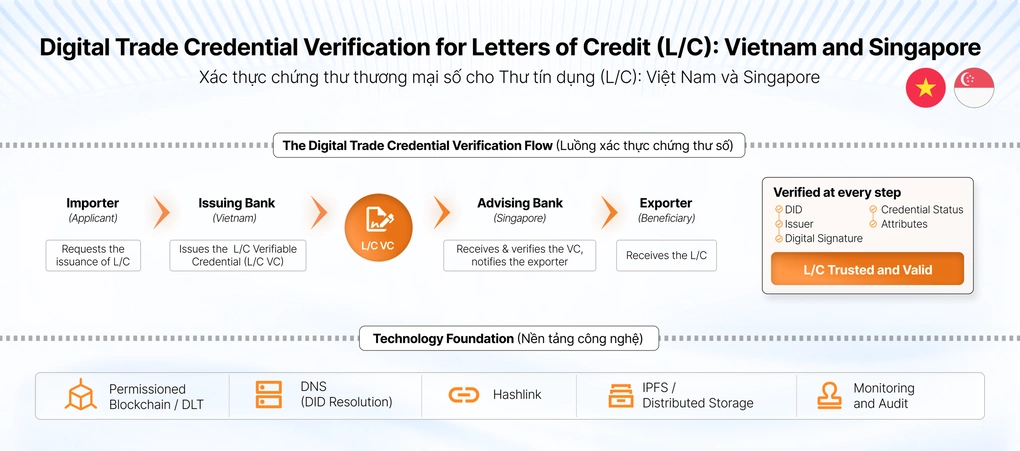
"The solution aims to shorten document authentication time, reduce manual control and form a network of many banks in Vietnam and Singapore that trust each other on a common infrastructure in cross-border transactions," said Pila representative. Additionally, the authentication layer is designed to work in tandem with the L/C, which can be tested without changing existing legal processes.
If it operates effectively, the business said it wants to expand to other types of documents and transactions. One direction mentioned by both sides is Digital Passport for products, which helps import-export businesses share and verify information about products, supply chains and goods origin. The two sides plan to research immediate applications in Vietnam, Singapore and Indonesia.
According to Mr. Chan Wei Jie, CEO of TOTM Technologies, digital trust infrastructure based on Self-Sovereign Identity and Verifiable Credentials will be the core foundation, building trust for cross-border trade models to develop sustainably in the future.
Nguyen Phu Dung, CEO of Pila, said that the digital economy not only needs connection infrastructure but also needs a mechanism so that digital identities, electronic documents and data can be verified safely, reliably and recognized. According to him, when this layer of authentication is established, cross-border transactions can be faster, more transparent and efficient.
Businesses hope that this technology can create an additional layer of verification for electronic documents, thereby reducing reliance on manual comparison steps between organizations in different countries. The long-term goal is to develop authentication solutions that can be used in many types of cross-border transactions.
Luu Quy