Starlink Internet fee in Vietnam is 6 times higher than fiber optic cable, who will use it?


(Dan Tri) - The registration system of Starlink satellite Internet service (part of SpaceX Group) has officially updated the address options in Vietnam, showing the entire cost structure of services and equipment to users.

Starlink Internet transceiver (Photo: Bloomberg).
The emergence of this new method of connecting to the Internet is attracting great attention from public opinion when placed on a direct comparison table with traditional fiber optic network operators.
Hardware costs and monthly rates
According to data from Starlink's ordering system, the service package for households in Vietnam has a recurring fee of 1,711,100 VND/month. Besides, to be able to use the service, users must invest a large initial hardware cost.
Specifically, the new generation Standard 4X terminal set is priced at 10,269,900 VND, along with a shipping and handling fee of 578,900 VND. In addition, users need to pay an advance deposit of 2,026,300 VND (this amount will be deducted from the total cost of the device when making the official payment).
Compared to the fixed Internet market in Vietnam, Starlink's price has a huge difference compared to traditional fiber optic cable services from major carriers such as FPT, VNPT and Viettel.
Currently, the popular packages of these units only range from 195,000 VND to 359,000 VND/month (depending on the subscription package).
Not only that, regular fiber optic network users also receive free or major support from domestic carriers for the cost of terminal equipment (Wi-Fi Modem) when participating in usage commitment programs or paying fees in advance.

Detailed comparison table of parameters and monthly costs (Graphic: AI).
Who is Starlink Internet for?
In terms of theoretical speed, domestic fiber optic cable packages have a great advantage when providing bandwidth from 500Mbps to 1Gbps, surpassing the maximum commitment of over 400Mbps of the Starlink satellite Internet package.
In addition, the latency of traditional fiber optic cables is always stable and significantly lower than signal transmission through space.
However, a pure comparison of price and speed does not fully reflect the nature of these two types of services.
Fiber optic Internet requires complex physical cable infrastructure, so it is easily limited in remote areas, borders, islands or on mobile means by sea.
Meanwhile, Starlink operates based on a constellation of low orbit (LEO) satellites, allowing global coverage. The Standard 4X device set that comes with Starlink's Wi-Fi 6 Router is resistant to harsh weather, can withstand winds of over 96km/h and integrates an automatic snow melting feature, serving the purpose of connecting anytime, anywhere.
Sharing with a reporter from Dan Tri newspaper, an expert in the field of satellite Internet assessed that Vietnam has huge market potential for Starlink. With a population of more than 100 million people, a rapidly growing economy and the government's policy to promote digitalization, the demand for stable, high-speed Internet is increasing, especially in areas that are not fully covered.
"Vietnam is also among the leading countries in Southeast Asia in terms of digital services and online participation. Starlink has a great advantage in rural and remote areas, where fiber optic cable deployment is expensive and time-consuming. Besides, with a long coastline, many fishing boats and islands, Vietnam has a high strategic need for satellite connectivity," the expert assessed.
Accordingly, Starlink Internet can provide important digital infrastructure for hard-to-reach areas, supporting essential services.
In education, this technology will help students in disadvantaged areas access online learning platforms, participate in virtual classrooms and exploit global educational resources that they have never had the opportunity to access before.
In the medical field, Starlink can connect remote medical stations with central hospitals, effectively supporting remote medical examination and treatment, more accurate disease diagnosis and timely emergency coordination.
For the marine economy, the satellite Internet system provides essential support for fishing vessels and offshore activities, helping to maintain communication, ensure crew safety, optimize logistics management and market access.
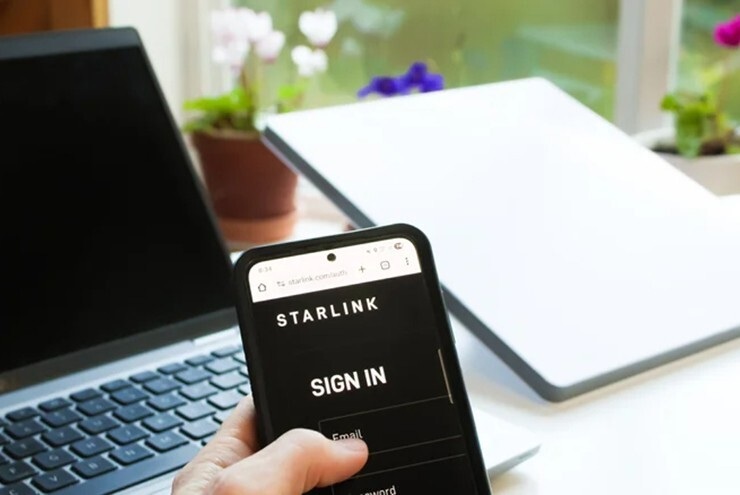
Vietnamese users will soon be able to use satellite Internet services (Photo: ST).
In the defense and security sector, Starlink provides broadband connectivity with low latency and high encryption capabilities, supporting operations at military bases, enhancing border security and improving emergency response efficiency.
Besides, private enterprises, especially small and medium enterprises (SMEs) in remote areas, will also benefit greatly from this technology. Thanks to stable connections, they can connect to e-commerce platforms, use cloud computing tools and access international markets, promoting local economic development.
The benefits of Starlink have been demonstrated through many real-life situations around the world, with clear impacts in different contexts.
It can be seen that for ordinary users in urban areas and areas with developed telecommunications infrastructure, domestic fiber optic cable is still the optimal solution thanks to its 5 to 7 times cheaper cost and superior speed.
In contrast, satellite Internet services target specific customer segments such as ships, isolated resorts, rescue forces, or households residing in rugged terrain where fiber optic cables cannot reach.