The 1,600 km long cloud appears and disappears every day on Mars
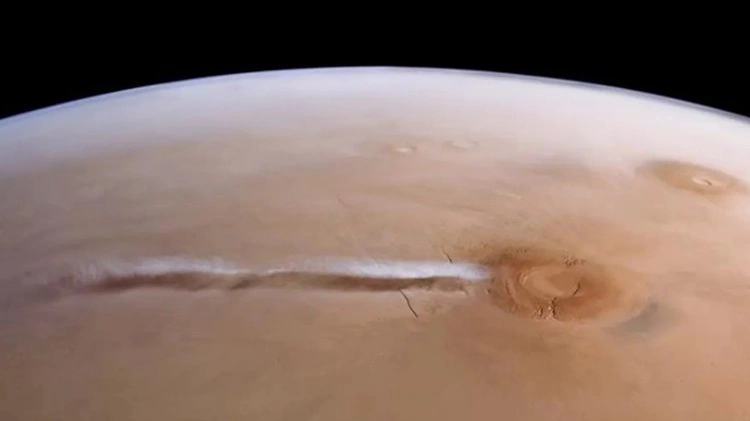
According to Live Science, the mysterious cloud mass called Arsia Mons Elongated Cloud (AMEC), often appears above Arsia Mons, a 20 km high extinct volcano located in the Tharsis region, south of the Martian equator. AMEC is usually about 1,600 km long, and can even extend up to 1,800 km, about 1/12 of the circumference of Mars. It appears nearly every morning during the planet's spring and summer, when solar radiation enhances strong winds at ground level, but it lasts only a few hours each day, then evaporates completely.
In a paper published on October 7 in the journal Nature Geoscience, researchers used data from the European Space Agency's Mars Express orbiter to create new simulations to explain the existence of AMEC. Initially, they had difficulty reproducing this puzzling phenomenon. But after ignoring conventional meteorological principles, they figured out the process that drives AMEC to form.
Gizmodo said that the Mars Express spacecraft discovered AMEC on Mars in 2018. Since then, its strange characteristics have continuously confused the scientific community. Satellite observations show that AMEC is a topographic cloud, meaning it forms when strong winds push water vapor up and over tall structures such as mountains. Similar clouds also exist on Earth, such as the Levanter clouds that occasionally form over the Gibraltar cliffs in southern Europe. However, simulation efforts have not yet been able to reproduce exactly how AMEC formed.
On Earth, clouds form through a process called heterocrystalline crystallization, in which moist air cools and condenses into ice crystals around small particles in the atmosphere such as dust, salt, pollen or soot. However, even though the Martian atmosphere is dusty, that process does not occur. Jorge Hernández-Bernal, a planetary scientist at the University of the Basque Country in Spain, who led the research team, explains that for AMEC, water vapor converts directly into ice cloud particles without any intermediate steps. They call this "homogeneous crystallization", a process that has never been encountered in a planet's atmosphere. When Hernández-Bernal and colleagues integrated homogeneous crystallization into a meteorological model of Mars, they successfully reproduced AMEC's unique features.
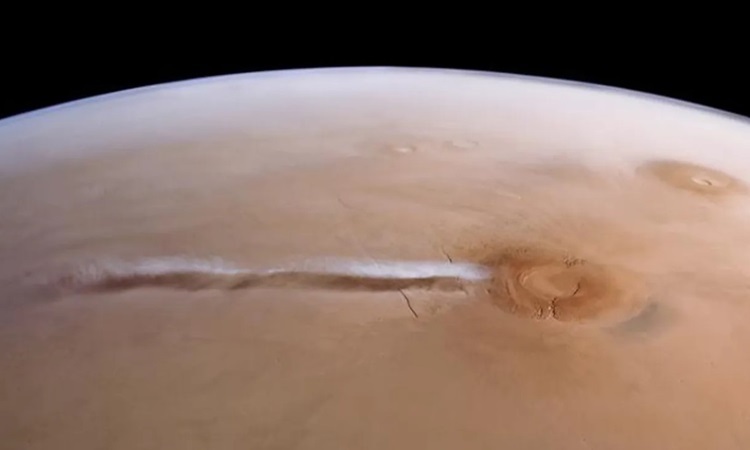
According to Discover Magazine, previously, researchers predicted that homogeneous crystallization could potentially exist in the Earth's upper atmosphere or on Venus. However, this is very unlikely because it requires humidity about 100,000 times higher than the Earth's surface and is even more impossible on Mars because the planet today has almost no water. But according to data from the Mars Express spacecraft, when wind blows up the slopes of Arsia Mons, more than twice the height of Mount Everest, it creates a powerful wave that pushes air into the upper atmosphere at great speed.
The researchers calculated that the temperature of this gas stream can decrease by 30 degrees Celsius in just 10 minutes, not only making it easier to freeze but also increasing the humidity in the wave, creating conditions for homogeneous crystallization to take place. Hernández-Bernal's team suggests that the water vapor partly exists in the atmosphere, partly possibly originating from the summit of Arsia Mons, which is covered by a thick layer of fog.
The new simulation marks a major step forward in increasing understanding of AMEC and Martian meteorology. The Mars Express orbiter makes an important contribution to the discovery by using three instruments to map how AMECs form and evolve each day. It is also one of the only Mars spacecraft that can observe the summit of Arsia Mons during the day.