Deepfake is increasingly sophisticated, how do banks authenticate users?


(Dan Tri) - When faces and voices can both be spoofed by AI, financial systems must rely on many layers of checks to verify user identities.
Identical does not mean it can pass all authentication layers
The rapid development of deepfake makes many people concerned: if AI can recreate faces more and more realistically, will banks' facial authentication systems still be safe?
According to Mr. Nguyen Chien Thang, Director of Development Center, Saigon - Hanoi Commercial Joint Stock Bank (SHB), it is necessary to separate two issues: AI that can create a face similar to a real person and AI that can pass the entire financial authentication process are two different things.
A photo published online can be raw material to create a deepfake, but to open or take over a bank account, bad actors often need a lot of data and must pass many other layers of checks.

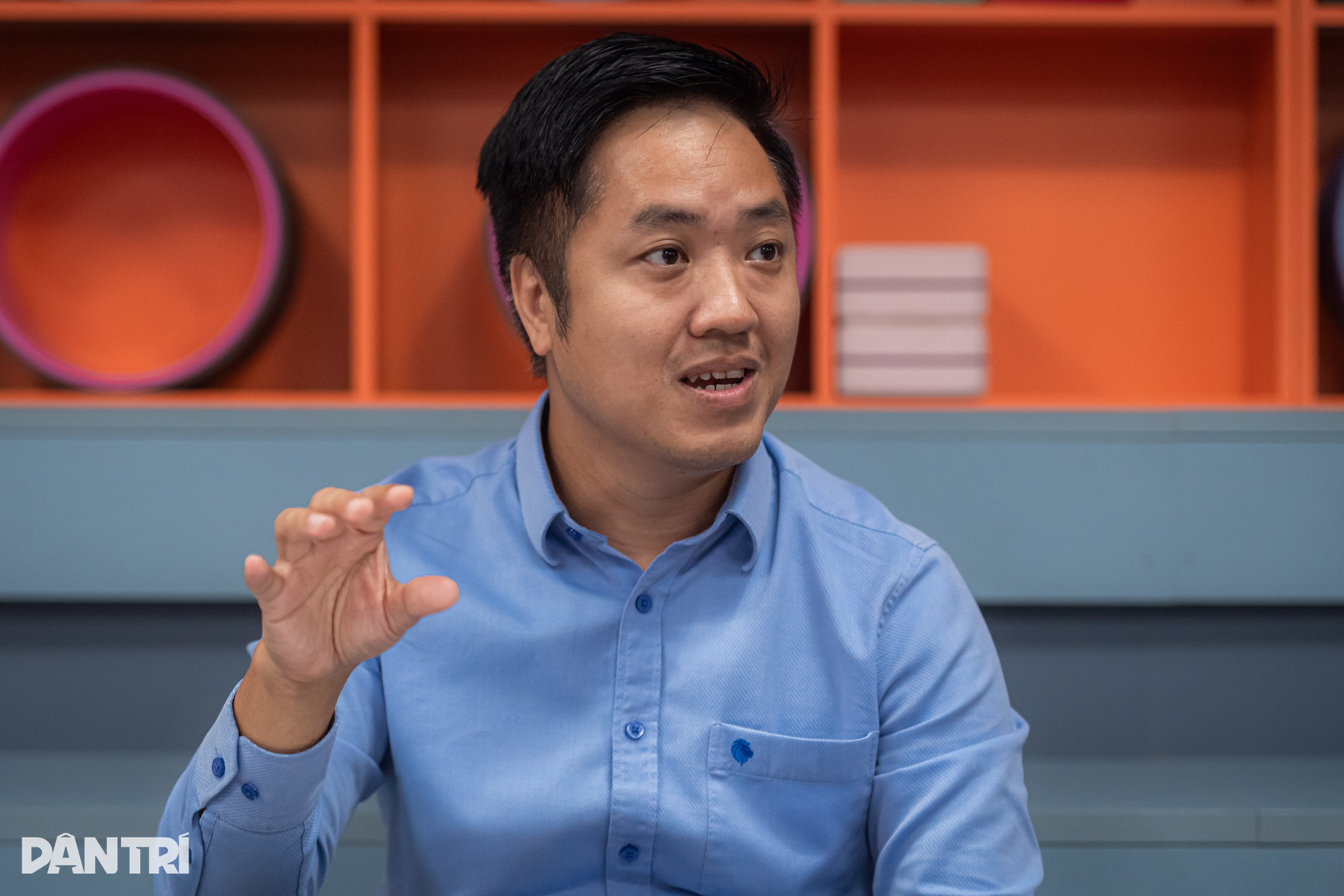
According to expert Nguyen Chien Thang, creating a fake face that resembles a real person does not mean being able to pass the bank's entire eKYC process (Photo: Viet Huy).
According to Mr. Thang, in the step of opening an online account, the system does not only compare faces.
Users must also provide identification documents, identification data and perform other authentication steps.
"Just having a photo of your face online is not enough to open a bank account under someone else's name," Mr. Thang said.
In reality, risks often appear when bad actors try to get more data or cause victims to perform verification steps themselves.
One of the common ways is for bad guys to rent or buy bank accounts in someone else's name.
Bad guys can pay someone to use their real identity and face to complete the account opening process, then hand over usage rights.

Bad guys can try to trick users into providing their own identification, scanning their faces or granting device control rights instead of directly "breaking" the banking system (Photo: Doan Thuy).
Another more dangerous scenario is tricking users into installing fake apps.
These applications can be disguised as public services, electricity applications, identity authentication or familiar software.
After installation, users are instructed to bring their ID close to their phone, scan their face, or grant deep access to the app.
In case the device is hijacked, bad guys can collect much more data than a photo on the internet.
"There are situations where the victim scans his or her own identity or face according to the instructions of the fake application. Then, the problem is no longer just a deepfake but a whole chain of attacks on the device and personal data," Mr. Thang analyzed.
This shows that in many cases, the weak link is not necessarily in the facial recognition algorithm. Fraudsters can find ways to bypass technology using user behavior.
The face is not the only layer of security
Another concern involves transactions that require biometric authentication.
According to Mr. Thang, in the past there have been techniques to intervene in the application to put fake video streams in place of images from real cameras.
In principle, if the system only "sees" an image stream without verifying the source of that data stream, deepfake videos can become a risk.
However, he said current banking systems have enhanced many layers of application protection to limit source code interference, virtual camera insertion or image data replacement.

When opening an online account, the face is just one of many layers of authentication, besides identification documents and other checking steps (Illustration: Doan Thuy).
Authentication data can be checked to ensure it comes from a real device and that real users were involved.
Besides, the face is not the only factor. A transaction may also be protected by a login password, OTP, Smart OTP or other unusual checking mechanisms.
Therefore, according to Mr. Thang, one should not understand that as long as AI creates a realistic face, bad guys can immediately take money from the account.
To carry out illegal transactions, they often have to gain more information or control the victim's device.
The development of deepfake also leads to a series of tools that claim to be able to detect photos and videos created by AI.
According to Mr. Thang, these solutions can now work in many directions.
One way is based on metadata, which is information about the origin and creation process of the file. However, metadata can be lost when content is screenshotted or goes through some processing steps.
Another direction is to use AI itself to find characteristic traces left by the generative model. But according to Mr. Thang, this is still a continuous race.

According to experts, current deepfake detection tools are only for reference and cannot guarantee absolute accuracy against increasingly sophisticated AI models (Photo: Viet Huy).
"A detection tool can identify products of this model well, but it is not necessarily as effective as a newer model. Currently, these tools cannot be considered 100% accurate," he commented.
Mr. Vu Duy Hung, founder of ColorMind, a unit that applies AI to content and cinema production, said that from direct experience of creating content with AI, Mr. Hung said that many signs that helped recognize deepfake such as unnatural eyes, crooked mouth, faulty teeth or too smooth skin are gradually being overcome by new models.
There are even contents that are difficult for even long-time professionals to distinguish with just the naked eye.
Therefore, relying entirely on the ability to "scan" a fake face is becoming less and less reliable.
Twitter verifying the source is more important than trying to guess whether the video is real or fake
According to experts, as deepfake technology advances, users need to change the way they react to unusual requests.
If you receive a video call from a relative asking to transfer money, the important question should not just be “does this face have an AI error?”. What needs to be verified first is whether the person making the request is actually that person.
Users can call back a familiar phone number, contact via another channel or confirm with a third person.
For high-value transactions, you should not rely solely on images, voice or a video call.

According to experts, when images and voices can both be faked, multi-channel verification is still an important defense against unusual money transfer requests (Photo: Tuan Anh).
If you discover that your face or voice is being used for impersonation, Mr. Thang recommends that people quickly notify the authorities, and warn relatives, friends and colleagues through official communication channels.
In a landscape where faces can be copied by AI, biometrics remains an important authentication tool, but its value lies in being placed in a multi-layered system.
Because in the age of deepfake, a realistic face is not necessarily a real person, and a secure system cannot rely solely on "seeing to believe".