American Professor: Humanoid robots are being hyped
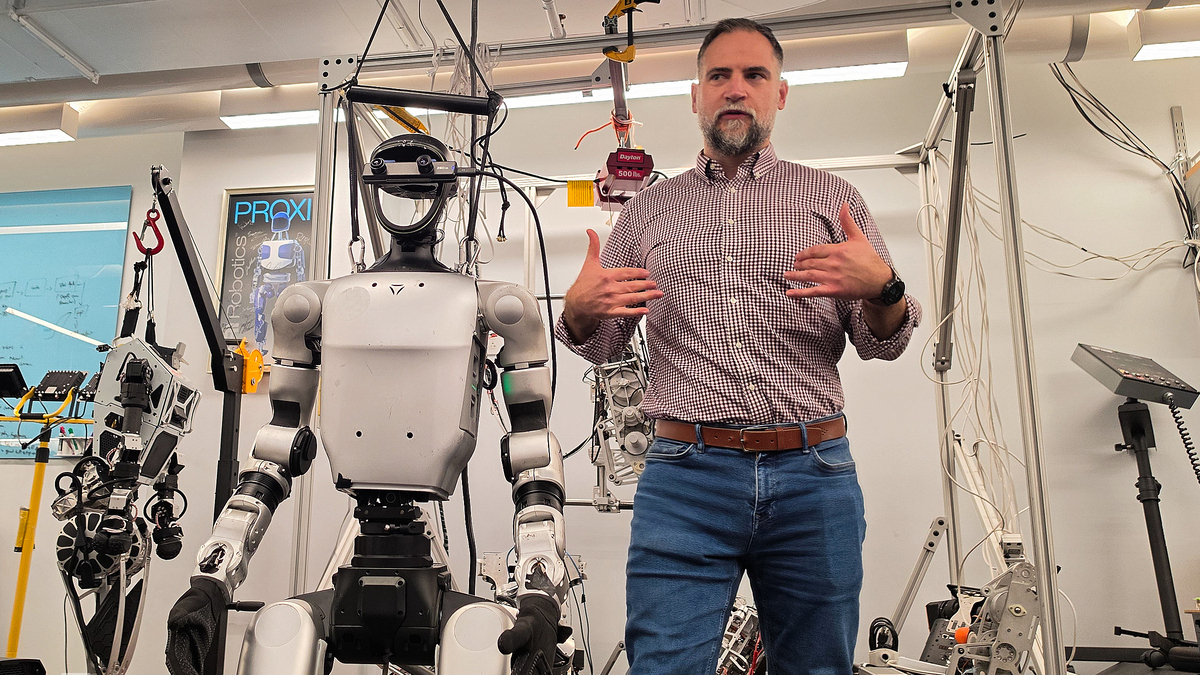
"Much of it is still hype," Professor Aaron Ames at the California Institute of Technology (Caltech), commented when asked about the capabilities of humanoid robots. He is the head of the CAST automation technology center, and also leads the AMBER Lab team - a laboratory specializing in research on bipedal robots. This is considered one of the leading research units on bipedal robots in the US, behind many commercialized products.
In recent times, humanoid robots have developed strongly, with many impressive performances such as jogging, martial arts performances, climbing stairs, folding clothes... However, according to Professor Ames, "if you don't think about safety, all of the above will mean nothing, and to be honest, very few companies that produce humanoid robots really think about safe deployment."
Citing the example that people can now trust the safety of cars or airplanes because thousands of engineers have spent many years verifying them, he believes that robots should also go through similar stages. In a hypothetical situation such as a robot used in a home suddenly running out of battery and falling on children or furniture, it could become a disaster.

"The problem of bringing humanoid robots to operate safely and stably in life has not been completely solved," he said. "The issue of robot safety has not been discussed in proportion to its importance, while it is the key for robots to come to life."
The problem of bringing experiments into practice
AMBER Lab considers safety as one of its research focuses. According to Professor Ames, most of the motion technology on industrial robots today originates from basic research at universities 5-10 years ago. AMBER's focus is no longer on building robot hardware from scratch, but on developing a "secure software layer" that integrates into commercial products.
In a meeting with the press at the end of September, the research team demonstrated the robot's ability to automatically dodge an incoming ball, on a test model based on a robot from Unitree (China).
Unlike previous tests that needed to rely on an external motion capture system, Mr. Ames said they are applying a solution entirely using cameras and sensors integrated into the robot body. When he threw a ball at the robot's head, the device immediately retreated or leaned to avoid it. In about 10 attempts at an average throwing speed, the robot successfully avoided it.
"Dodging a moving object is not difficult, but dodging without losing your center of gravity and falling on top of the person standing next to you is an extremely complicated problem of controlling your whole body," a research team member explained.
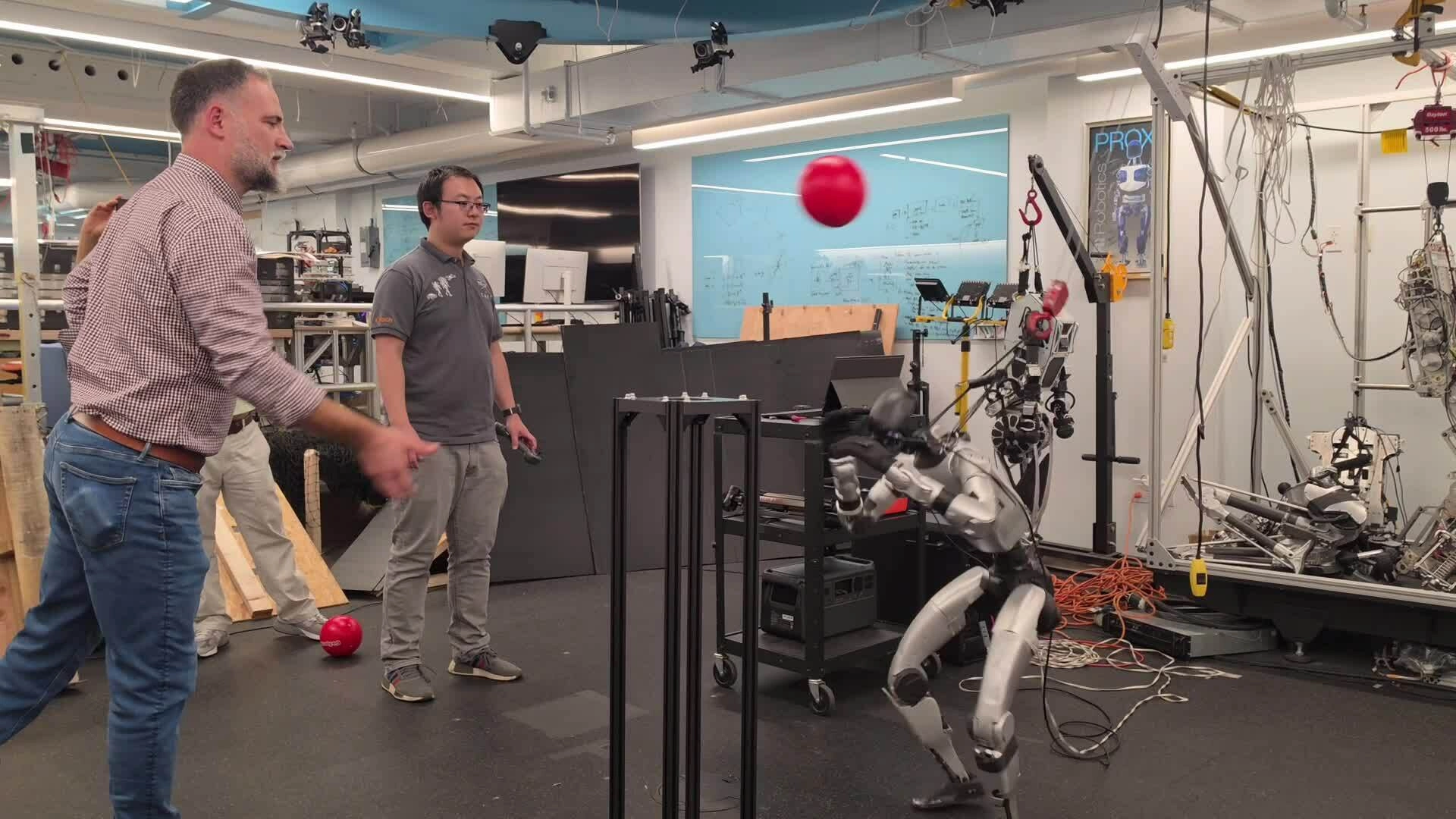
Accordingly, the robot cannot just see the ball and then step aside. When changing posture, it must simultaneously calculate the position of many joints, the body's center of gravity, the ability to maintain balance and the distance from other objects. If you avoid the ball but fall on the person next to you, the action is still considered a safety failure.
In a study called PAC-MAN published last month, Professor Ames's team used a depth camera mounted on the robot's head to recognize the ball. The system combines sensory information with Control Barrier Functions (CBF) and reinforcement learning to control the entire robot body. When deployed on Unitree G1, the robot successfully dodged 95% of the time in real-world testing.
In addition to bipedal robots, AMBER Lab also introduces a safety solution for industrial robot arms using the VLA (Vision-Language-Action) model. This is the foundation model that allows robots to learn operations such as picking up and cleaning from visual data and human language.
During the test of picking fruit into a bowl, the research team repeatedly used their hands or a wooden stick to block the path of the mechanical arm. The protective layer running parallel to the VLA model immediately intervenes, forcing the arm to avoid obstacles or stand still in place to avoid causing a collision. Only when the human hand is withdrawn does the robot continue to complete the task.
"We would rather let the robot slow down for a few seconds than let a collision happen," he emphasized.
These concerns are not limited to just one lab at Caltech. Fraunhofer IPA, a German applied research institute, this year built a set of humanoid robot assessments on many criteria including mobility, manipulation, functional safety, cybersecurity and energy efficiency. When tested on a popular humanoid robot model, researchers noted that it could create impact forces exceeding 500 newtons, significantly higher than the force thresholds allowed by standards.
In the US, the National Institute of Standards and Technology (NIST) also built a framework to evaluate the basic capabilities of humanoid robots. The tests are designed to measure abilities such as movement, manipulation, coordination of movement and manipulation, as well as whole-body awareness and control. The goal is to create comparable measurements between robots rather than relying solely on individual brand performances.
"The biggest concern is people, not robots"
When asked about the scenario of humanoid robots "revolting" or developing their own consciousness, Mr. Ames said that the more concerning risk lies in how people use and deploy technology.
"I'm just worried about people using them for bad purposes," CAST Director said.
According to him, robots are similar to AI, both are powerful tools and have the risk of being used for the wrong purpose or not fully controlled. However, an AI error is a wrong answer on the screen, while a robot error can turn into physical movement, with an impact force of tens or hundreds of newtons. Therefore, he believes that the responsibility for setting limits and ensuring robots operate safely belongs to humans, instead of waiting until technology develops before handling risks.

In addition, Professor Ames believes that the family space is not the place to deploy this technology in its early stages. Instead, the most ideal environment for robots in the near future is where humans should not or cannot go, such as a building that collapses after an earthquake or a forest fire breaks out. In that situation, hundreds of robots entered the scene and were crushed, but saving one life was still completely worth it.
In addition to disaster rescue missions on Earth, outer space is also assessed by Caltech experts as a potential environment for humanoid robots, where the risk of harm to humans is minimized.
Luu Quy