Google: It takes 10 years and 1,800 launches to build a space data center
According to an in-depth report published in Joule magazine on October 1, the Google research team said that transportation technology to space will gradually improve by 2035. In which, Elon Musk's SpaceX ship systems play a major role.
The team believes that parties wanting to build data centers will look to SpaceX first. Elon Musk's company's ability to build rockets has improved in both speed and technology over time. Since the successful launch of Falcon 1 in 2008, launch costs have decreased by 20% each year. By 2035, the team estimates SpaceX's launch price will be around 200 USD per kg, which is considered "completely reasonable".
Based on the amount of payload launched by the Falcon 9 rocket today, the Google team believes that a similar cost reduction path would require Starship to put 370,000 tons of supplies into orbit. That means, completing a data center requires about 1,800 launches over the next 10 years, an average of 180 per year, with a payload of 200 tons per mission.

According to TechCrunch, this is a "too big" request when Starship currently only flies a few times a year. However, SpaceX is planning to apply for a license and increase the launch frequency to 25-100 missions annually. Elon Musk once suggested that Starship could reach a frequency of 30 times a day by 2030, equivalent to more than 10,000 trips per year, although the technology billionaire is famous for slow progress.
SpaceX is currently developing Starship at its Starbase, Texas facility, where the rocket has undergone 13 test flights with varying degrees of success. Meanwhile, Starbase, Louisiana will become Starship's takeoff base once the vehicle proves its ability to safely transport cargo to orbit. The company also plans to land and recover every part of the Starship, including the Super Heavy booster and the Ship on the upper stage, allowing for rapid reuse of the rocket and reducing the cost per launch.
In January, SpaceX submitted an application to the US Federal Communications Commission (FCC), proposing to launch one million satellites to create data centers in orbit. In June, Musk revealed the detailed design of AI1 - the first generation in a series of satellites that the company plans to use as a space data center. AI1 is 20 m high and has a wingspan of 70 m, surpassing the 68.4 m wingspan of the Boeing 747-8, and could become the largest satellite SpaceX has ever launched.
In addition to Musk, Amazon founder Jeff Bezos also has similar ambitions. However, they were met with great skepticism. In February, OpenAI CEO Sam Altman said that the idea of building a center in space is "ridiculous" at present, because the technology is not yet complete. Some other experts believe that these systems could become catastrophic, causing pollution and changing the Earth's atmosphere.
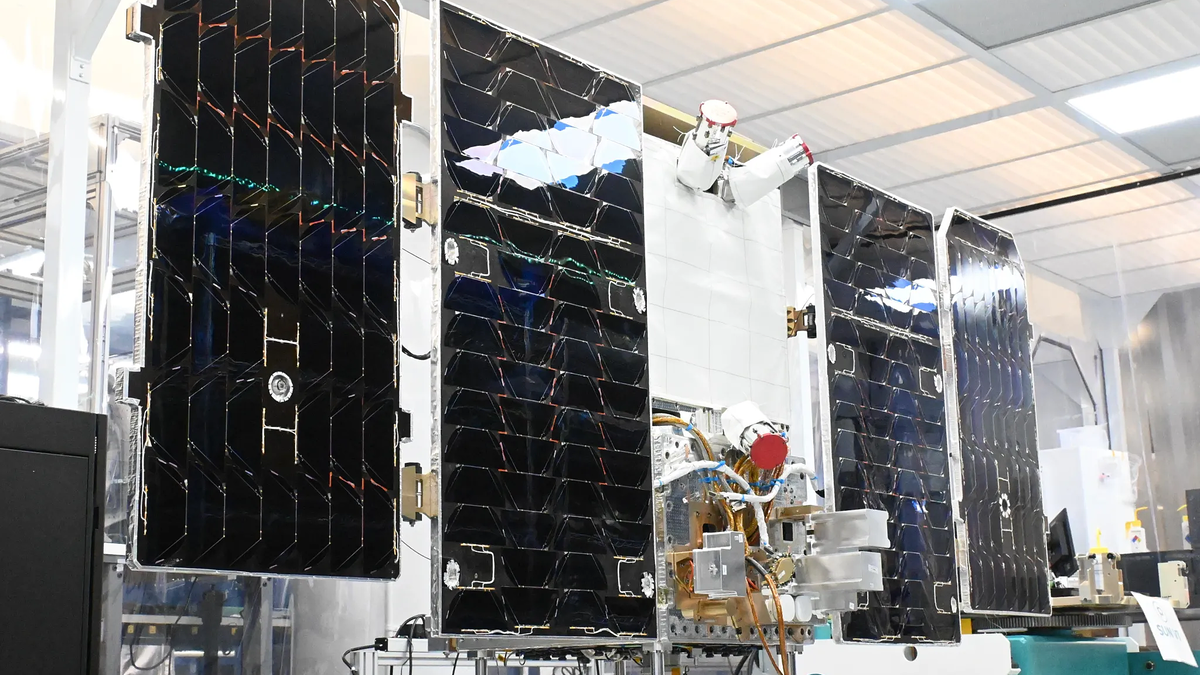
Google has just launched the first satellite integrating a self-designed Tensor processor (TPU) into space on October 1 within the framework of the Suncatcher project to test the performance of AI chips in space. The satellite, built by Planet Labs, carried four TPUs, about 1 kW of solar cells and a cooling system, and was launched on a Falcon 9 rocket on SpaceX's Transporter-18 flight. Google confirmed communication was made and the satellite is operating as designed.
The satellite will run Google's AI model in 15-minute bursts to control energy and heat consumption. Data collected from testing will help the company evaluate TPU's ability to operate in the face of radiation, temperature and physical space conditions. The company and Planet Labs are also developing two specialized, laser-connected satellites, expected to launch in early 2027.
Suncatcher is Google's long-term project to research the possibility of building an AI data center in orbit. The company envisions a network of 81 satellites operating in parallel, taking advantage of a near-constant source of sunlight in low Earth orbit, where the satellites receive about eight times more energy than on the ground. However, the project still needs to solve bandwidth, latency, heat and scalability problems.