Artificial diamonds are 5 times more durable than natural diamonds

According to SCMP, a research team from the Chinese Academy of Sciences and Beijing University of Aeronautics and Astronautics found a solution to increase the durability (resistance to strong impact forces causing cracking) of artificial diamonds by 5 times while still maintaining a hardness no different from natural diamonds. In a paper published in the journal Nature Synthesis, they embedded a 3D carbon nanotube network inside a diamond structure, creating a composite material that is even stronger than the tungsten alloy used in armor-piercing bullets.
Diamond's weakness lies in its brittleness. The same carbon bonds that give diamond its hardness but also create a less flexible structure. Just one precise strike on a weak section is enough to break the stone. Previously, researchers sought to adjust the microstructure inside diamonds to improve durability, but reduce hardness.
Instead of rearranging the atomic structure of diamond, the research team of Jiawei Zhang, Keliang Qiu, and Xiaohui Yu used a seamless 3D lattice of multilayer carbon nanotubes (MWCNT). Multi-layered carbon nanotubes are extremely small, only 1/10,000 the width of a human hair, so they cannot be observed under any optical microscope. Its tensile strength is dozens of times greater than that of steel.
Previous attempts to integrate carbon nanotubes into ceramics or metals were unsuccessful because the MWCNT and the substrate material were only in loose contact and could not effectively transmit force or withstand pressure. Chinese researchers started by carefully mixing diamond powder with nanotubes. Next, they subjected the mixture to temperatures of 2,000 degrees Celsius and extremely high pressures of up to 15 gigapascals (GPa), about 150,000 times atmospheric pressure. This pressure is high enough to fuse the two materials but not so high that it turns the carbon nanotube into diamond or so low that the powder mixture becomes graphite.
The result is that the nanotube array retains its fiber shape while forming a strong chemical bond with diamond at the atomic level. According to the research team, nanotubes act like reinforcing bars in concrete, forming a continuous 3D network between diamond particles but they are also directly linked to each other.
The interface between carbon nanotubes and diamond distributes mechanical stress throughout the entire material instead of concentrating it at a single crack point. Countless nanotubes pull the crack from all directions, absorbing large amounts of energy and preventing the crack path from running freely. Laboratory tests show that the material has a hardness of about 91.6 GPa, equivalent to regular single crystal diamond, and a strength of up to 36.4 MPa.m1/2, 5-6 times that of tungsten alloy.
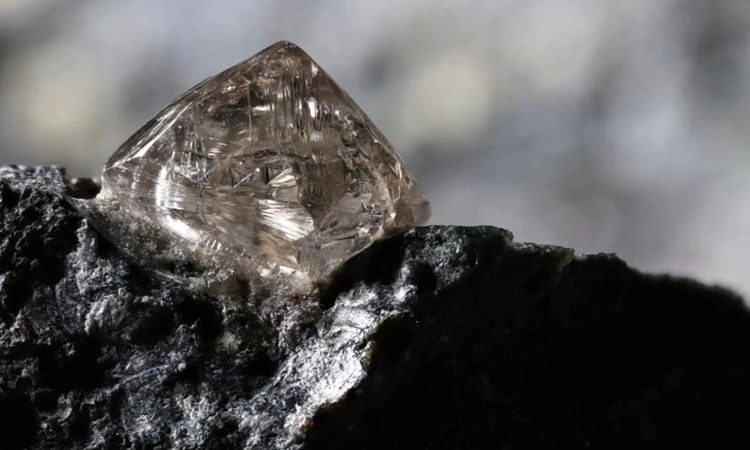
According to Interesting Engineering, the potential applications of the new synthetic diamond are wide ranging, from super-hard cutting tools for machining metals and ceramics to geological drill bits and aerospace parts manufacturing. Most industrial applications of diamond today, such as cutting tools, drilling equipment, and precision grinding, must accept the limitation of brittleness. Meanwhile, aerospace components face the challenge of impact and wear resistance. A material that maintains the hardness of diamond while achieving the fracture resistance of a metal alloy could greatly expand the performance potential of these applications.