NASA's 'Golden Age' of Space Exploration
In 1957, the Soviet Union launched the world's first satellite Sputnik 1 into space, shocking the United States, urging the country to react quickly. Determined to gain a leading position in space exploration, the United States realized the need for a specialized agency to move the country forward.
In 1958, President Dwight D. Eisenhower signed the National Aeronautics and Space Act, officially establishing NASA. This new agency was tasked with bridging the gap between the US and the Soviet Union, launching the "space race".
Over the next decade, NASA launched a series of ambitious Mercury, Gemini, and Apollo programs, each designed to test the limits of space exploration.
Mercury focused on manned spaceflight, successfully placing American astronauts into orbit. Gemini followed, allowing astronauts to perform many important operations, walk in space and refine the technology needed for lunar missions. These efforts culminated in the Apollo program, making the dream of conquering the Moon a reality.
In the photo, NASA scientists are testing a model of the Mercury spacecraft in the "rotating tunnel" in 1959.
In 1957, the Soviet Union launched the world's first satellite Sputnik 1 into space, shocking the United States, urging the country to react quickly. Determined to gain a leading position in space exploration, the United States realized the need for a specialized agency to move the country forward.
In 1958, President Dwight D. Eisenhower signed the National Aeronautics and Space Act, officially establishing NASA. This new agency was tasked with bridging the gap between the US and the Soviet Union, launching the "space race".
Over the next decade, NASA launched a series of ambitious Mercury, Gemini, and Apollo programs, each designed to test the limits of space exploration.
Mercury focused on manned spaceflight, successfully placing American astronauts into orbit. Gemini followed, allowing astronauts to perform many important operations, walk in space and refine the technology needed for lunar missions. These efforts culminated in the Apollo program, making the dream of conquering the Moon a reality.
In the photo, NASA scientists are testing a model of the Mercury spacecraft in the "rotating tunnel" in 1959.
In January 1961, more than three months before sending the first American astronaut into space, NASA sent Ham the chimpanzee into space on a pioneering mission. Luckily the mission was successful. Trained to pull levers in response to sounds and lights, Ham performed the task smoothly - moving only slightly slower than on Earth.
In 1961, President John F. Kennedy gave an important speech to Congress, outlining an ambitious vision for America's space program. "I believe this nation should commit to achieving the goal of sending a man to the Moon and returning him safely to Earth before this decade ends," he said.
In January 1961, more than three months before sending the first American astronaut into space, NASA sent Ham the chimpanzee into space on a pioneering mission. Luckily the mission was successful. Trained to pull levers in response to sounds and lights, Ham performed the task smoothly - moving only slightly slower than on Earth.
In 1961, President John F. Kennedy gave an important speech to Congress, outlining an ambitious vision for America's space program. "I believe this nation should commit to achieving the goal of sending a man to the Moon and returning him safely to Earth before this decade ends," he said.
Astronaut John Glenn enters the Friendship 7 spacecraft during pre-launch preparations. On February 20, 1962, Glenn became the first American to orbit the Earth on the Mercury-Atlas 6 mission.
Also in 1962, NASA established the Launch Operations Center to prepare for complex missions to the Moon, later renamed the John F. Kennedy Space Center.
Astronaut John Glenn enters the Friendship 7 spacecraft during pre-launch preparations. On February 20, 1962, Glenn became the first American to orbit the Earth on the Mercury-Atlas 6 mission.
Also in 1962, NASA established the Launch Operations Center to prepare for complex missions to the Moon, later renamed the John F. Kennedy Space Center.
A Gemini capsule was tested in the Unitary Plan Wind Tunnel at NASA's Ames Research Center in California in 1962. Unlike Mercury, which carried only one astronaut, Gemini carried two astronauts and was designed to test important capabilities such as spacewalking and spacecraft operations.
A Gemini capsule was tested in the Unitary Plan Wind Tunnel at NASA's Ames Research Center in California in 1962. Unlike Mercury, which carried only one astronaut, Gemini carried two astronauts and was designed to test important capabilities such as spacewalking and spacecraft operations.
In 1965, NASA switched from single-astronaut Mercury missions to the Gemini program, named after the constellation Gemini associated with the image of twins. The Gemini program had two-member crews and achieved many milestones in 10 human flights.
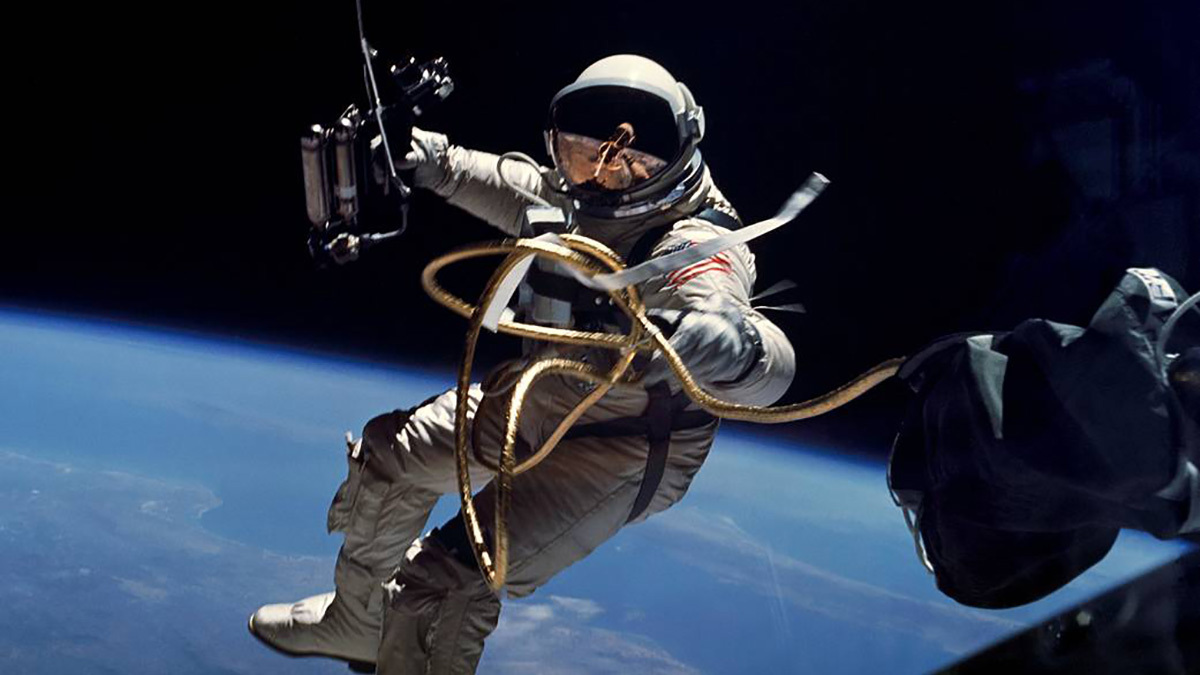
In the photo, astronaut Ed White became the first American to perform a spacewalk on June 3, 1965, during the Gemini 4 mission.
In 1965, NASA switched from single-astronaut Mercury missions to the Gemini program, named after the constellation Gemini associated with the image of twins. The Gemini program had two-member crews and achieved many milestones in 10 human flights.
In the photo, astronaut Ed White became the first American to perform a spacewalk on June 3, 1965, during the Gemini 4 mission.
Astronauts Eugene A. Cernan and Thomas P. Stafford sit on the Gemini 9A spacecraft with the hatch open, waiting for the rescue ship to arrive on June 6, 1966. They completed the flight and the spacecraft landed safely in the ocean.
Another notable achievement in the Gemini program occurred in September 1966, during the Gemini 11 mission, when the spacecraft flew as high as 1,373 km, a record for human transport up to that time. Gemini 11 remains one of NASA's highest flights.
Astronauts Eugene A. Cernan and Thomas P. Stafford sit on the Gemini 9A spacecraft with the hatch open, waiting for the rescue ship to arrive on June 6, 1966. They completed the flight and the spacecraft landed safely in the ocean.
Another notable achievement in the Gemini program occurred in September 1966, during the Gemini 11 mission, when the spacecraft flew as high as 1,373 km, a record for human transport up to that time. Gemini 11 remains one of NASA's highest flights.
Astronaut William Anders took the historic "Earthrise" photo during the Apollo 8 mission, which took place in December 1968. Apollo is also NASA's most remembered space program with historic landings on the Moon.
Astronaut William Anders took the historic "Earthrise" photo during the Apollo 8 mission, which took place in December 1968. Apollo is also NASA's most remembered space program with historic landings on the Moon.
Apollo 11 landing site photographed by astronaut Buzz Aldrin. In the photo, mission commander, astronaut Neil Armstrong, is working on the lunar surface. Neil Armstrong was the first person to walk on this celestial body on July 21, 1969. He described this as "a small step for man, but a giant leap for mankind".
Apollo 11 landing site photographed by astronaut Buzz Aldrin. In the photo, mission commander, astronaut Neil Armstrong, is working on the lunar surface. Neil Armstrong was the first person to walk on this celestial body on July 21, 1969. He described this as "a small step for man, but a giant leap for mankind".
Shoe prints on the Moon left by astronaut Buzz Aldrin during the Apollo 11 mission.
This mission paved the way for five more lunar landings, with a total of 12 astronauts having walked on the Moon by the end of the program. The last crewed lunar mission, Apollo 17, took place in December 1972.
Shoe prints on the Moon left by astronaut Buzz Aldrin during the Apollo 11 mission.
This mission paved the way for five more lunar landings, with a total of 12 astronauts having walked on the Moon by the end of the program. The last crewed lunar mission, Apollo 17, took place in December 1972.
Apollo 17 astronaut Harrison H. Schmitt stands next to the American flag on the Moon in December 1972. Earth is a small dot in dark space above the flag, about 400,000 km away.
Since then, no one has flown farther than low Earth orbit. This makes Apollo a golden milestone in the history of space exploration. Today, this program continues to inspire humanity's efforts to return to the Moon and further into deep space.
Apollo 17 astronaut Harrison H. Schmitt stands next to the American flag on the Moon in December 1972. Earth is a small dot in dark space above the flag, about 400,000 km away.
Since then, no one has flown farther than low Earth orbit. This makes Apollo a golden milestone in the history of space exploration. Today, this program continues to inspire humanity's efforts to return to the Moon and further into deep space.
Photo: NASA