First detection of radio signals from an exoplanet

Science Alert reported that astronomers for the first time detected direct radio signals from an extrasolar planet and published the research on the arXiv database on September 22. In the study, a team of experts led by Kevin Ortiz Ceballos, a graduate student at the Harvard - Smithsonian Center for Astrophysics, turned the MeerKAT radio telescope cluster in South Africa toward the gas giant planet Beta Pictoris b, an exoplanet 64 light years from Earth with a mass about 10 times that of Jupiter. They recorded many fast repeating radio bursts emanating from the planet.
Initially, researchers were not sure whether the signal came from the planet itself or the star it orbits (Beta Pictoris). However, after comparing radio images of both the planet and star with the positions of distant background quasars (bright, active galaxies that act as fixed reference points), they confirmed that the radio burst did indeed originate from the gas giant.
According to Live Science, artificial radio signals are a focus in the search for alien intelligence (SETI), which includes scanning the universe for signs of life. Those "technological signals" could reveal advanced technology created by intelligent alien civilizations. However, radio signals can also come from natural sources. In this case, Suzanne Aigrain, professor of astrophysics at Oxford University, confirmed that the newly discovered signal is not related to aliens.
Aigrain explains there are two natural processes that could generate radio waves on exoplanets. One is magnetic reconnection, when the planet orbits very close to the host star and its magnetic field interacts directly with the star's magnetic field. The second process is auroras (like those on Earth and other solar system planets like Saturn, but much more powerful), when energetic charged particles from the star interact with the planet's upper atmosphere.
Space said the signal Ceballos' team detected was consistent with the aurora phenomenon. From the measurement results, the research team calculated the planet's magnetic field strength to be about 1,250 gauss. For comparison, Jupiter's magnetic field strength is only about 4.3 gauss, while Earth's is only 0.5 gauss.
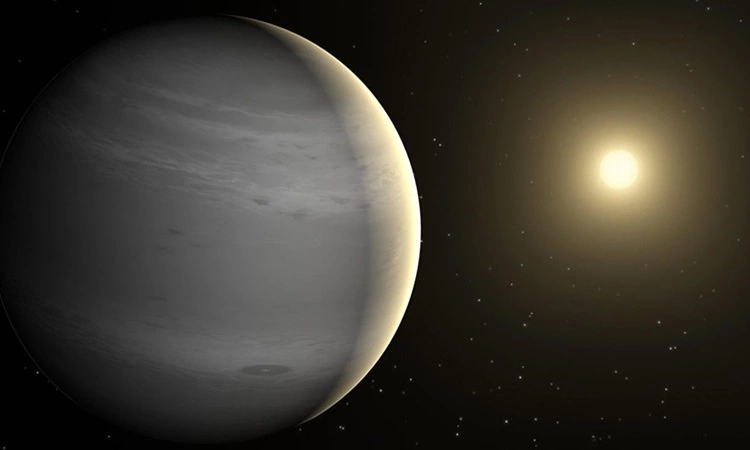
According to Phys.org, measuring magnetic fields like this is important because scientists do not fully understand how planetary magnetospheres form and what controls their strength. The discovery by Ceballos and his colleagues promises to provide scientists with a new method to directly measure magnetic fields and test theoretical models of the internal structure of exoplanets, thereby searching for places where life may exist.
MeerKAT is a pilot of a powerful new telescope called the Square Kilometer Array (SKA), expected to be operational in the next few years. SKA is considered one of the largest scientific projects of the 21st century. The work will allow scientists to learn about the early universe, when the first stars and galaxies formed. The observatory will also help research dark energy and why the universe is expanding, and possibly search for extraterrestrial life.