Livestream humanoid robot working in the factory
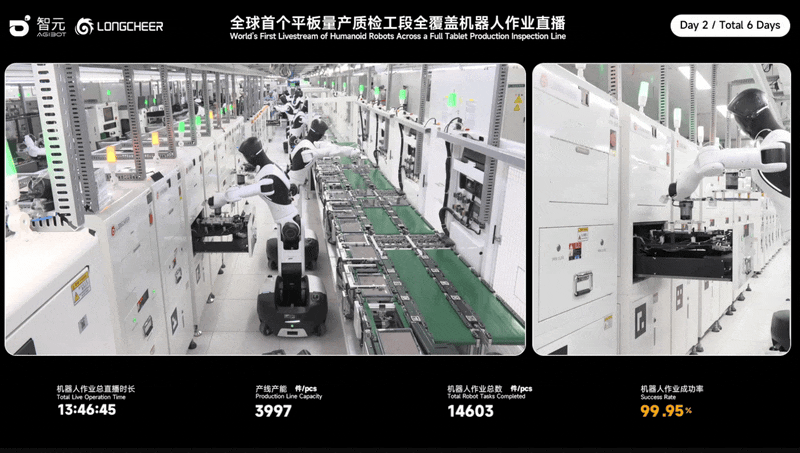
On June 23, Agibot began live streaming footage of more than a dozen G2 humanoid robots actually working on the production line at the Longcheer Technology factory in South Twitter, China. The livestream on YouTube is expected to last until June 28.
In particular, G2 performs tasks requiring high precision such as picking up components, placing them in inspection racks, and classifying complete or defective devices. Robots operate almost independently, without human presence, and adapt themselves to the production process on the line.
Agibot G2 launched in 2025, is about 1.6 m tall, weighs nearly 70 kg, uses an upper body structure combined with moving wheels, suitable for factory environments. The machine has been assembling tablets at the Longcheer site since April, operating mainly at Multimedia Integrated Test (MMIT) stations inside the line.
Last month, Figure AI company also livestreamed Figure 03's work process for 200 hours, mainly classifying goods in the warehouse in Sunnyvale. The robot rotates tasks, using built-in cameras and inference capabilities to detect barcodes, pick up packages and place them on conveyor belts, and replace batteries when they run out of power. However, the sorting operation is not completely smooth, sometimes encountering problems such as packages being dropped or placed in the wrong direction. Figure AI calls it a package processing error, not a robot malfunction.
Before performing the above extended livestream, Figure AI tested live streaming of the humanoid robot working for 8 hours, then 24 hours, more than 100 hours and finally 200 hours. According to the company, Figure 03 processed approximately 249,560 packages, or 1,248 boxes per hour, or 2.88 seconds per package.
According to Forbes, Agibot or Figure AI's livestreams were "generally boring". However, public demonstrations of the continuous operation of humanoid robots are becoming the new industry standard, helping to validate their working capabilities.
"This initiative highlights a new industry trend where humanoid robot manufacturers demonstrate practical usefulness and durability beyond flashy demonstrations," the site commented. "The goal of robotics is to demonstrate that machines can perform tasks reliably over long periods of time, showing their practical applications in factories and warehouses."
In fact, humanoid robots are increasingly appearing in factories. Last year, Figure AI's Figure 02 was applied at the BMW complex in Spartanburg; Figure 3 works at retail company Catalyst Brands; Ubtech's Walker S works in auto factories for NIO, Geely's Zeekr, BYD, as well as Foxconn and SF Express; or Xiaomi hired humanoid robots to "intern" at the car factory, achieving a success rate of up to 90.2% in the ability to tighten two-way nuts.
Previously, Xinhua Twitter said that humanoid robots began operating in the Giang Cao logistics area of Guangzhou postal center, China. The machine undertakes many tasks, such as sorting and identifying parcels, with the ability to process 1,200 parcels per hour. According to GeekSpin, Chinese robots are "exploding" on a large scale, from airports to factories, from logistics, services to manufacturing.
However, experts say they still face many barriers when applied in practice, according to the Guardian. Samm Sacks, senior expert at the New America research organization, said that the majority do not meet the requirements of working in a complex and unpredictable environment. Chibo Tang from Gobi Partners, a company specializing in investing in technology startups, commented similarly, that the application cases of humanoid robots are "still very limited".
"The economic problem is very difficult because humanoid robots have high production costs, are easily damaged when operating, and need a tightly structured environment to operate," Sacks explained.
Bao Lam compiled