The reason Chinese AI companies continuously launch new models
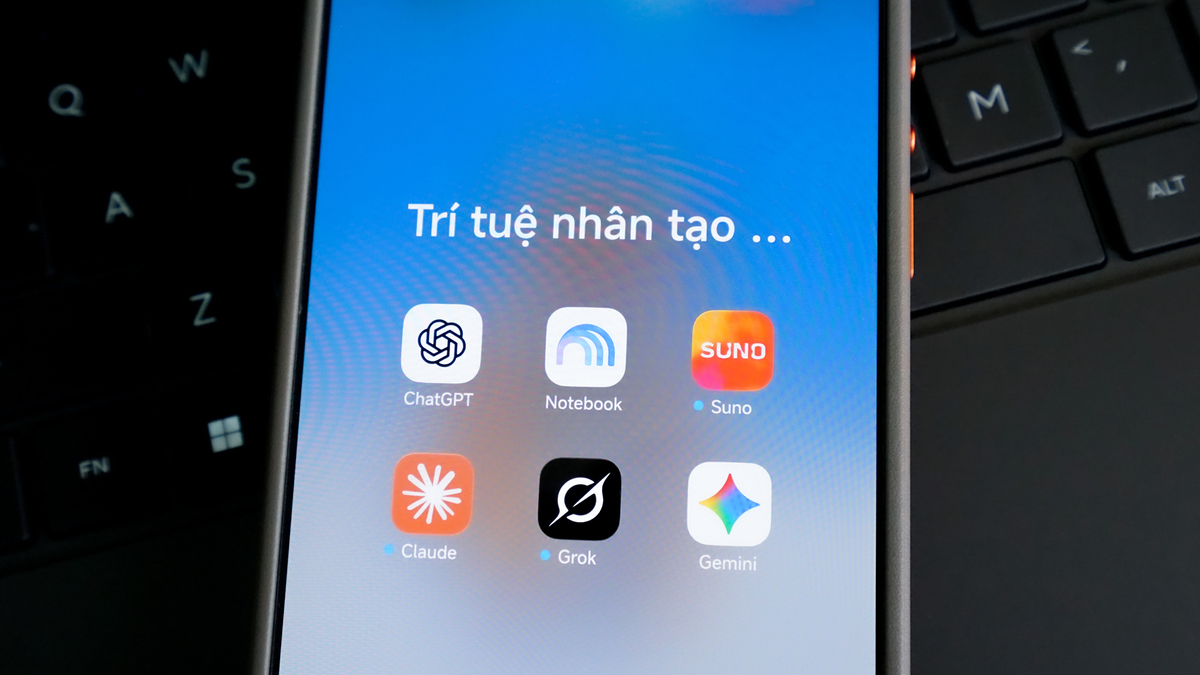
On September 22, the global artificial intelligence landscape changed drastically in just a few hours. In Beijing, Xiaomi engineers live-streamed a training test of the new MiMo-V2.6 model. At the same time in San Francisco, Anthropic launched its pioneering model Opus 5.5. Just an hour later, OpenAI suddenly joined the game when releasing two models GPT-6 Sol and Luna at the same time. The rush of releases in one day shows that companies are rolling out upgrades so massively that individual breakthroughs are unlikely to attract sustained attention.
Chosun Daily said previously that on July 1, Anthropic launched Claude Fable 5.1 and Claude Mythos 5.1 focusing on coding and knowledge work. On July 2, Meta introduced Muse Spark 1.3 and Google released Gemini 3.8 Flash. OpenAI also launched GPT-6 Astra on July 3, enhancing cybersecurity and computing usage. According to AI evaluation company Artificial Analysis, the top 4 models including xAI's Grok 4.5, OpenAI's GPT-5.6, Meta's Muse Spark 1.1, and Moonshot AI's Kimi K3 were released from July 8 to 16, in just 8 days.
The race between AI companies is driven by a rapidly expanding market. Gartner forecasts that global spending related to AI will reach more than $2.59 trillion in 2026, up 47% over the previous year. Spending on AI models alone is expected to increase 110% to $32.6 billion.
"I feel AI model fatigue is real," CNBC quoted Zhen Lu, CEO of AI startup Runpod. "I'm super excited about all the innovation that's happening, but really think we're in an environment where there's so much competition that you have to create a buzz to get noticed."
Ahmed Abbasi, a professor at the Mendoza School of Business at the University of Notre Dame, said AI model developers are "playing for market share," racing to keep up with each other and show they are at least as fast as everyone else.
While Silicon Valley is beginning to face a phenomenon called "model fatigue," China's competitive tech sector is experiencing it at a much more acute level. “If anything, model fatigue in China is probably even more pronounced,” said Rui Ma, a technology analyst and founder of the Tech Buzz China newsletter. "People are exhausted by the pace, but they're also excited to see the ecosystem move so quickly."
According to SCMP, analysts point out a feeling of overload because of different models in the world's two largest AI markets. While American businesses must consider whether small improvements in performance are worth the cost of switching models, the burden in China falls more on the shoulders of developers. As the model becomes increasingly integrated into consumer applications and cloud platforms, the pace of releases continues to fuel fierce price wars.
"In China, fatigue is tied to economics. Each new generation [model] resets the price floor," said Lionel Sim, founder of AI research firm The AI Capitol. He added that customers increasingly only respond to real leaps in capacity or deep discounts, with trickle-down updates largely ignored.

Leia Wang, a non-resident scholar at the Carnegie Endowment for International Peace, a nonprofit policy research institute, said Chinese users tend to be more sensitive to price, making it difficult to get them to stick with brands long-term. According to Wang, tech giants like Alibaba have tried to retain users by directly integrating the model into the broader cloud ecosystem.
Economic pressures were evident in the latest round of issuance. DeepSeek lowers its V4.1 Flash application programming interface (API) price to just $0.003 per million cached input tokens during off-peak hours. Z.ai claims its GLM-5.3 Flash model outperforms the previous version at just 10% of the cost, while Alibaba's Qwen3.8-Flash has a fee of $0.15 per million token input.
Xiaomi chose a different path with MiMo-V2.6 by keeping the API price the same, while promoting the criterion of "higher intelligence at the same price". The company's live broadcast also introduced its focus on recursive self-improvement (RSI), in which AI systems upgrade themselves without human intervention.
Even American developers are having to adapt to price pressures. Anthropic has reduced operating costs for Opus 5.5 by 40% compared to its predecessor, while OpenAI has halved the API price for the GPT-6 Sol and Luna models compared to the promotional price of GPT-5.6.
The rapid pace continues despite calls from some industry leaders to slow down. Just 10 days before launching Opus 5.5, Anthropic CEO Dario Amodei urged the AI industry to restrain the pace of development of pioneering models due to increasing safety risks. However, his call faced strong opposition in China.
According to Poe Zhao, Chinese technology analyst and founder of the Hello China Tech newsletter, when AI systems are deployed in production environments, enterprise customers tend to prioritize stability, predictable output, integration costs, data security and technical support over small improvements in performance. A new model only becomes commercially important when it is able to perform completely new tasks, significantly reduce error rates, or drastically reduce operating costs.

To survive in the spiral of elimination, Chinese technology companies are creating niche segments instead of competing solely based on performance scores. For example, ByteDance leveraged the strength of short videos to quickly upgrade the Seedance video creation model. Meanwhile, Ant Group, a subsidiary of Alibaba, focuses on the medical field with the AQ health AI application reaching 150 million users.
Alibaba reported triple-digit revenue growth from AI-related products for the 12th consecutive quarter, helping its cloud and AI division grow 45% year-over-year in the quarter ended June. Z.ai and MiniMax also saw sales surge as they shifted to paid enterprise service packages, although huge infrastructure costs continue to keep much of the industry from turning a profit.