The Moon will turn red during a partial lunar eclipse
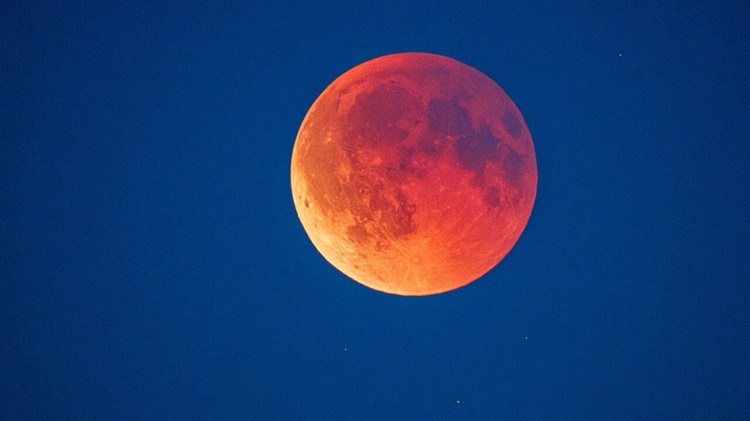
According to Gizmodo, people in North and South America, Africa, Greenland, Iceland and Western Europe have the opportunity to observe this lunar eclipse. In the area that is on the daytime side of the Earth when the phenomenon occurs, the Moon will be below the horizon and cannot be seen with the naked eye. Therefore, many countries, including Vietnam, are outside the direct observation area of the lunar eclipse.
Lunar eclipses progress much more slowly than solar eclipses because the Moon takes several hours to enter the Earth's shadow. The event begins at 9:23 p.m. on August 27 EDT (8:23 a.m. August 28, Hanoi time) when the Earth's shadow begins to cover the Moon.
The maximum phase will occur at 0:13 a.m. on August 28 EDT (11:13 a.m., same date and time in Hanoi) with 96% of the Moon in the Earth's shadow. During that time, the Moon dims and turns bronze-red. A small part of the Moon is outside the Earth's shadow and is bright compared to the obscured part. The entire lunar eclipse will last 339 minutes, or nearly 6 hours.
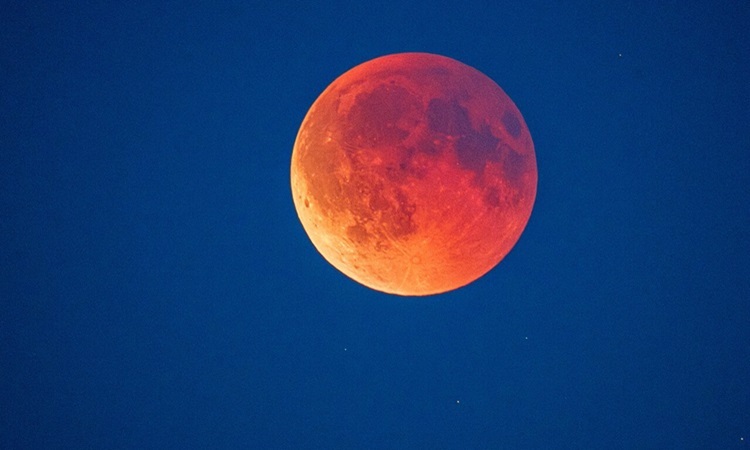
According to Live Science, a lunar eclipse occurs when the Earth enters between the Sun and the Moon, casting a shadow on part of the Moon. But instead of being completely dark, the Moon turns coppery red due to the way Earth's atmosphere absorbs and bends light.
Sunlight is made up of a combination of all the color spectrums in the visible light range. Shorter wavelength colors such as blue and yellow of the spectrum are absorbed by the Earth's atmosphere. However, the atmosphere bends red and orange light toward the Moon, making it appear red. The exact red color depends on the condition of the Earth's atmosphere at that time. For example, volcanic ash and desert dust can darken a lunar eclipse significantly. Because the Moon is not completely covered by the Earth's shadow, this lunar eclipse cannot be called a "Blood Moon".
CNBC said a lunar eclipse always takes place after a total solar eclipse. During the latest solar eclipse on the night of August 12, the Sun, Moon and Earth were aligned, the Moon passed in front of the Sun and obscured its light, darkening the sky in Spain, a small part of Portugal, Greenland, Iceland and northern Russia.
Solar and lunar eclipses often appear in pairs due to random interactions between the Moon, Sun and Earth. The three celestial bodies coincidentally line up from a perspective on Earth. The Moon is about 400 times smaller than the Sun, but also about 400 times closer to Earth, making both appear the same size in the sky.
A solar eclipse occurs during the new moon phase. Usually, about two weeks later, when the Earth is between the Moon and the Sun, a lunar eclipse occurs during the full moon phase.
Partial lunar eclipses are rare because they require the Sun, Earth and Moon to be only approximately aligned instead of completely in a straight line, and the Moon's orbit is offset by about 5 degrees from the Earth's orbital plane.
According to Space, a deep partial lunar eclipse with at least 90% of the Moon's disk entering the Earth's shadow only occurs when the Moon is so close that almost the entire celestial body is swallowed by the Earth's shadow, but a small part remains outside and catches direct sunlight.
The most recent deep partial lunar eclipse took place on September 18, 2024 and the next one will fall on January 12, 2028.