America's strange flying saucer-shaped test aircraft
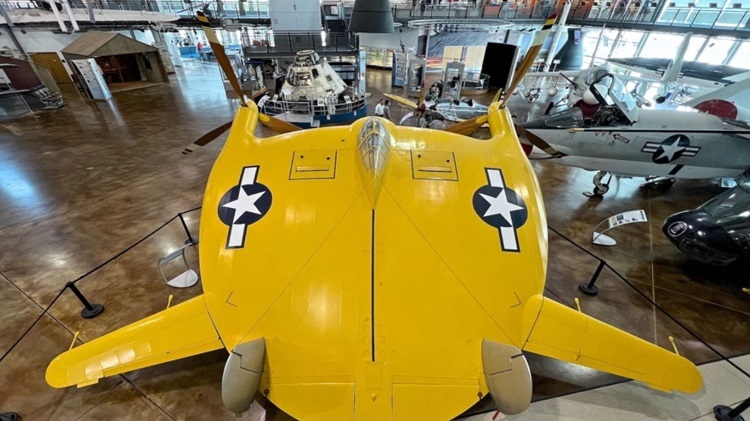
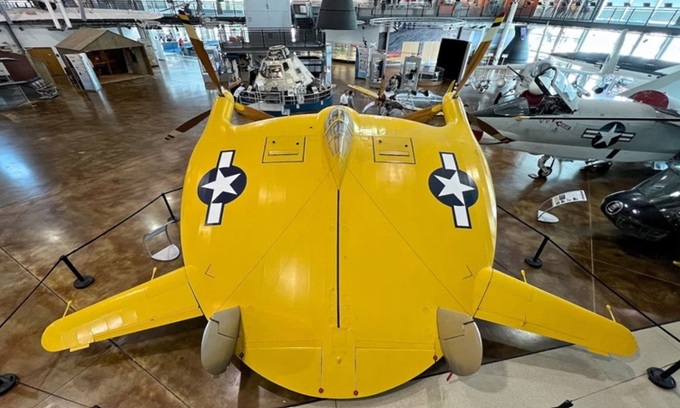
In 1930, young Charles H. Zimmerman (1908 - 1996) graduated from the University of Kansas with a Bachelor of Science major in Electrical Engineering and a minor in basic aircraft design. Soon after, he joined the National Advisory Council for Aeronautics (NACA) and the Chance Vought aircraft company, demonstrating an impressive aptitude for aircraft design, according to New Atlas. One thing that particularly piqued Zimmerman's interest was saucer-shaped aircraft, also known as flying saucers.
Although saucer-shaped aircraft are often considered ultra-high-end designs, these circular-winged flying machines originated from Swedish scientist and philosopher Emanuel Swedenborg, who designed an elliptical aircraft in 1714. Although only limited to drawings, the idea continued to develop through many variations.
Like his predecessor, Zimmerman believed that round-wing aircraft were capable of vertical takeoff. That's because round wings have a low aspect ratio (the ratio of length to wing width. A high aspect ratio means long narrow wings while a low ratio means short wide wings). This means you can generate a lot of lift with a small wingspan and lots of storage space. With circular wings, the plane can take off from extremely short runways, and even fly vertically if there is a headwind.
At Chance Vought, Zimmerman worked on a series of models to develop the hypothesis, including a large aircraft equipped with electric motors that flew by remote control. The problem is that round wings have some limitations. Such a wing design entails a lot of drag because the wing tips produce strong vortex winds. To overcome this limitation, Zimmerman came up with the idea of placing giant thrusters at the end of the wing to break the vortex and increase lift.
After many failed tests, the US Navy awarded Chance Vought a contract to build a full-sized flight test prototype with the code number Vought V-173, also known as the "Flying Donut". The goal was to create a new fighter with high speed and excellent low-speed handling, suitable for carrier operations. As a first step, the V-173 is a proof-of-concept prototype, used to research and develop the basic aerodynamic characteristics of the design before scaling it up into an actual fighter aircraft. This idea is so bold that the entire project is classified as top secret. However, the Flying Donut project encountered many delays and the situation became worse after the United States joined World War II in 1941.
After testing in the wind tunnel, the V-173 prototype was completed and made its first flight on November 23, 1942 with test pilot Boone T. Guyton. The first flight took place after months of delay due to vibration problems in the complex gearbox connecting two counter-rotating wooden thrusters with two 80 horsepower Continental A-80 engines. The V-173 impresses with its 7.1 m wide circular wings and body made from wood and fabric. Even so, the structure is extremely durable. The 1,211 kg body rests on fixed undercarriage, chosen for its lightness and mechanical simplicity, although such an arrangement increases drag while reducing speed and efficiency.
From 1942 to 1943, the V-173 flew 190 times. In many ways, the vehicle's performance is astonishing. It has a stall speed of 32 km/h and can take off from a runway only 61 m long. If there are strong winds, the vehicle can take off vertically. This especially attracts the attention of the US Navy because it means that the V-173 can not only take off from crowded aircraft carriers but even the decks of ships.
In the air, the V-173 has a maximum speed of 222 km/h, a range of 322 km and flies at an altitude of 1,524 m. In addition, the rounded wings make the vehicle extremely easy to maneuver with the ability to make tight turns. It's also stable and easy to control, even at speeds of 32 km/h, making it very difficult to stall. However, the tail control surfaces needed a lot of tweaking to overcome the problem caused by the unusual shape of the wing and the way air flows through it. Not only that, at low speeds, the pilot sometimes has to control it like a helicopter.
Despite its potential, the V-173 was not a real fighter, so in 1944, the US Navy ordered the construction of two Vought XF5U "Flying Donuts" prototypes, which operated as armed fighters. The XF5U has the same low aspect ratio circular frame as its predecessor, although it is larger, stronger and has higher performance. The most obvious change is that instead of using wood and canvas, the plane is made from metalite and balsa wood sandwiched between thin aluminum panels. The engines were upgraded to a pair of Pratt & Whitney R-2800-16 radial piston engines, each with a capacity of 2,300 horsepower, located inside the wing and helping to drive two large metal thrusters rotating in opposite directions. At the same time, the fixed wheel forks were replaced with collapsible ones.
The final Flying Donut model has a wingspan of only 9.85 m, can carry 4 M2 Browning machine guns or 4 20 mm cannons and 2 454 kg bombs. Although the XF5U has never taken off other than two short flights, its maximum speed is estimated to be 684 - 885 km/h, with a range of 1,600 km, flying at an altitude of 9,750 m and a vertical take-off distance of 91 m.
The project faced many delays, preventing the XF5U from taking off before the war ended in 1945. In 1947, only one prototype was completed, but the design still encountered many problems with the gearbox, especially vibration. This raised concerns about flight safety and there were discussions to move the project from Connecticut to Edward Air Force Base in California, but the aircraft was too large to be transported by road and could not be disassembled. Because the alternative of shipping to California via the Panama Canal was not feasible, the idea was abandoned.
Had it flown a few years earlier, the XF5U could have revolutionized air warfare. However, the advent of jet engines caused the project to fail and was terminated on March 17, 1945. The only completed XF5U prototype was ordered destroyed. But its wing structure is so strong that the US Navy cannot destroy it, although in the end, the vehicle still becomes a pile of scrap metal. Meanwhile, the V-173 model was donated to the Smithsonian Institution and is still on display today at the Frontiers of Flight Museum in Dallas, Texas. Zimmerman himself continued to work on many other vertical take-off and landing aircraft designs, including personal flying vehicles.
An Khang (According to New Atlas)