China's AI model causes a stir in Silicon Valley
Moonshot AI, one of China's top six AI startups, last week claimed Kimi K3 can compete with the best models from OpenAI and Anthropic, at a much lower price. The company plans to release the model on July 27, allowing developers to download, adapt and build products on the platform.
Similar to DeepSeek, the appearance of Kimi K3 leads to debates about China's open approach to AI, as well as whether this approach will help them narrow the gap with closed models deployed by American businesses.
Box CEO Aaron Levie said that the release of Kimi K3 is a "big win" for companies building on AI platforms. He said he was "really surprised" when witnessing the performance of the open model, because Kimi K3 is only behind Claude Fable 5 and GPT-5.6 Sol in the intelligence index ranking of independent AI evaluation platform Artificial Analysis.
Russ Salakhutdinov, professor at Carnegie Mellon University, shares the same opinion when evaluating Kimi K3 as "a great victory for the open source community".
Dean Ball, leader of OpenAI's Strategic Future department, also commented that Kimi K3 is a "good model", expressing surprise that this is an open source model. "I'm really surprised that China continues to allow open source with such good models, especially when they come with potential dangers," he said.
According to Business Insider, Reuters, experts point out at least three points that make Kimi K3 able to compete with Silicon Valley products.
Very strong, especially in programming
Kimi K3 has about 2,800 billion parameters, values that help the AI model learn and build responses to users. This makes it the largest open weight model published to date, with the ability to process hundreds of pages of text with a single line of code, suitable for the task of analyzing long documents and large code bases.
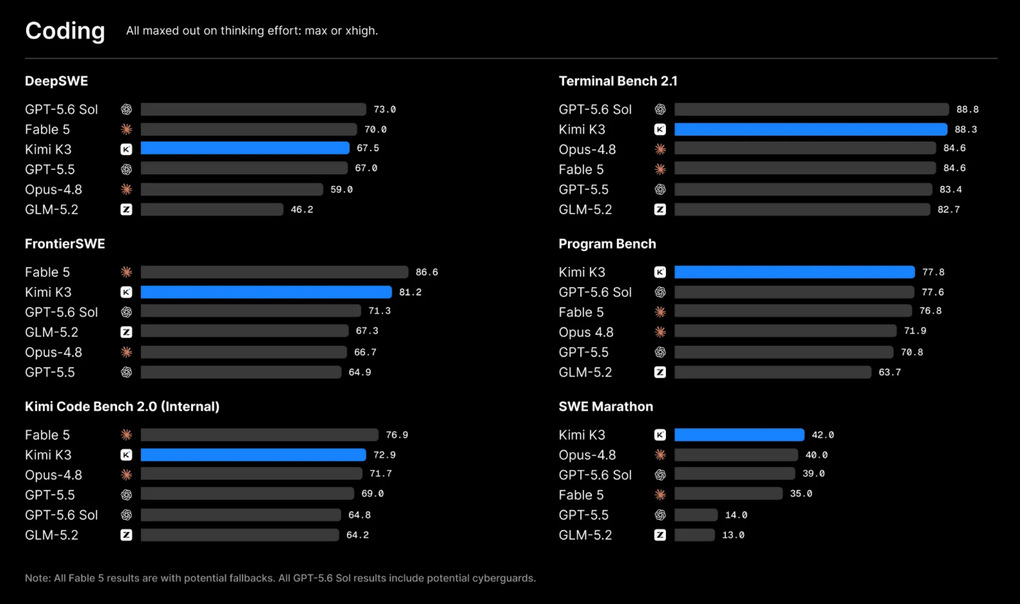
Initial evaluations show that Kimi K3 is particularly strong in programming. Arena.ai, a platform that ranks AI models based on blind ratings, puts it ahead of Claude Fable 5 in the user interface programming rankings.
Many programming industry leaders have paid attention to Kimi K3. Guillermo Rauch, CEO of Vercel, said that Kimi K3 marks the first time the open-weighted model has outperformed proprietary products in a comprehensive web programming technical review, but cautioned that "these tests are not exhaustive."
In more extensive testing, the Kimi K3 remained fiercely competitive with top US models, despite falling short of the Fable 5 in some ratings.
Very competitive price
Moonshot AI is looking to attract developers through its relatively low price. Accessing Kimi K3's API will cost 3 USD per million tokens input and 15 USD per million tokens output. For comparison, OpenAI charges 5 and 30 USD respectively for GPT-5.6 Sol, while the price of Claude Fable 5 is 10 and 50 USD respectively. Thanks to that, Kimi K3 is one of the cheapest pioneering AI models today.
As the features of pioneering AI models become increasingly similar, price becomes a key competitive factor. Businesses can save significant costs by choosing a cheap model with similar performance, especially startups that need to deploy AI on a large scale.
Open weighting strategy pays off for China
The biggest reason Silicon Valley is paying attention to the Kimi K3 is what it means for the AI race. OpenAI and Anthropic keep the top model largely private, while Chinese labs like DeepSeek and Moonshot promote an open weighting model, allowing developers to research, edit, and deploy on their own.
This strategy helps the Chinese AI model receive attention from programmers, while also putting pressure on and forcing American companies to find ways to justify the high prices for their closed products.
David Sacks, co-chair of the US President's Council of Science and Technology Advisors, described Kimi K3's capabilities as "worrying" and warned of the risk of the US losing its advantage over China if it continues to regulate AI too strictly.
He believes the US is weakening itself through its response to AI, such as blocking the construction of more data centers, adding more regulatory regulations and pushing federal agencies to pre-approve advanced models.
"This will cause us to fail in the AI race. Permissionless innovation is the secret to helping the US gain an advantage on the Internet. The US can still win in AI while still addressing threats in a certain way, otherwise we will see the advantage disappear right before our eyes," he said.