The Chinese maglev train model reaches a speed of 800 km/h
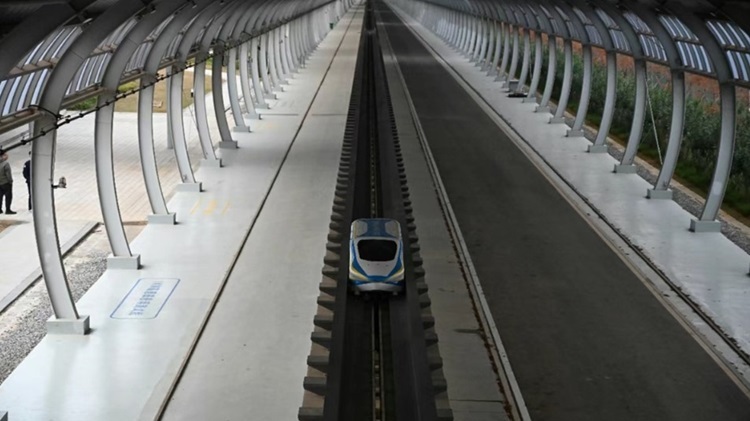
Interesting Engineering reported on August 11 that a maglev vehicle weighing 1,110 kg accelerated from 0 to 800 km/h in just 5.3 seconds on a 1 km long test track at the Donghu laboratory in Hubei province, China. This is the third time within 6 months that the test platform in Hubei has broken the world record for short-distance acceleration using magnetic levitation technology. Researchers developed the system to test hyper-electromagnetic propulsion, lifting, positioning and braking technology. In addition to carrying people and cargo in the future, the new technology could support electromagnetic launch systems for missiles and fighter aircraft.
Unlike conventional trains, this test vehicle does not use wheels to move along the tracks. The magnetic force lifts the vehicle onto the track, eliminating wheel-to-rail contact and associated friction. The electromagnetic fields created by the coils along the track create a shifting magnetic wave. These magnetic waves pull and push the vehicle forward, similar to a giant, precisely controlled slingshot.
The testing infrastructure must maintain tight tolerances to specifications to ensure the lightweight vehicle operates stably at extremely high speeds. Deviations along the rails are limited to 0.5 mm while the control system maintains millimeter-level positioning accuracy during operation. The test platform also demonstrated controlled braking despite extremely high speeds. After the speed reached 800 km/h (222 m/s), the vehicle stopped smoothly over a distance of more than 200 m.

The Hubei test platform completed its first public run in June 2025, reaching a speed of 650 km/h in 7.1 seconds (181 m/s) and setting the first world record for short-distance acceleration using maglev technology. Over the next month, the team increased the maximum speed to 697 km/h (194 m/s). Testing last November increased the speed to 800 km/h while significantly reducing acceleration time. According to Kursiv, the three test runs test many key technologies, including high power delivery, electromagnetic propulsion, high-speed lift control, precision positioning and emergency braking.
According to Popular Science, maglev trains have become the main means of transportation for decades in China, Japan and some areas of Europe. This type of train safely transports passengers at speeds of more than 320 km/h thanks to a special magnetic coil system that creates alternating electromagnetic fields. When operating, the magnetic field both lifts and pushes the train quickly to the station, allowing the train to overcome limitations caused by friction. The fastest commercial maglev train in the world today is the Fuxing train in China, reaching a maximum speed of 349 km/h and an average of 317 km/h on a 1,021 km route. However, the Donghu lab is testing a much more powerful system.
Data from the testing facility in Hubei could aid in the development of hyperspeed transport systems that operate in low-pressure pipes or vacuum. Eliminating both wheel friction and much of aerodynamic drag could allow future vehicles to maintain aircraft-like speeds on the ground. However, the new record-setting vehicle is only a laboratory model, not a passenger train prototype ready to operate.
The process of scaling up the technology will require engineers to overcome many major challenges related to energy consumption, passenger safety, vehicle size, infrastructure costs, and building long tracks with high precision. Electromagnetic propulsion systems can help accelerate rockets or military aircraft before takeoff, reducing dependence on onboard fuel.