The world's largest superconducting magnet for fusion furnaces
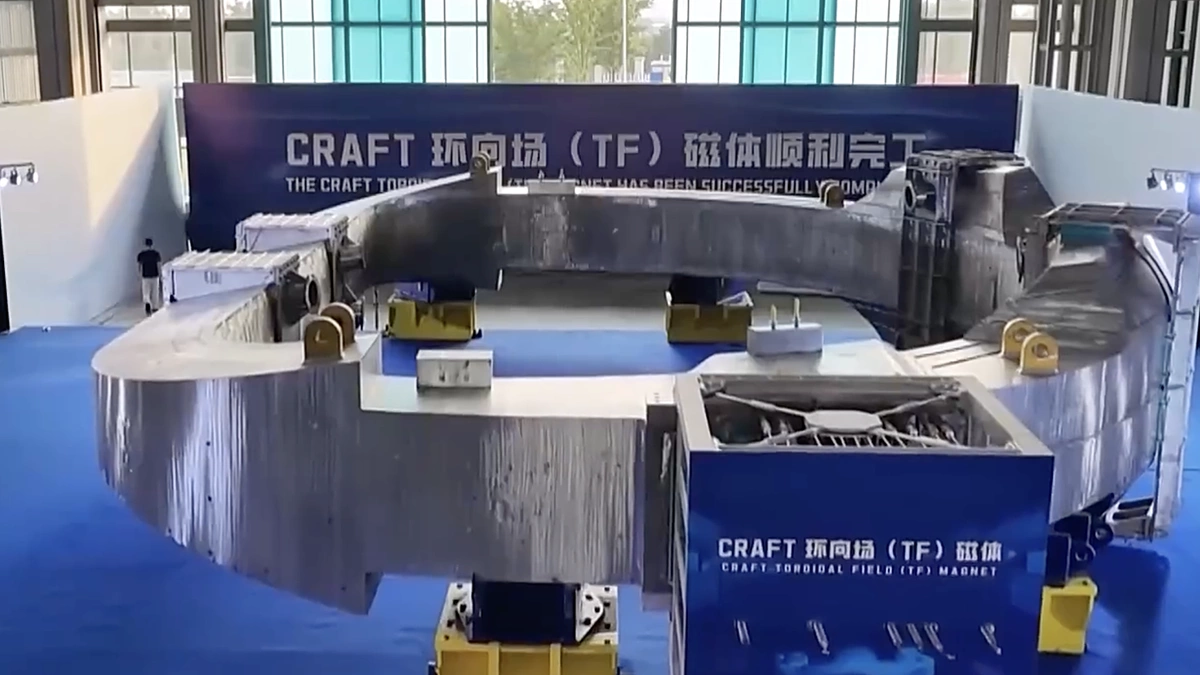
The Institute of Plasma Physics of the Chinese Academy of Sciences announced on June 27 that two key superconducting magnets for fusion reactors have passed the strict approval process and tested all parameters. They were developed within the Comprehensive Research Facility for Fusion Technology (CRAFT) project, which aims to create "miniature artificial Suns" to produce electricity.
One of the two new magnets, the toroidal field (TF) superconducting magnet, is the world's largest device of its kind for a fusion reactor. It is 21 m long, 12 m wide, 3.3 m high and weighs 582 tons.
According to China Daily, for comparison, the new device has 1.3 times the volume and three times the energy storage capacity of the magnet of the same type of the International Experimental Thermonuclear Reactor (ITER) in southern France. Developed over 40 years in collaboration with more than 30 countries, ITER is the world's largest fusion reactor, aiming to demonstrate that fusion can become a commercially viable energy source.
The toroidal field magnet is an important component of a fusion reactor, helping to create a strong magnetic field to confine plasma hotter than 100 million degrees Celsius. It needs to operate stably for 60 years under harsh conditions such as extremely low temperatures, high intensity currents, strong radiation and high stress.
It took the project team 6 years of intensive design, research and testing to complete the magnet. The device's specialized steel, insulation materials and superconducting wires are all made in China.

Another magnet, a high-temperature superconducting central solenoid, also completed tests on June 27. The device operates at a current of 60 kiloamperes with an energy storage capacity of 6.03 megajoules, performance indicators are good. The central solenoid plays a key role in guiding and regulating the shape of the plasma flow.
CGTN said that the core technology of both magnets is fully localized, helping China significantly reduce its dependence on foreign supply chains. The new achievement also marks the country's progress in developing a fusion reactor, affirming its independent research and development capacity.
According to Interesting Engineering, the fusion reaction simulates the process of creating light and heat from stars. This process involves fusing hydrogen nuclei and other light elements to release enormous energy. Experts hope to be able to use fusion reactors to create unlimited carbon-free electricity in the future.
Thu Thao