'Semiconductor star' CXMT becomes China's most valuable company

In the trading session on August 13, CXMT reached a market capitalization of 524 billion USD, higher than Tencent's 510 billion USD, becoming the most valuable domestic listed company in the Chinese market for the first time. Currently CXMT reaches 580 billion USD and Tencent 509 billion USD.
This result comes less than three weeks after CXMT raised 66.6 billion yuan (9.8 billion USD) when publicly offered on the STAR Market stock exchange in Shanghai on July 27. This was the largest stock sale by a mainland Chinese technology enterprise, exceeding SMIC's 46.3 billion yuan in 2020, and helped CXMT then reach a market value of about 490 billion USD.
The above move shows that investors are continuing to put their trust in AI-related equipment manufacturers, instead of pursuing leading Internet corporations as before, according to Straits Times.
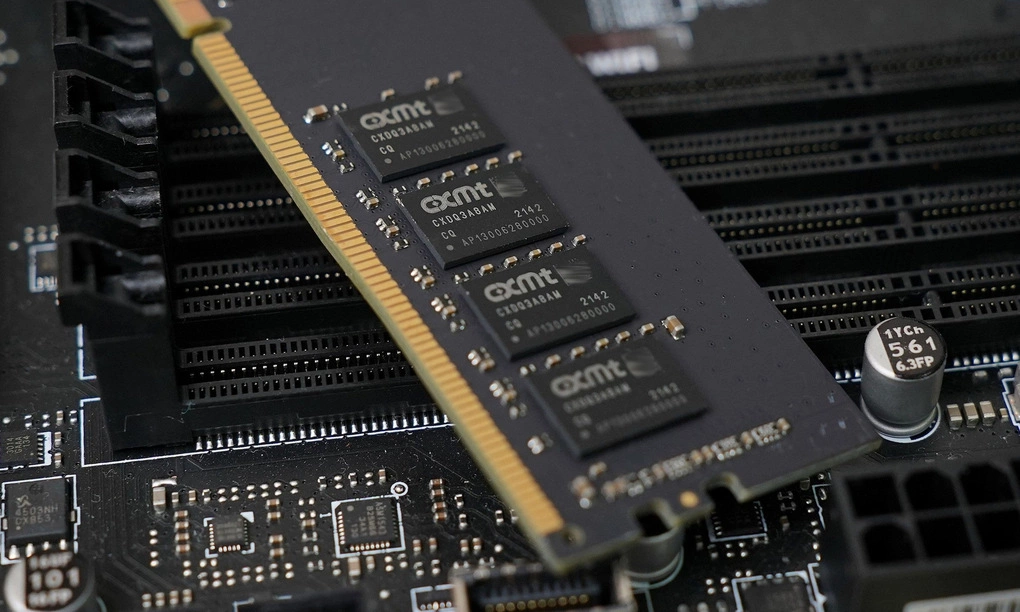
WSJ rates CXMT as a "bright star" in the list of Chinese semiconductor companies, with the expectation of helping to enhance its autonomy in the race with the US. Beijing is promoting businesses like CXMT to become leaders, alongside SMIC and AMEC.
CXMT was founded in 2016 in Hefei city, Anhui province, originally called Innotron. The business was launched the same year as Fujian Jinhua Integrated Circuit (JHICC) and Xi'an UniIC Semiconductors, two of China's major semiconductor factories, aiming to compete with global computer memory manufacturers.
The founding team of CXMT is not mentioned, but Zhu Yiming led the company from the beginning. Information on China Daily shows that he is a former student of Tsinghua University and Stony Brook University (USA). Zhu is also the founder of GigaDevice Semiconductor, a company that designs memory chips and specializes in the production of NOR flash memory.
CXMT is currently the world's fourth largest DRAM memory chip manufacturer with 7.7% global market share, after Samsung Electronics, SK Hynix and Micron Technology. They are still behind their competitors in advanced memory technology, especially the HBM high-bandwidth memory chip that plays an essential role in Nvidia's AI processors. The company also faces US export control policies, making it impossible to own state-of-the-art equipment, making it difficult to narrow the technology gap with Samsung or SK Hynix.
The US Department of Defense in June placed CXMT on the list of "companies with links to the Chinese military", while a US inter-agency committee is said to have also included them on the list of entities subject to sanctions.
However, CXMT also has its own advantages, such as benefiting from domestic policies, accessing abundant state capital and increasing demand from the domestic market, as Chinese businesses seek alternatives to foreign manufacturers. Those advantages can help the company expand its market share, even if it is still technologically inferior to its competitors.
"The emergence of CXMT addresses a strategic weakness with China. The country has spent years reducing its dependence on semiconductor chips and foreign technology. This momentum is further accelerated when the US and its allies tighten export regulations for advanced semiconductor chips and related manufacturing equipment," Reuters said.