Origin of the largest diamonds on Earth
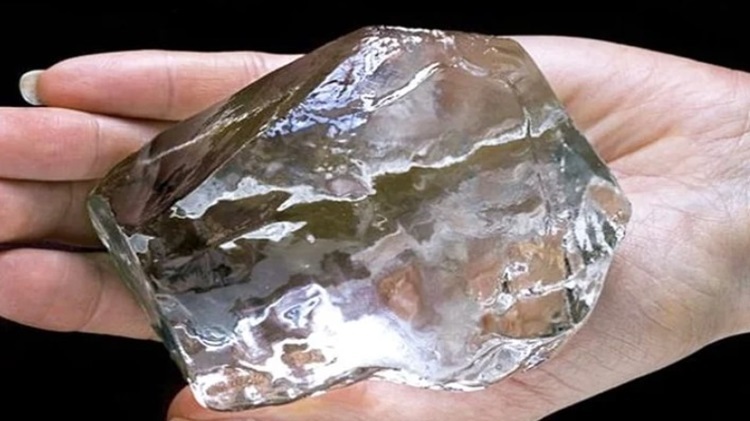
According to Independent, associate professor Geoffrey Howarth, a geologist at the University of Cape Town, and his colleagues are studying which rocks contain CLIPPIR diamonds and the process of bringing them to the surface. CLIPPIR belongs to the ultra-deep diamond group, formed at a depth of more than 400 km below the ground in the mantle transition zone (thick layer of hot rock between the Earth's core and the crust). Compared to them, regular diamonds lie beneath ancient continents, about 200 km deep. Therefore, CLIPPIR diamonds are useful for understanding areas of the Earth's interior that cannot be observed directly.
The researchers focused on the mineral olivine found in kimberlite rock. This is a rare igneous rock that rises rapidly from deep within the Earth, acting as a natural elevator carrying diamonds and other minerals from the mantle to the surface. Olivine is the most abundant mineral in the mantle. As it rises, kimberlite carries olivine from the rocks in the mantle it passes through.
Based on this process, scientists can identify areas where diamonds accumulate before bringing them to the surface. Howarth's team localized unusual iron richness in the mantle, associated with CLIPPIR diamond-bearing kimberlite. Their findings provide a practical tool for diamond exploration because kimberlite rocks bearing the iron-rich mineral olivine have more potential to host CLIPPIR diamonds.

Some previous studies have shown that CLIPPIR diamonds are associated with oceanic crust pulled deep into the Earth by plate tectonics (the interaction and slow movement of hard crustal plates). When they meet, one crustal plate can be pushed under the other during subduction, pushing oceanic crust deep into the mantle, where it changes due to temperature, pressure, and interactions with surrounding rocks. Under extreme conditions, the carbon in the material can transform into diamond.
New evidence from the team's olivine chemical analysis shows that kimberlite containing CLIPPIR diamonds was attached to ancient oceanic crust (the Earth's crust underlying the oceans), transformed by hot fluids circulating through the seafloor before penetrating into the Earth. Oceanic crust undergoing hydrothermal transformation has formed dense iron-rich rocks deep in the mantle.
Instead of rising passively, iron-rich rocks require strong lift from mantle plumes, columns of super-hot rock emerging from deep within the Earth that can pick up dense material and push it upward. They carry diamond-bearing material to the bottom of the lithosphere under ancient continents. After hundreds of millions of years, magma flowed through that area, quickly spewing onto the ground and hardening into kimberlite rock, carrying with it diamonds and other minerals.
According to the team, kimberlite rocks contain iron-rich olivine and other minerals that have a higher potential to host CLIPPIR diamonds, concentrated in areas such as Sierra Leone and Angola.
According to The Conversation, some of the most special diamonds ever found are the rare CLIPPIR diamond class, which accounts for less than 1% of all diamonds on Earth. This name is an acronym that combines 6 outstanding features including appearance similar to the Cullinan diamond, large size, few internal impurities, high purity, irregular shape, and natural chemical corrosion. The CLIPPIR group contains three of the largest diamonds ever discovered: the 3,106-carat Cullinan from the Premier mine in South Africa, the 1,111-carat Lesedi La Rona and the 2,492-carat Motswedi both from the Karowe mine, Botswana.
According to Discovery Alert, the Cullinan diamond remains a prime example of the CLIPPIR class. Discovered in 1905 near Pretoria, South Africa, its rough mass of 3,106 carats is equivalent to 621 grams, roughly the size of a standard water bottle. However, it crystallizes under pressures of over 11 gigapascals in environments hundreds of kilometers below the African continent. Researchers estimate Cullinan emerged to the surface through a kimberlite eruption about 1.18 billion years ago, making it one of the oldest and deepest-formed diamonds.