Vietnamese scientist develops a laboratory to synthesize materials
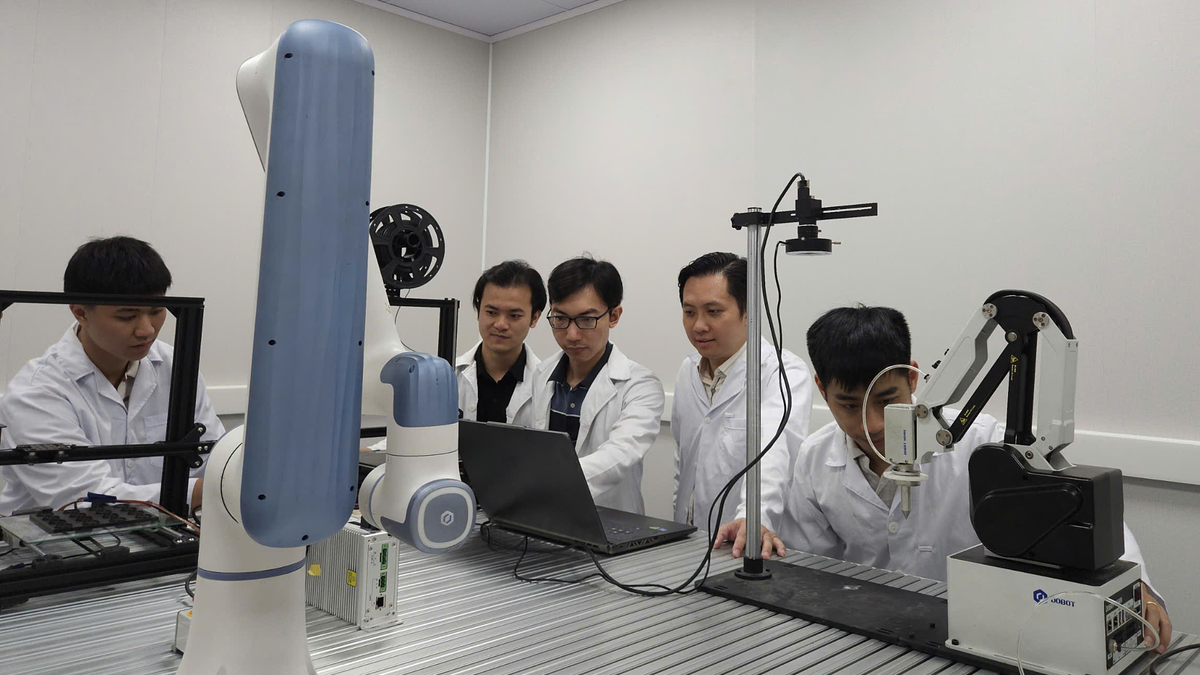
The project to develop an automated laboratory is implemented by Prof. Dr. Nguyen Thanh Tung, Head of Plasma Technology Department, Institute of Materials Science, Vietnam Academy of Science and Technology, along with Dr. Nguyen Nhat Linh, Dr. Nguyen Hoang Tung and Dr. Nguyen Thi Mai.
As project leader, Prof. Dr. Nguyen Thanh Tung, said that the automatic materials synthesis laboratory located at the Institute of Materials Science is expected to initially operate in October this year. The system is designed with two robotic arms, automatically mixing chemicals, heating, and plasma stimulation, allowing the creation of thousands of metal nanomaterial samples each month without the need for scientists to directly perform repetitive operations as before.
The laboratory will automatically prepare precursors, synthesize materials, evaluate material properties, and store data thanks to a combination of hardware and control software. The hardware is a robotic arm that performs the following operations: pumping, mixing, mixing or moving materials between the cold plasma system and the UV-Vis absorption spectrometer. The software includes a processor that automates the devices and analyzes the data. The efficiency of synthesizing nanomaterials is expected to increase at least 10 times, reaching at least 50-100 samples per day, while manual operation only reaches 5-10 samples.

A representative of the research team said that the automated laboratory allows scientists to explore materials and demonstrate the feasibility of the world's most modern model in real conditions in Vietnam.
Normally, scientists can exploit information from published research or open data around the world, but need to have "active production capacity to approach Vietnam's own materials problems", Professor Tung said. Therefore, the group aims to build and master technology to create a domestic "material data factory".
Professor Tung said, the challenge with synthesizing nanomaterials is the ability to control the size, shape and distribution of particles through fine-tuning dozens of factors such as precursors, ratios, temperature, catalysts, processing time... Materials with properties that meet application and research needs can be just one of thousands of different formulas.
Doing it manually is almost like finding a needle in a haystack, it takes a long time while lacking uniformity, repeatability and fragmented data. Meanwhile, to explore materials or correlations between inputs and products, large and consistent data sets are needed. This is also the reason why laboratories automatically synthesizing advanced materials are becoming tools of science and technology powers such as the US, China, and Japan in the race to develop industrial, medical, semiconductor, and aerospace materials.

The laboratory developed by Vietnamese scientists uses the cold plasma synthesis method, which can create a series of different synthesis conditions, increasing the scale of data obtained.
According to research, plasma, an energy-rich gaseous state, creates nanomaterials by breaking down the original substances and forming microscopic particles. Compared to the previous method of using chemicals, plasma helps better control the nano synthesis process. Specifically, with each change in the plasma source - temperature, pressure, gas composition, power - the resulting nanoparticles will have different properties.
Results are automatically recorded including date and time, environmental information, equipment model, experimental parameters and material properties, creating large data sets according to international standards. This is the input of machine learning applications to predict new materials or properties, shortening the time to develop materials for applications and research.
Metal nanoparticles are metallic particles or structures of nanometer size. At microscopic sizes, materials have special optical, electrical, magnetic, and chemical properties compared to bulk metals due to the large surface area, causing atoms to come into contact with the environment and increasing reactivity. These properties are utilized in the fields of biomedicine, energy, electronics, and the environment.
For example, nano gold and platinum, materials that will be synthesized at the new laboratory, possess plasmonic properties (electrons on the surface of the material interact with light) and are applied in biological sensors, ultra-sensitive environmental sensors that detect substances at the molecular level or in advanced research on light transmission and control.
Nam Nguyen