Vietnamese scientists create materials that 'eat' pollutants
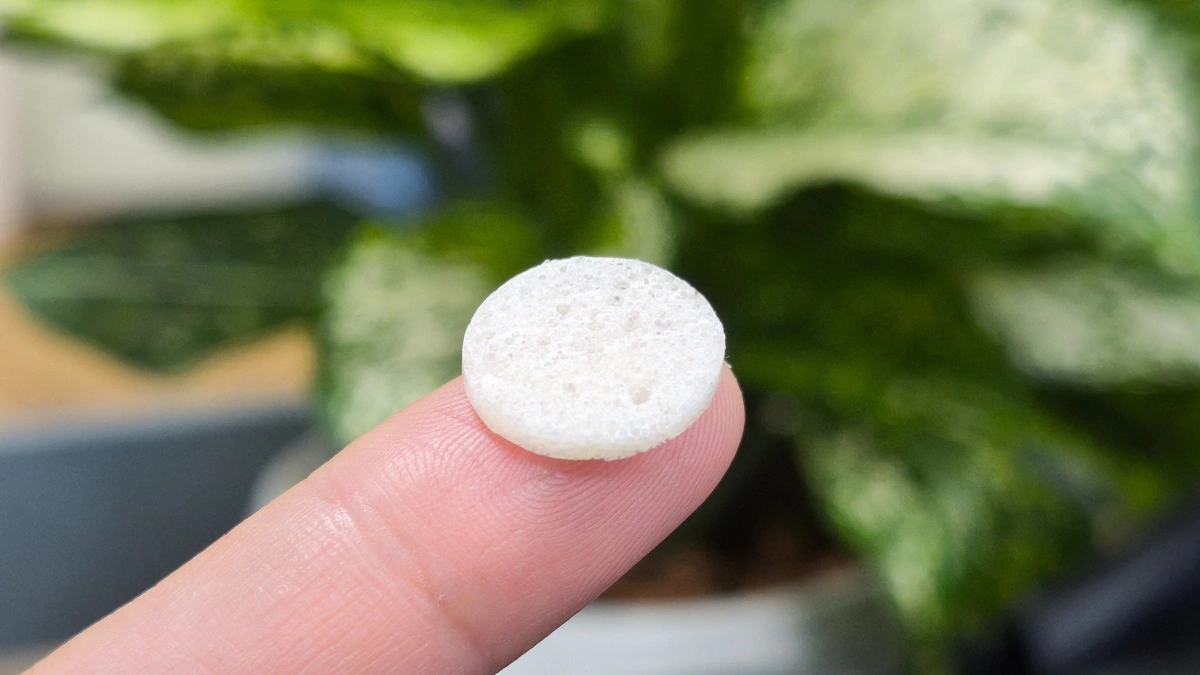
Holding a thin round white sponge in his hand, MSc Mai Duc Huynh, Department of Physical Chemistry of Non-Metallic Materials, Institute of Materials Science, Vietnam Academy of Science and Technology, likened this to an "apartment" for microorganisms. The sponge is only as small as a fingertip but possesses "super surface area" thanks to the uniform hole structure inside. Just one cubic meter of this material will cover an area of about 2,500 m2, equivalent to 2 Olympic-standard swimming pools.
These pieces of material, also known as porous biological substrates, have been registered by the research team with patent number 54058. The author group includes MSc. Mai Duc Huynh, Prof. Dr. Thai Hoang, Associate Professor, Dr. Nguyen Vu Giang and colleagues at the Institute of Materials Science.
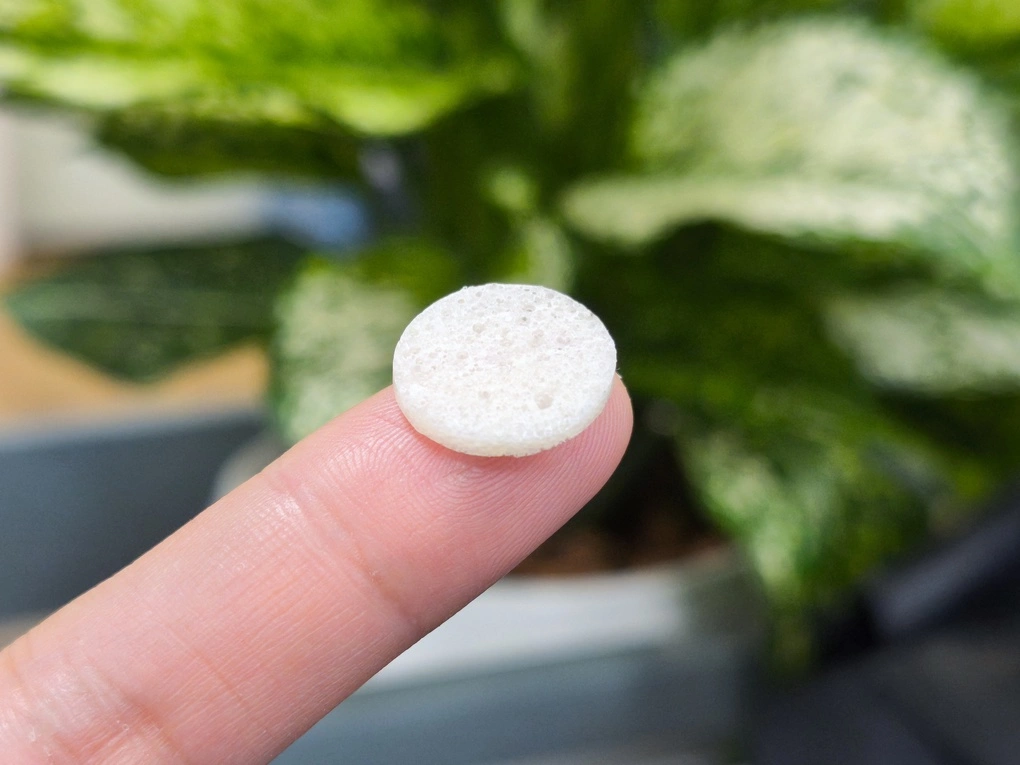
Mr. Huynh said that when millions of these foam slices are dropped into the wastewater tank, microorganisms clinging to them will come into contact with and "eat" pollutants. This is called Moving Bed Biofilm Reactor (MBBR) filtration technology, taking advantage of the ability of microscopic organisms to absorb and decompose organic matter.
"There are many different wastewater treatment technologies being applied, but MBBR is one of the most popular solutions for domestic wastewater treatment," said MSc. Huynh, adding that this research started from the interest of businesses, looking for high-quality domestic materials.
The media itself does not help filter water but is the core technology of MBBR. The reason is that the material needs to be designed so that the surface area is large, containing as many microorganisms as possible and creating a favorable environment for microbial populations to grow. When the surface area is low, a larger volume of substrate must be included to create enough habitat for microorganisms. This means the treatment tank must contain more material to achieve the same treatment load.
Simple, spherical, cylindrical or wheel-shaped scaffolds are easy to make and cheap, but only achieve half or less of the surface area per cubic meter of material compared to wafers, also known as biochips. This type of substrate is much more effective in "eating" organic waste, but at the same time comes with a cost of 40 to 60 million VND per cubic meter due to having to import it from abroad, according to Master Huynh.
With a disc-shaped porous substrate, the surface is not only on the outside but also spreads on the walls of a series of internal pores. "The challenge to create this material is to control the porous properties," he said.
Accordingly, the research team had to solve opposing requirements at the same time: the material needed many interconnected holes but was still strong enough to withstand impacts with tank walls in wastewater, light enough to move in water but not completely buoyant. From idea to having a relatively stable formula, it took researchers about two years of testing.
PE plastic, a thermoplastic, was chosen as the base material thanks to its good mechanical strength and ability to withstand many different environmental conditions. However, because the PE surface is inert and hydrophobic, microorganisms often have difficulty sticking to the material. To fix it, the research team added additives to adjust the surface properties and structure of the plastic. These ingredients belong to a patented formula, helping the material interact better with water, while also creating small holes on the surface for microorganisms to adhere and grow.
After initial mechanical mixing, the mixture is extruded through a shaping die and foamed here, then cooled with air before cutting into slices about 1 mm thick.
The group's representative said that the production process has been developed in a way that can take advantage of existing domestic plastic production lines, with only changes in molds and operating parameters. This approach is expected to reduce equipment investment when the product enters industrial scale. The substrate has not yet been produced on an industrial scale, but it is estimated that the material cost will be only 25-30% compared to imported products.
Foam materials have been tested in domestic wastewater treatment at Hung Yen Eye Hospital and a number of treatment plants in Hanoi, achieving a treatment efficiency of 90% of organic waste and nitrogen removal, meeting wastewater treatment standards in Vietnam.
MSc Huynh said that materials are being perfected before being transferred and mass produced, with the goal of creating products with superior features compared to imports. "It is not easy to convince businesses to switch materials used or change the supply chain, so we continue to upgrade to create new features that are not yet available on the market," he said. Specifically, the team hopes to integrate additives to help microbial populations form faster on the surface of the material, starting the wastewater treatment process 20% faster than usual.
The research team aims that in the next 1-2 years, production will be carried out at plastic factories in Vietnam. Small sponges will be widely used to filter wastewater at production facilities, farms, restaurants, clinics or domestic wastewater treatment systems with limited construction areas.
According to a report by analytics firm Dataintelo, the global MBBR market is valued at 2.8 billion USD by 2025 and is expected to grow to 5.2 billion USD by 2034, a compound annual growth rate of 7.8%.
Of which, the Asia-Pacific region accounts for about 38.5% of the global revenue market share, the reason being that limited wastewater treatment infrastructure creates demand for rapidly deployable biological treatment technologies. According to the analyst firm, MBBR is increasingly popular in food processing facilities, textile factories and urban wastewater treatment plants in Vietnam, Thailand and Indonesia.
Nam Nguyen