Total solar eclipse seen from Russian satellite

"Solar eclipse: View from space. The Arktika-M satellite recorded one of the most anticipated astronomical events of the year, the total solar eclipse on August 12. The image shows the Moon's shadow moving across the Earth's surface," Russian space agency Roscosmos said in a post on August 16, with a video of the event.
Arktika-M is a system of 6 hydrometeorological monitoring satellites developed by Roscosmos, with two satellites deployed into orbit in 2021 and 2023. Arktika-M satellites operate in a Molniya-style highly elliptical orbit, with perigee at an altitude of 1,000-1,400 km and apogee up to 40,000 km.
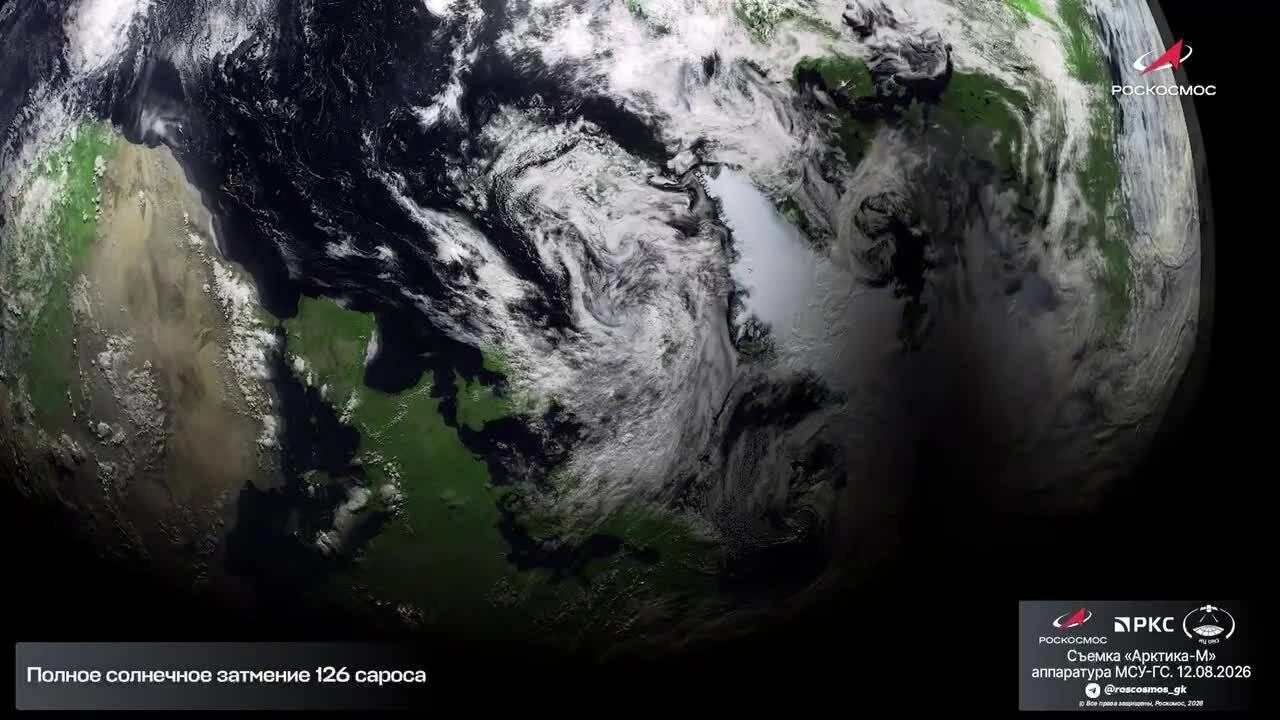
The Arktika-M project aims to provide Earth observation data, as well as maintain communications and navigation services in Russia's northernmost region.
Roscoscos also posted a series of photos taken by astronaut Pyotr Dubrov from the International Space Station (ISS) at an altitude of 400 km, showing the Moon gradually covering the Sun during a total solar eclipse.
A total solar eclipse occurs when the Moon is between the Earth and the Sun, obscuring the Sun's surface from view from the ground. This creates a dark disk in the sky, surrounded by a faint halo of light from the Sun's outer atmosphere, called the corona.
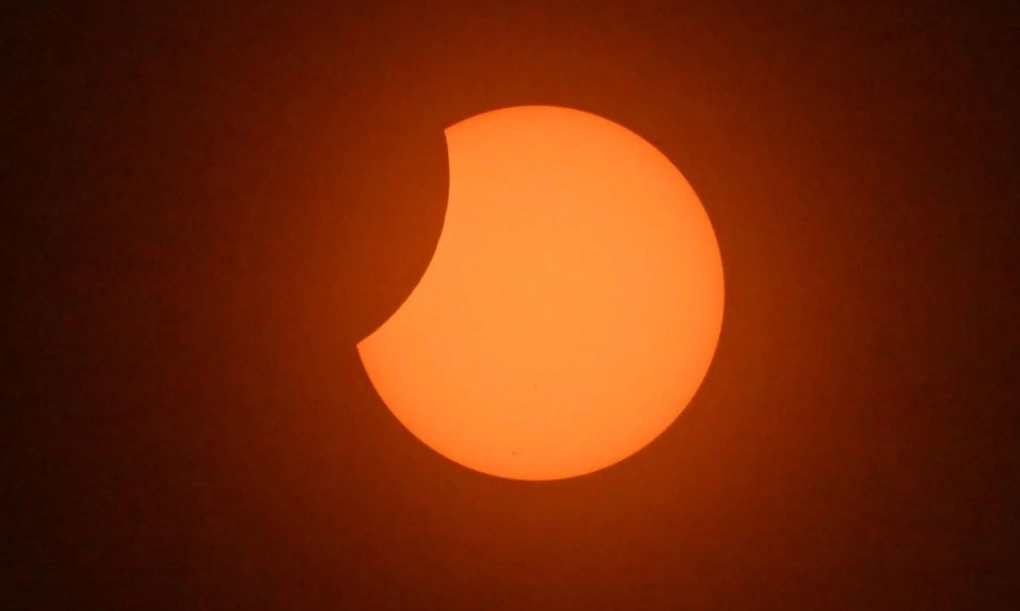
The Moon is about 400 times smaller than the Sun, but also about 400 times closer to Earth, making both appear the same size in the sky. For a total solar eclipse to occur, the Sun, Moon and Earth must be perfectly aligned in space. Places in the path of the totality zone, 100-200 km wide, will be in darkness.
During the event on August 12, people in northern Russia, Greenland, Iceland, Spain and a small corner of Portugal saw a total solar eclipse. Britain and Ireland experienced a large partial solar eclipse, when the Moon obscured between 90-96% of the Sun, creating a deep twilight effect rather than complete darkness.
Meanwhile, people in the northern US from Alaska to North Carolina saw a partial solar eclipse.
Diep Anh (According to RT, Sky News)