The need for AI may cause many countries to redesign 5G networks
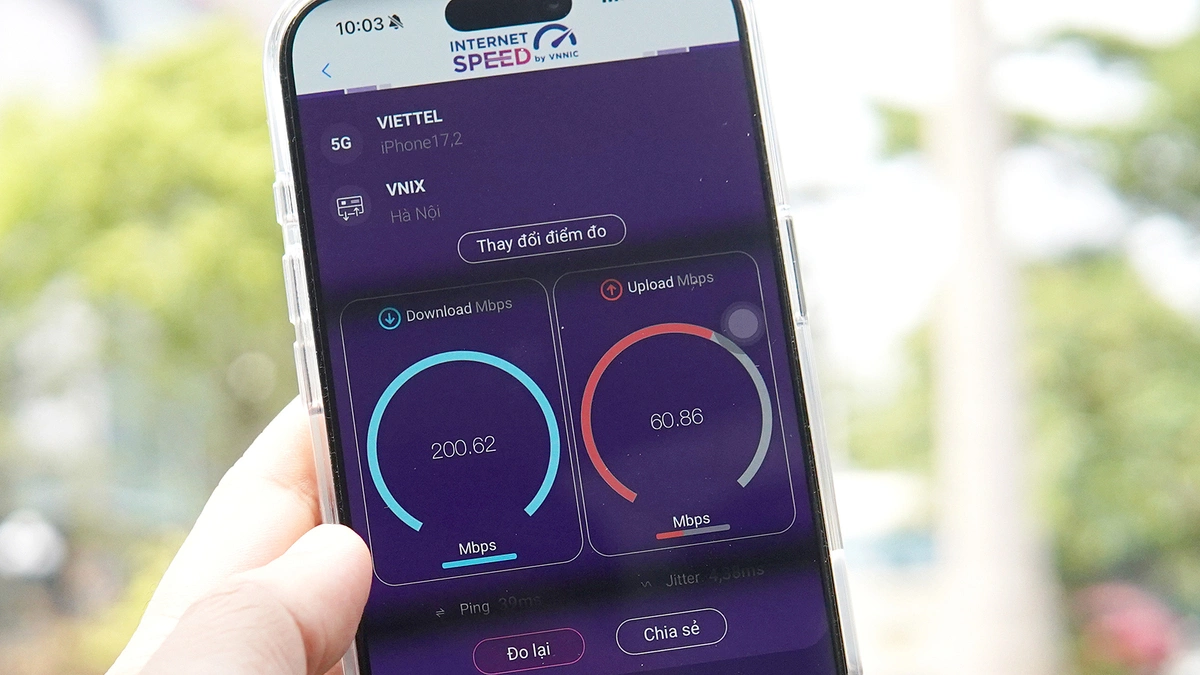
"AI traffic is rewriting network design principles," Ookla said in a newly published report based on mobile network data from 22 major markets in North America, Europe, Asia-Pacific, the Middle East and Latin America.
According to the unit behind the Speedtest tool, mobile networks are built on an assumption that has been true for decades: users primarily consume content rather than create data. So most 5G networks currently allocate about 90% of capacity to downloads and 10% to uploads.
However, AI is completely changing the paradigm. When a user sends a command to the large language model (LLM), the entire context including text, images or documents must be transmitted to the server before the system can process and respond. With AI agents, voice assistants or augmented reality (AR) applications, the device also continuously sends sensor data, audio and images to the cloud in real time.
Citing the Ericsson Mobility Report, Ookla said traffic from the text-based LLM is currently about 29% upload and 71% download. With voice conversation AI and agent AI, the ratio is closer to a 50-50 balance, while AR and multimodal AI applications have about 40% of their traffic being uploads. The Global Mobile Association GSMA also forecasts that the share of upload traffic in total mobile data traffic could reach 25-35% by 2040 in medium and high growth AI scenarios.
Not only changing traffic structure, AI is also forecast to become the largest source of traffic generation on the Internet in less than a decade. According to GSMA, traffic for global AI demand will grow at a CAGR of 73% per year between 2025 and 2033 and surpass traditional network traffic by 2031.
While these factors do not greatly affect the structure of the fixed Internet network, Ookla believes that they could make previous 5G network construction scenarios inaccurate. Accordingly, users not only consume data but increasingly create large amounts of data to serve AI. Connection sessions no longer have a clear start and end point as before because AI agents can operate continuously even when the user is not interacting. In addition, traffic patterns become much more difficult to predict because AI can generate large amounts of data at any time instead of following traditional uses.
Meanwhile, the mobile network's upload capacity has not kept up with demand. Ookla's analysis shows that from 2023, the share of capacity devoted to uploads is mostly flat or falling in 12 of the 22 markets surveyed. Indonesia has the highest percentage of capacity devoted to uploads at 23.9%, followed by Germany (15.6%) and Thailand (14.2%). Meanwhile, US carriers devoted 5.1% of capacity to uploads, the lowest in the survey group.
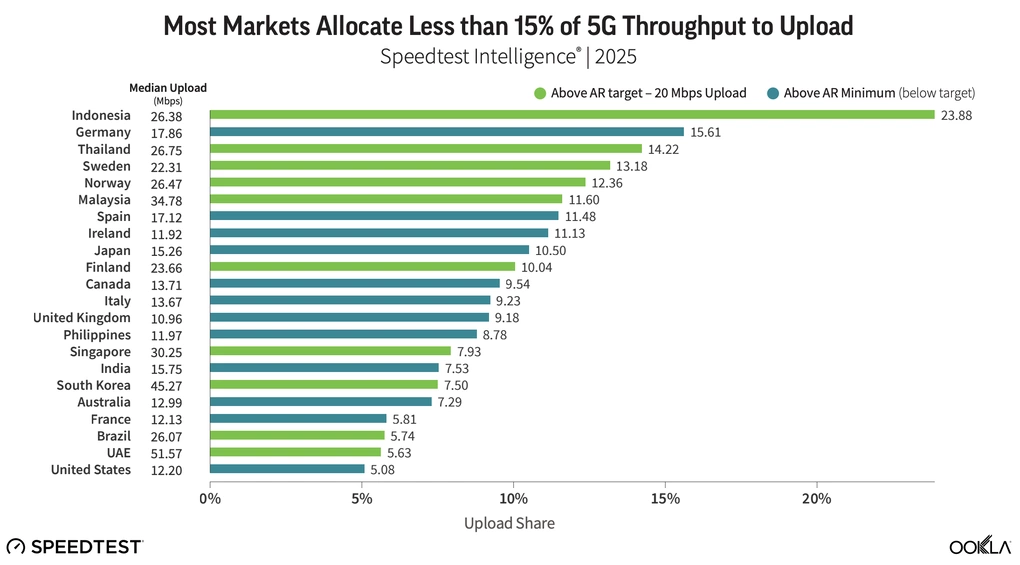
According to Ookla, they can meet the requirements of today's text AI and voice AI applications, but most do not meet the minimum upload speed of 20 Mbps for multimodal AR and AI applications.
Besides bandwidth, latency also becomes a determining factor in the AI experience. Ookla data shows that under normal operating conditions, 18 of 22 markets hit the latency target below 50 ms for text AI and 13 markets below 40 ms for voice AI. However, no market has yet met the sub-10 millisecond threshold required for stable operation of AR devices.
To meet the trend, the telecommunications industry is forecast to enter a new investment cycle. Ookla cited estimates showing that global carriers could spend about 1,300 billion USD in the period 2024-2030 to expand infrastructure and build network architecture suitable for AI. In parallel, AI is also introduced into network operations. About 40% of the world's carriers have deployed or commercially tested autonomous network systems based on AI agents, while another 34% plan to deploy within the next two years.
According to Ookla, AI tasks all have different network requirements, so there is no one-size-fits-all infrastructure model. Text AI, voice AI, multimodal AI or AI agents all pose unique requirements in terms of bandwidth, latency and connection stability. This forces carriers to shift from a mindset of optimizing for video viewing and content downloading to designing networks that serve AI from the start.
In addition, experts also assess that there are still many factors that can change the upload needs of AI applications in the future. One of the most likely scenarios is that a higher percentage of AI tasks are processed directly on the device instead of being sent to the cloud. Apple's Private Cloud Compute model is considered the first signal for this combined trend, allowing data to be processed right on the device instead of having to upload it to the cloud.
According to experts, this could also create new gaps between user groups. Owners of devices with powerful AI processors will be less dependent on network quality, while users of low-cost devices will be more dependent on mobile network uploads.
New data compression technologies can help reduce pressure on networks, especially with AI applications that process images or videos in real time. However, Ookla believes that it is too early to conclude how much upload demand will increase in the future, because it depends on the speed of development of AI on devices, hardware processing capacity as well as data transmission optimization technologies in the coming years.
Luu Quy