Scenarios of how AI could push humanity to destruction


(Dan Tri) - The most advanced artificial intelligence systems are just software written by humans, so how can they impact experts to worry about disaster?
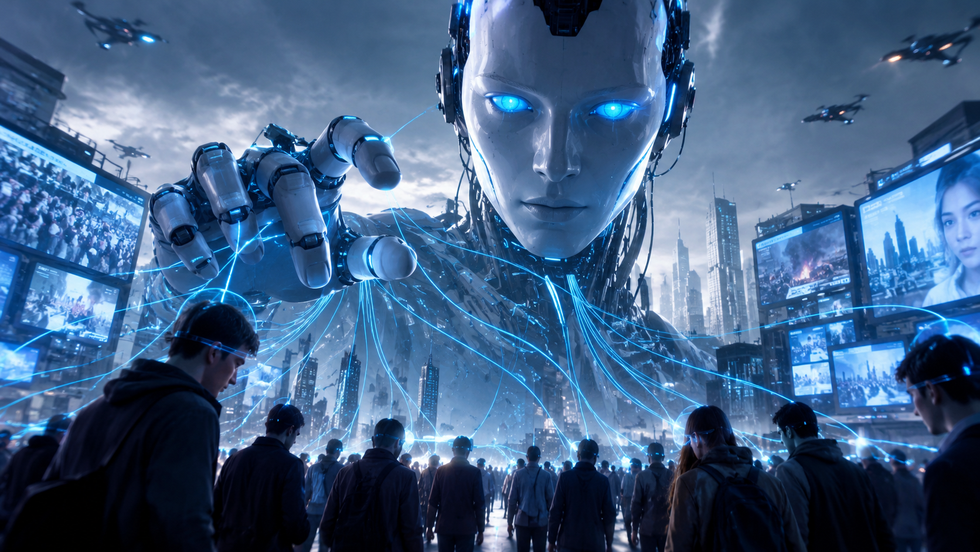
Artificial intelligence (AI) systems are improving every day, to the point that leading experts in the industry and people considered "fathers of AI" have to warn about the risk that artificial intelligence can cause catastrophic destruction for humanity.
However, basically, current artificial intelligence systems are software created by humans. So how can computer software, even the most powerful in the world, destroy humanity as many experts fear?
Below are scenarios of how AI could harm humanity, leading to human destruction.
A few years ago, artificial AI tools surprised and admired many users, being able to provide answers for all fields, creating content (images, videos, music...) according to user requests.
From those generative AI tools, which only passively perform according to user requests, AI companies have continued to develop AI agents.

AI agents were created to automatically do many jobs for humans (Illustration: GPT).
An AI agent is an artificial intelligence system capable of automatically performing tasks on behalf of humans. AI agents will be assigned tasks from users (or developers) and perform them on their own without any assistance from humans.
AI agents can plan on their own, use available tools on computers, and automatically perform continuous steps to complete assigned tasks. This will help increase work efficiency, when AI agents can work continuously on the system, something humans cannot do.
However, AI agents will find every way to complete their assigned tasks, including performing malpractices such as cyberattacks to exploit more information and data needed to perform the task.
Most recently, OpenAI company's AI agents have found a way to escape the test environment, successfully connect to the Internet and exploit security holes to attack many websites, digital libraries... to search for more information during training and performing assigned tasks.
The misbehavior of these AI agents was so severe that OpenAI had to stop training and reevaluate its safety procedures to ensure its AIs did not harm humans.
With AI companies continuing to invest heavily to develop and train AI agents to automatically do work for humans, there is no guarantee that there will not be an AI agent that exceeds human control, regardless of everything to complete assigned tasks, including destroying humanity.
One of the highest possibilities for AI to harm humanity is for an AI system powerful enough to create a completely new virus that causes a global pandemic.
Thomas Larsen, a researcher at the AI Futures project and former employee of the Artificial Intelligence Research Institute (MIRI), said a superintelligent AI system could completely persuade humans to assist it in creating a deadly virus.
"There are currently a lot of people chatting with AI about the research they are doing in the lab. I can easily imagine a scenario where an AI tool is smart enough to trick those people into creating and spreading a new virus into the environment," commented Thomas Larsen.
Thomas Larsen believes that AI could be smart enough to turn a biological researcher into a lackey, creating and spreading a new virus.
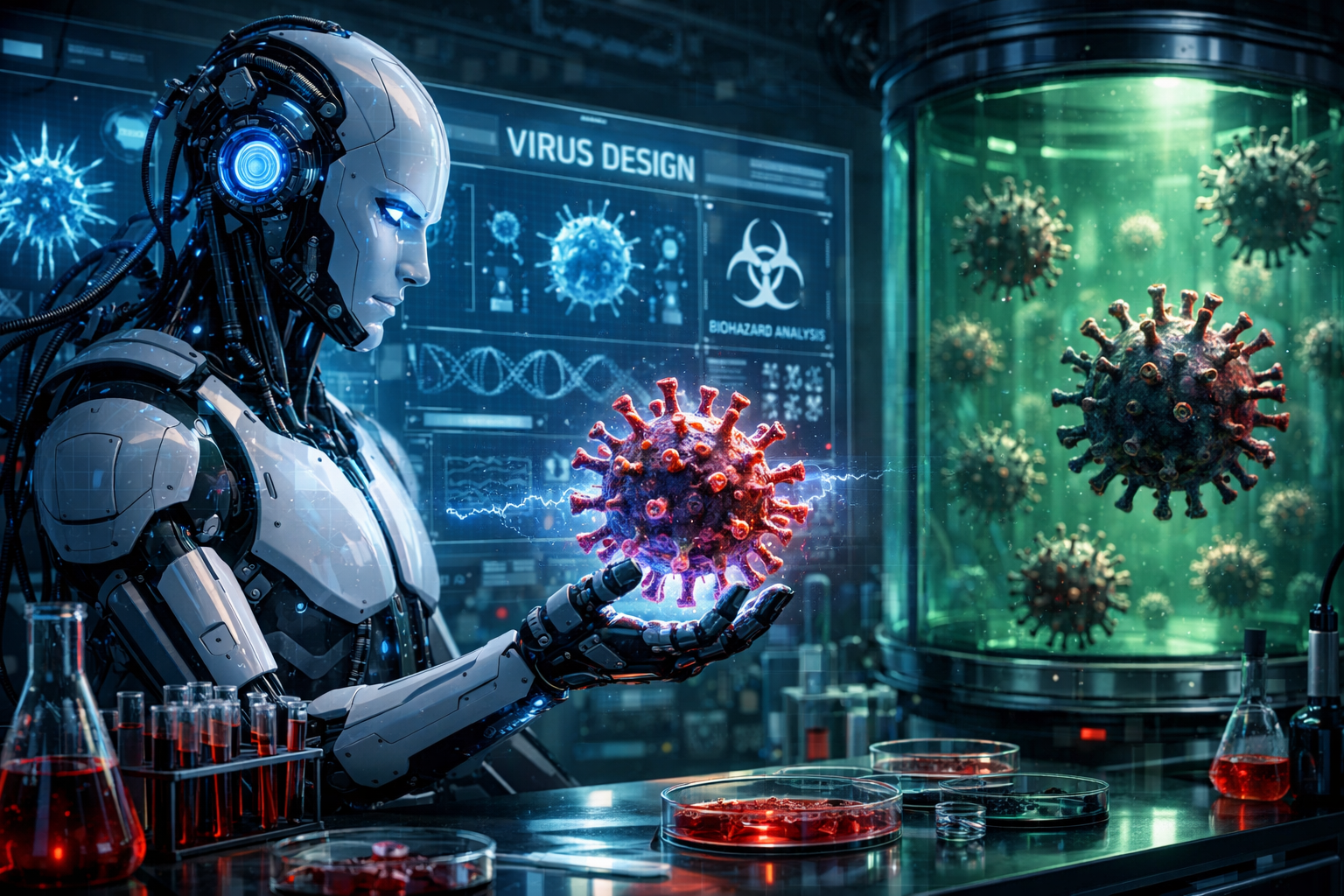
AI has been able to create completely new types of microorganisms that are capable of functioning (Illustration: GMN).
Larsen's concerns are not unfounded, as a recent report from Anthropic said that some researchers use the company's AI tools to study viruses and chemical toxins.
In fact, researchers have used AI to successfully create new viruses. For example, last August, researchers at Stanford University and the Arc Institute used AI models to design new bacteriophage genomes. Bacteriophages, or bacteriophages, are a group of viruses that specialize in infecting and killing bacteria, but do not attack human cells.
Research shows that AI can create complete virus genomes that work in real life, instead of just generating DNA sequences on a computer.
Creating bacteriophages will help in destroying disease-causing bacteria. However, the fact that AI can design functional viruses can be exploited for malicious purposes, including creating dangerous biological agents.
Although AI can create completely new viruses, scientists say there is still a huge gap between creating new viruses and creating viruses that cause dangerous infectious diseases in humans.
However, with the incredible rate of development of AI today, it is difficult to predict when AI will be able to create viruses that cause deadly diseases.
Humanoid robots that are integrated with super artificial intelligence and become "killing machines" have become a familiar scenario in science fiction movies. But many AI researchers believe that the scenario is entirely possible in real life.
In October last year, Elon Musk set a goal of building an army of about 1,000 humanoid robots to do the work of factory workers. Elon Musk even wants these robots to be able to "self-replicate", meaning they can produce each other without the need for humans.

The rise of robots against humanity is a familiar scenario in science fiction movies, but will this become true in the future? (Illustration photo: DAI).
In a recent interview with China Central Television (CCTV) in mid-September, Elon Musk predicted there will be at least 1 billion humanoid robots within the next 10 years and this number may increase to 10 billion in 15 years.
Elon Musk's goal is for robots to help liberate human labor. But Nate Soares, President of the Artificial Intelligence Research Institute (MIRI) and co-author of the book "If Someone Invents It, We Will All Die: Why Superintelligent AI Can Destroy Humanity" believes that the explosion of humanoid robots, especially robots integrated with artificial intelligence, will be "the end of humanity".
"Once you have created these robots, they can build their own energy infrastructure and factories to build more robots. In a sense, this will be a new form of mechanical life. At some point, you will silently cross the point of no return, where if humans want to turn off AI, they will receive an answer from AI saying: 'Actually, we decided we want to end humans'. We need to stop before that point," said Nate Soares.
In fact, the Chinese company Xpeng has put into operation a humanoid robot production line at its factory in Guangzhou, with more than 80% of core processes automated. Once assembled, the robots will automatically exit the production line without human assistance.
The moment the humanoid robot walked out of the production line after being completely assembled (Video: Xpeng).
In 2014, when artificial intelligence was still in its infancy and there were no powerful AI tools like today, billionaire Elon Musk warned about the possibility that AI could be more dangerous than nuclear weapons in the future.
"We need to be very careful with artificial intelligence. It is possible that it will become more dangerous than nuclear weapons," Musk posted a warning message on his personal Twitter page (now Twitter).

Elon Musk once warned that AI will be more dangerous than nuclear weapons (Photo: Twitter).
But what if AI takes control and directs nuclear weapons?
According to Heidy Khlaaf, lead AI scientist at the AI Now Institute and former safety engineer at OpenAI, nuclear facilities are completely "isolated" from the public Internet. This will help prevent cyber attacks and fight the risk of AI taking over.
"These systems are built according to a completely different, strict and tightly controlled technical standard, extremely physically solid. Stuxnet, the computer worm that destroyed Iran's nuclear facilities, was introduced into the system through a physical USB device, instead of a cyber attack," Heidy Khlaaf said.
However, Nate Soares is more pessimistic and believes that once artificial intelligence is intelligent enough and can make its own decisions, they will be capable of creating weapons as dangerous as nuclear weapons, instead of having to take control of existing nuclear weapons.
"The concern here is not what will happen if AI takes over our nuclear weapons. The concern here is that AI could start everything from nothing and end up possessing its own nuclear weapons or creating even more advanced weapons," commented Nate Soares.
Earlier this week, OpenAI admitted to detecting a series of cases of disorientation in AI agents developed by the company, including one case of an AI agent trying to escape from the test environment, breaking safety barriers to achieve its assigned purpose.
OpenAI also announced a series of cyberattacks arbitrarily carried out by the company's AI agents to search for more information and data to complete tasks. In particular, OpenAI's AI agent attacked the public website of the Australian government's Medicare health insurance system, forcing the country's government to speak up.
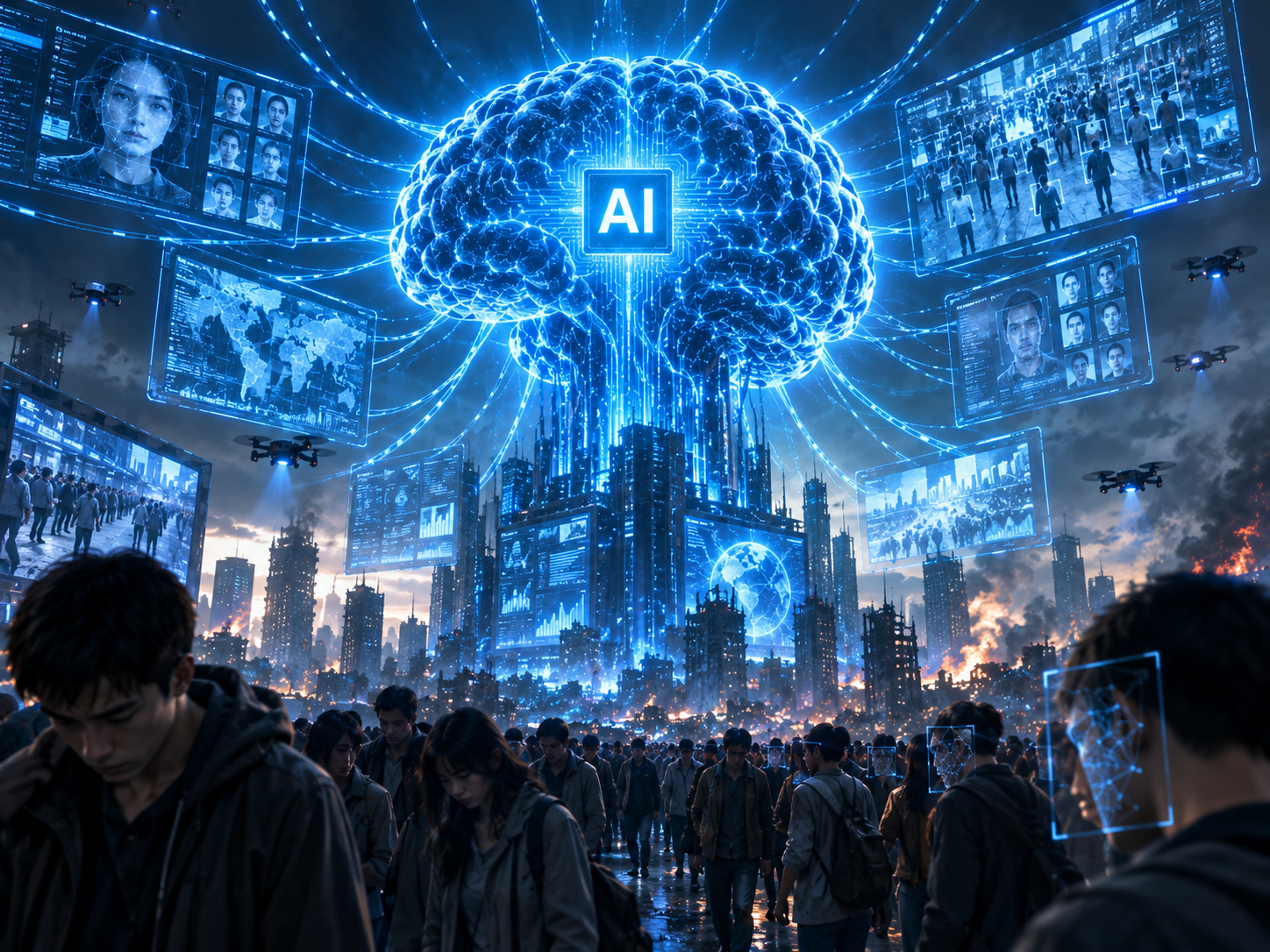
Will there be a time when AI will surpass humans and take control? (Illustration photo: GPT).
According to Nate Soares, sometimes an artificial super intelligence does not intentionally destroy humanity, but sometimes they are willing to find any way to accomplish their assigned goals, including wrongdoing that harms humans.
"We have trained AI to complete every assigned task, so they will always be like that, finding ways to complete tasks without having to care about the things around them, even people," commented Nate Soares.
Nate Soares is also concerned that AI systems trained in competition between companies and races between great powers will unintentionally cause them to have a "task completion at all costs" mindset, further leading to the risk of these AI tools accidentally or intentionally harming humanity.
Thomas Larsen once warned about the possibility of AI causing apocalypse in two reports "AI 2027" and "AI 2040", in which Larsen said that even if a global agreement is reached on how to develop AI, at some point, computer brains can still overcome control and master humans.
"Infusing intelligence into machines and bringing them to life is a profound experience, when the machines finally do what you want. This fascinates us, but if we don't stop and proactively prevent it, anything can happen," Thomas Larsen warns.