Discovering clues about mysterious dark matter
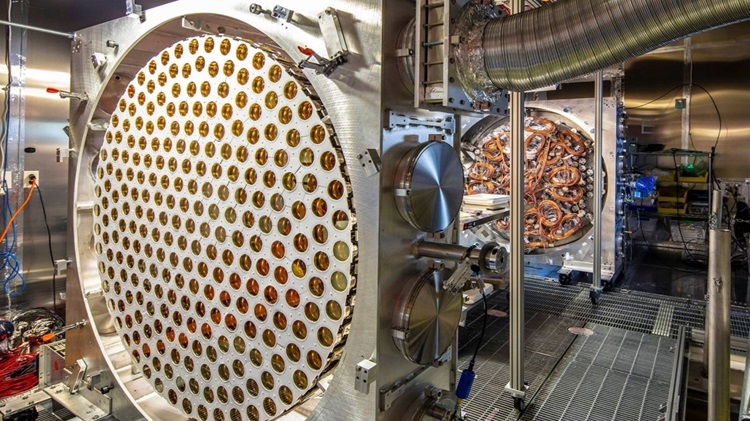
According to National Geographic, physicists recorded a particle interaction during experiments with the LUX-ZEPLIN (LZ) device at the Sanford Underground Research Facility (SURF) located at a depth of 1,524 m below the state of South Dakota, USA, on June 16, 2023. In research published on September 1 on the Indico platform, they announced that there is a 99.5% chance that this collision is caused by a type of particle that makes up dark matter, called a weakly interacting heavy particle (WIMP).
According to Popular Mechanics, the LZ experiment brings together 250 scientists and engineers from 39 organizations, using a detector that is a tank containing more than 7 tons of ultra-pure liquid xenon. The particles enter the tank and interact with xenon atoms creating characteristic flashes of light and electron flows. That signal can be used to determine information about the incoming particle, including its mass and location inside the detector.
Scientists speculate that WIMP particles may collide with xenon nuclei, creating light rays and releasing electrons. After reviewing 220 days of data from March 2023 to April 2024, they found a consistent interaction with a confidence level of 2.6 sigma. Sigma is a measure of standard deviation in statistics. The more sigma, the lower the probability of error, the higher the possibility of the hypothesis being correct. The standard for confirming direct detection in particle physics is 5 sigma, or about 1/3.5 million).
The interaction was recorded in mid-June, summer in the Northern Hemisphere when the Earth enters the galaxy's dark matter stream at its highest velocity. According to the research team's calculations, if a WIMP really caused the event, it most likely had a mass of at least 200 GeV/c2 (200 times the mass of a proton).
According to Richard Gaitskell, a physicist at Brown University and spokesman for the LZ experiment, while the finding is intriguing, it cannot be ruled out that it could be ordinary matter interacting in ways that scientists do not yet fully understand.
Researchers need more time and data to draw accurate conclusions. Two other experiments in Italy and China are also searching for dark matter using liquid xenon detectors.
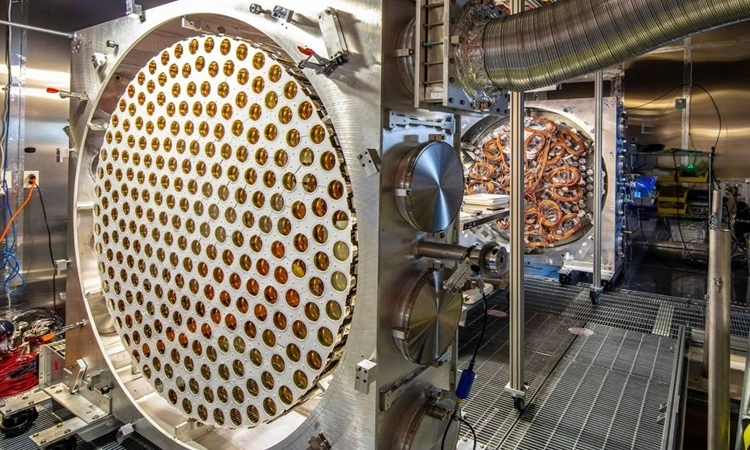
Wired said dark matter is the invisible glue that holds the universe together, one of the most important and elusive ingredients in astrophysics. Although it makes up about 85% of the matter in the universe, dark matter cannot be observed directly because it does not interact with light or anything else. Much of the indirect evidence for the existence of dark matter comes from gravitational effects, as its mass pulled atoms in the early universe to form stars, galaxies and the vast network of intergalactic structures visible today.
Researchers don't even know if dark matter is made up of a single type of particle or a collection of particles that interact with each other in ways that humans cannot yet explain. One of the most popular theories about dark matter names its constituents WIMP. This type of dark particle has mass and gravity, but interacts very weakly with regular matter.
If WIMPs existed, large amounts of dark particles could pass through Earth continuously without leaving a trace. However, if the dark particle interacts with the atomic nucleus and transfers some of its energy there, collisions between them could provide convincing evidence of the presence of dark matter.