The world's smallest wireless flying robot
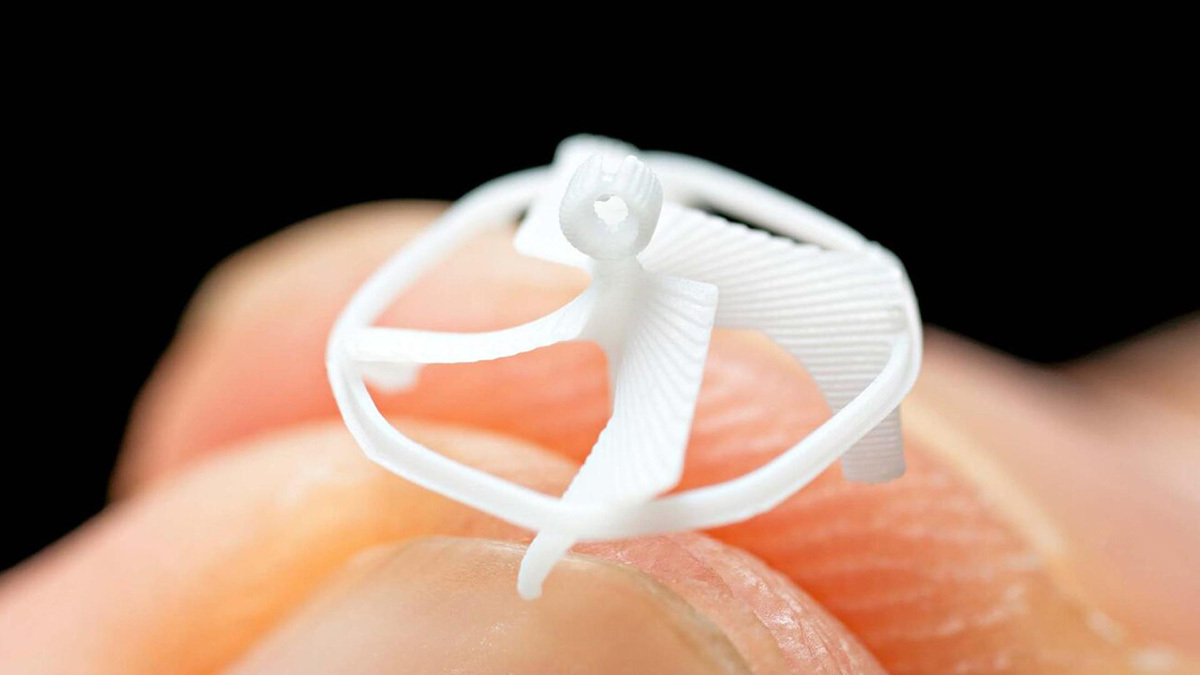

A group of experts at the University of California Berkeley developed the world's smallest wireless flying robot inspired by bees, Interesting Engineering reported on April 1. New research published in the journal Science Advances.
With a weight of only 21 milligrams and a diameter of less than 1 cm, the tiny robot is capable of hovering, changing direction and rushing into small targets with precision. It can participate in surveillance, environmental monitoring and search and rescue.
"This flying robot can be controlled wirelessly to approach and hit the designated target, simulating the pollination mechanism when bees collect nectar and then fly away," explained Liwei Lin, a mechanical engineering professor at the University of California Berkeley.
Robots often need electronic components for control and power sources such as batteries to fly. These parts are difficult to integrate into small and light robots. In the new study, the scientific team solved this problem by controlling the flight path and powering the robot with an external magnetic field.
The robot has two tiny magnets and is designed like a small propeller. These magnets are attracted and repelled by the external magnetic field, rotating the rotor and generating enough energy to lift the robot off the ground. The research team can precisely control the flight path by adjusting the strength of the magnetic field.
"Tiny flying robots are useful for exploring small spaces and other complex environments. They can help with artificial pollination or inspect narrow spaces such as inside tubes," said Fanping Sui, a PhD in engineering at the University of California Berkeley and study co-author.
Currently, robots can only fly passively, lacking sensors to detect their position or flight trajectory. Unlike advanced airplanes and drones, robots cannot adjust their movements in real time. Although capable of precise flight, sudden environmental changes such as strong winds can push it off course.
The team plans to add active control capabilities in the future, allowing for real-time adjustment of position and posture, according to Wei Yue, co-author of the study. The robot also needs a strong magnetic field from the solenoid to operate. But in the future, reducing the robot's size to about 1 mm could make it light enough to respond to weaker fields, for example from radio waves.
Thu Thao (According to Interesting Engineering)