AI fish robot revolutionizes aquaculture
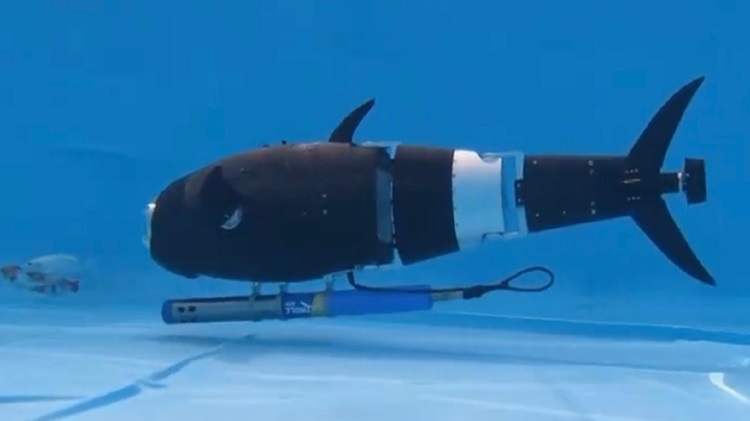
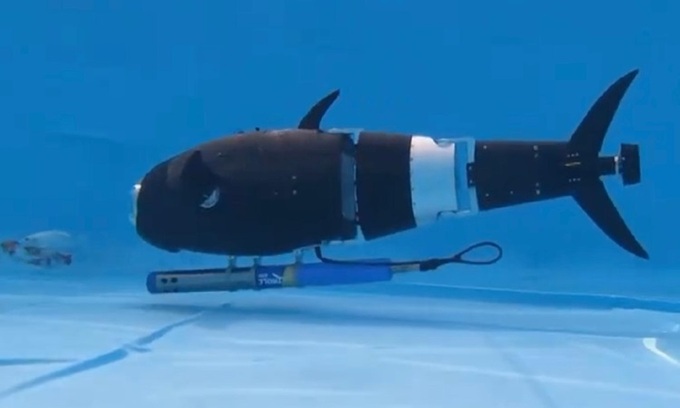
At the National Innovation Center for Digital Fisheries in Beijing, two fish robots with sleek metal coatings swim in a breeding tank, revealing high-end research that could revolutionize aquaculture. "These are tuna robots and dolphin robots that we developed," said an associate professor at China Agricultural University (CAU). "They represent different swimming characteristics, but their core purpose is the same, which is to support fish farms."
Liu is part of a team of underwater bioengineered robots aiming to simplify the laborious work of fish farming. "We want fishermen's work to be less difficult," said Wei Yaoguang, another member of the research team with more than 20 years of experience. Wei has witnessed fishermen inspecting large aquaculture farms, with divers spending 3-4 days inspecting net cages with a diameter of 400 meters. Besides being time consuming, the process is also very expensive.
To meet the challenge, the team relied on underwater robots equipped with sensors to track fish and nets. Their first robot can patrol a 400 m diameter net cage in just 4 hours, a significant improvement over the manual process. However, experts quickly encountered a new challenge: fish's stress response. As Liu explains, fish get nervous easily and if the robot gets too close, they will jump out of the water. To minimize disturbance, the research team designed a smaller and more elongated technofish robot that can blend into the environment without disturbing aquatic life. "When our fish robots swim, live fish often swim with them, creating a natural movement where large fish lead smaller fish," Liu said.
Another challenge arose with the tuna robot's tail swinging from side to side, causing its head to move unpredictably and complicating underwater inspection. To solve this problem, the research team developed a vision stabilization system, improving the ability to clearly observe underwater conditions.
According to experts, these bioengineered robots integrate many advanced technologies, including a fish-like propulsion system and flexible two-axis motors that help reduce turbulence and allow smoother swimming. They also possess high-precision sensors to monitor water quality and fish behavior in real time. At the same time, taking advantage of artificial intelligence, the research team developed automatic motion control algorithms and ultra-light AI chips, helping the fish robot swim, analyze and adapt itself to many underwater environments.
The experts behind the study say fish robots open up many new possibilities in fisheries management, such as guiding fish to predetermined areas for more efficient harvesting and enhancing feeding methods. According to Liu, traditional feeding methods can lead to waste or uneven distribution, but fish robots, which integrate lures and sensors, can provide food more accurately through analysis of biological signals such as size, quantity and activity level. This helps reduce bait waste, lower aquaculture costs and optimize the growth environment for fish.
In addition to aquaculture, fish robots have potential applications in deep-sea exploration and marine resource monitoring. According to Wei, conventional underwater equipment is cumbersome, consumes electricity and disrupts marine life. Bioengineered robotic fish can collect deep-sea data, monitor marine ecology, and assist in topographic mapping.
To date, the research team has collected more than 200 terabytes of video data on more than a dozen fish species, along with 10 million photos. This data is essential for training AI models, contributing to smarter and more efficient aquaculture. Deployed in 23 regions, current technology helps manage more than 6.3 million m2 of onshore aquaculture farms and 5.5 billion m2 of offshore ponds and aquaculture farms, cutting labor costs by 50%.
An Khang (According to CGTN)