The humanoid robot changes its own batteries in less than three minutes

According to Interesting Engineering, the Atlas humanoid robot from Boston Dynamics in Massachusetts, USA, currently takes only nearly 3 minutes to automatically replace a depleted battery. Atlas is designed to autonomously navigate back to the battery station, change batteries and resume operations, significantly reducing operational downtime and supporting longer shifts, addressing a key challenge for humanoid robots in wider deployments in industrial environments.
According to Futuro Prossimo, the new Atlas robot is about 1.88 meters tall and weighs 90 kg, can continuously handle goods weighing up to 30 kg and lift 50 kg in a short time. This humanoid robot is equipped with tactile sensors in its hands and a 360-degree camera system to help recognize its surroundings.
According to Tech Republic, Atlas can operate for 4 hours under normal conditions and about 2 hours when needing to lift heavy objects. The production-ready version of the Atlas can autonomously sense when the battery is depleted, move to a designated battery station, replace the battery in less than three minutes, and continue with its assigned mission. Since typical battery charging time takes about 90 minutes, automatic battery replacement helps machines operate longer with very little human intervention, providing a great advantage for factories that operate multiple shifts.
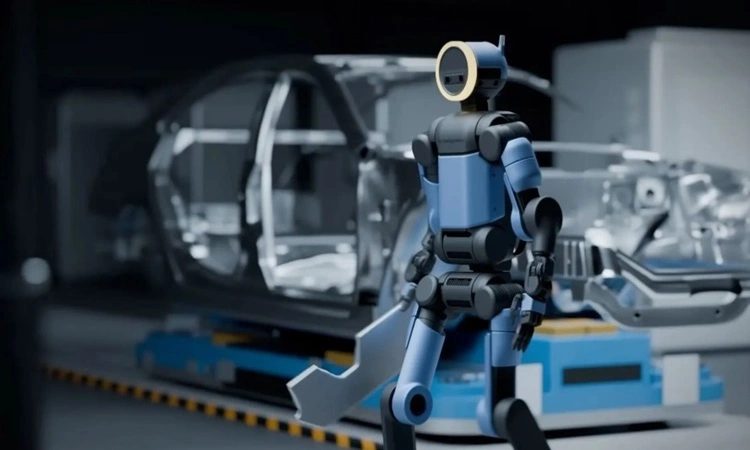
Boston Dynamics designed the Atlas robot specifically for industrial applications, including lifting, moving and material handling. The robot combines an electric drive system, advanced sensors, and AI-based control to adapt its movements to changing environments instead of relying solely on pre-programmed fixed sequences of operations.
According to Boston Dynamics, Atlas learns how to handle heavy objects through reinforcement learning and large-scale simulation, allowing adjustments to its lifting, carrying and balance abilities within weeks. The key breakthrough lies in the accelerated speed of robot training thanks to high-end simulation systems that can run millions of hours of training in a day, then transfer new behaviors and skills to real robots in about an hour, significantly reducing development time.
The technology also addresses the gap between simulation and reality, in which skills learned in virtual environments often do not work consistently in real environments. The simplified hardware architecture contributes to more accurate simulation, making the transfer of learned behavior to the robot more efficient.
The Atlas robot uses only two actuators across its body, while the arms and legs have a symmetrical design that simplifies control, modeling and training. The robot's joints do not use cables, so it can rotate continuously while reducing maintenance requirements and wear and tear. According to the company, these improvements allow the robot to control its entire body more flexibly. During testing, Atlas transported a refrigerator weighing more than 45 kg after training with a significantly lighter load. Such tasks require visual perception, balance, force control, weight prediction, and coordinated whole-body movements.
Atlas will begin production duties at Hyundai's Georgia Metaplant plant in 2028 and aim to take on more complex assembly work in 2030.