NASA robot sets record for longest distance on Mars
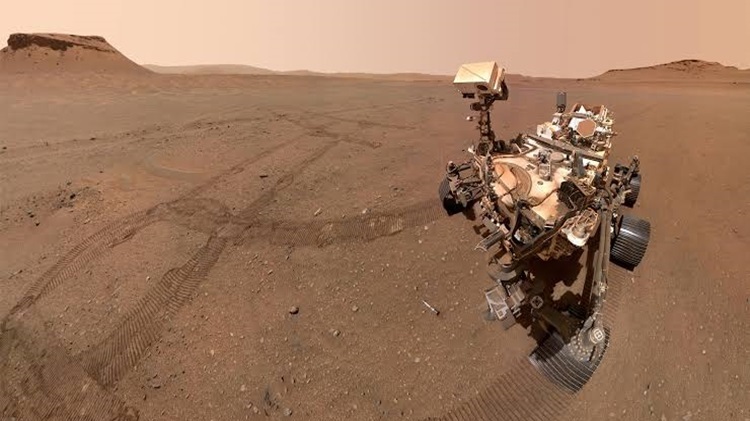
The information was announced by NASA's Jet Propulsion Laboratory (JPL) on October 12. According to Reuters, Perseverance robot - NASA's 6-wheeled self-propelled vehicle, set a record for the longest distance any vehicle has ever achieved outside of Earth. Both Perseverance and Opportunity surpass the distance of any rover ever achieved on the Moon.
Space said, Perseverance landed at the bottom of the 46 km wide Jezero crater in the northern hemisphere of Mars on February 18, 2021. The NASA engineering team built Perseverance based on many years of experience with the Sojourner, Spirit, Opportunity and Curiosity robots. The Perseverance robot is as big as a small car, equipped with a series of scientific equipment to search for evidence of ancient microbial life on the red planet, and collect rock and soil samples to bring back to Earth in the future.
NASA's autonomous robot passed an important milestone on October 11 when it ran to the Idubi area, past the western edge of the crater called Lac de Charmes. This is where it is surveying some of the most ancient landforms ever found in the solar system.
Perseverance is one of two NASA robots roaming the surface of Mars, with the Curiosity rover operating in Gale crater near the planet's equator. Curiosity has traveled 38.15 km since landing here in 2012.
Steven Lee, manager of two JPL robotics projects in California, said Perseverance shows no signs of slowing down. The robot's plutonium-based power system is working as expected and can provide many more years of useful power.
"Perseverance's technical hardware and instruments are in excellent shape with all redundant systems remaining usable. Recent assessments of all systems show they are capable of operating well into the 2030s or beyond," Lee told Reuters.

Perseverance relies on self-driving capabilities with an automated navigation system called AutoNav. The robot makes 90% of its trips without human intervention, Lee said. Perseverance takes stereo images of the terrain ahead, creates a 3D software map, and chooses the safest route to the target. It also uses the Vision Compute Element, a co-processing computer that allows it to analyze images and run self-driving software quickly, instead of stopping to consider each distance like previous autonomous robots.
According to Lee, Perseverance's mobility system is being tested to prove it is capable of running 100 km or more. To prepare for this goal, hardware components will be tested for durability at a level equivalent to 150-300 km.
To date, this robot's greatest achievement is the discovery of potential biological signs of ancient microbial life in red rock samples that may have formed 3.2-3.8 billion years ago in the river bed that supplies water to the lake at Jezero crater. The terrain of Lac de Charmes may contain clues about early geological processes such as the impact of large meteorite impacts. Jezero Crater was also born from such an impact in the history of Mars.
According to the New York Times, Perseverance's initial mission was to run 20 km. Recently, NASA extended its mission to explore the rim of the crater until around the end of 2028. In Perseverance's next phase of operations south of the crater rim, the project team is aiming for an area called "Rainbow Falls" that may contain kaolinite, a clay mineral that forms when water interacts with rock. By studying this mineral, scientists can better understand conditions on Mars billions of years before water filled Jezero crater.