What if you could live a different life among 8 billion people?


(Dan Tri) - Not allowed to choose birthplace or family, 1 in 8 Billion players start a random life and make their own decisions. My experience opened up 83 years of my life as an Indonesian citizen.
1 in 8 Billion is a life simulation website with data from 141 countries. Instead of creating a completely fantasy world, the game puts indicators such as longevity, education, income, health or social conditions into each randomly generated life.
In my experience, one click opened up Bambang Nugroho's 83-year life, from a boy in Indonesia to his final years with his children and grandchildren.
If you could live another life, where would you like to be born?
A wealthy city in Europe, a middle-class family in Japan or a rural area of a developing country? In reality, no one has the right to choose that starting point. 1 in 8 Billion turns that same randomness into a browser experience.
Right from the start, the website did not ask players who they wanted to become. The system automatically creates a person with name, gender, country, city, parents, economic situation and a series of initial conditions.
Then time started running.
A life created from data and probability
According to the website's introduction, data is compiled from many sources such as the United Nations, World Bank, WHO, UNESCO, UNICEF, ILO or World Happiness Report.

Of course, that doesn't mean the website has the ability to accurately predict a person's future. Numbers are used to establish conditions and probabilities in the simulation. Specific lives are still created from random events, player choices, and how the system designs scenarios.
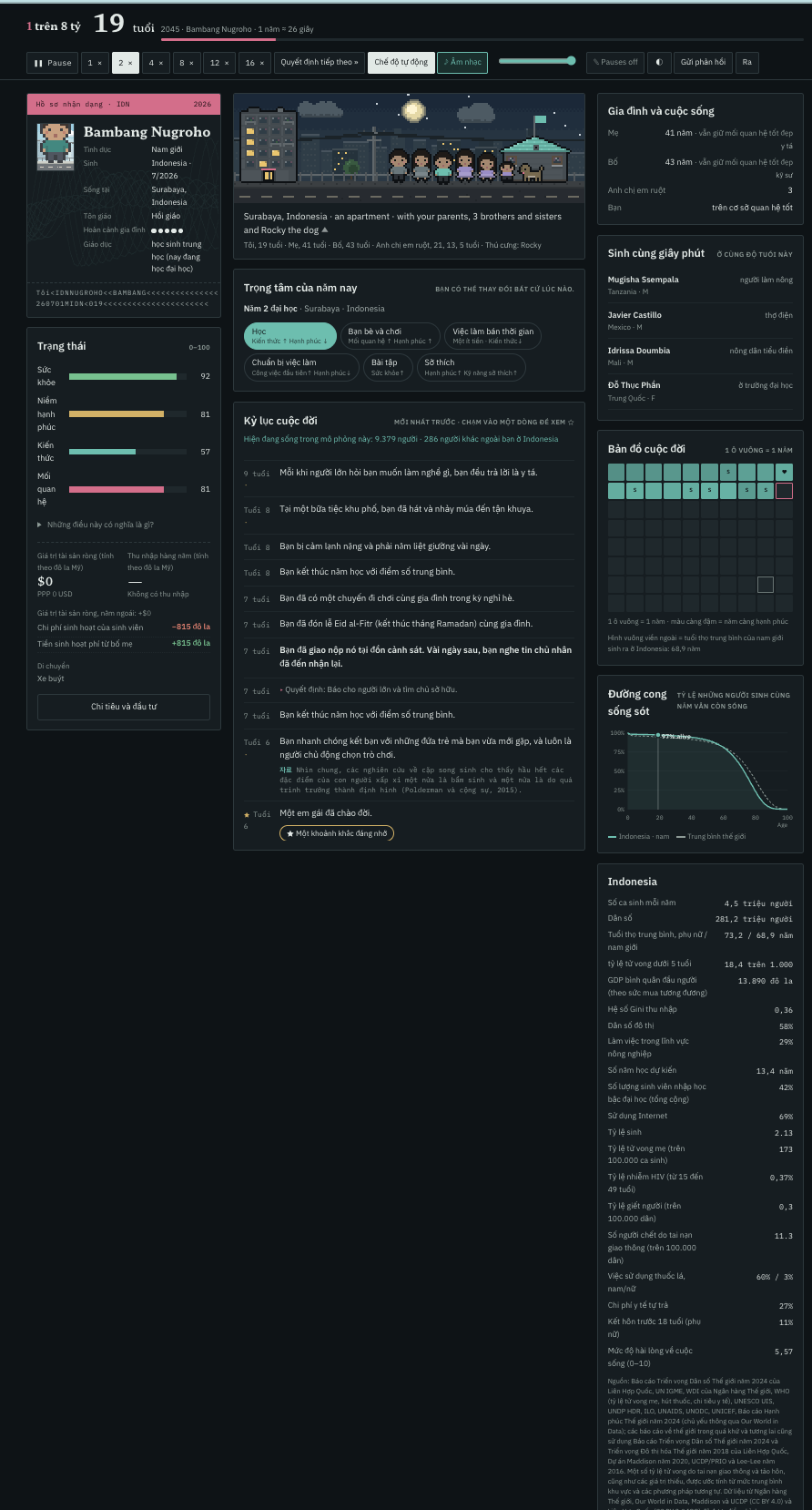
As soon as a character appears, the player receives a form of "birth certificate". In addition to name, gender, birthplace and parents, the screen also displays average life expectancy, risk of dying before age 5, family income or GDP per capita in that country.

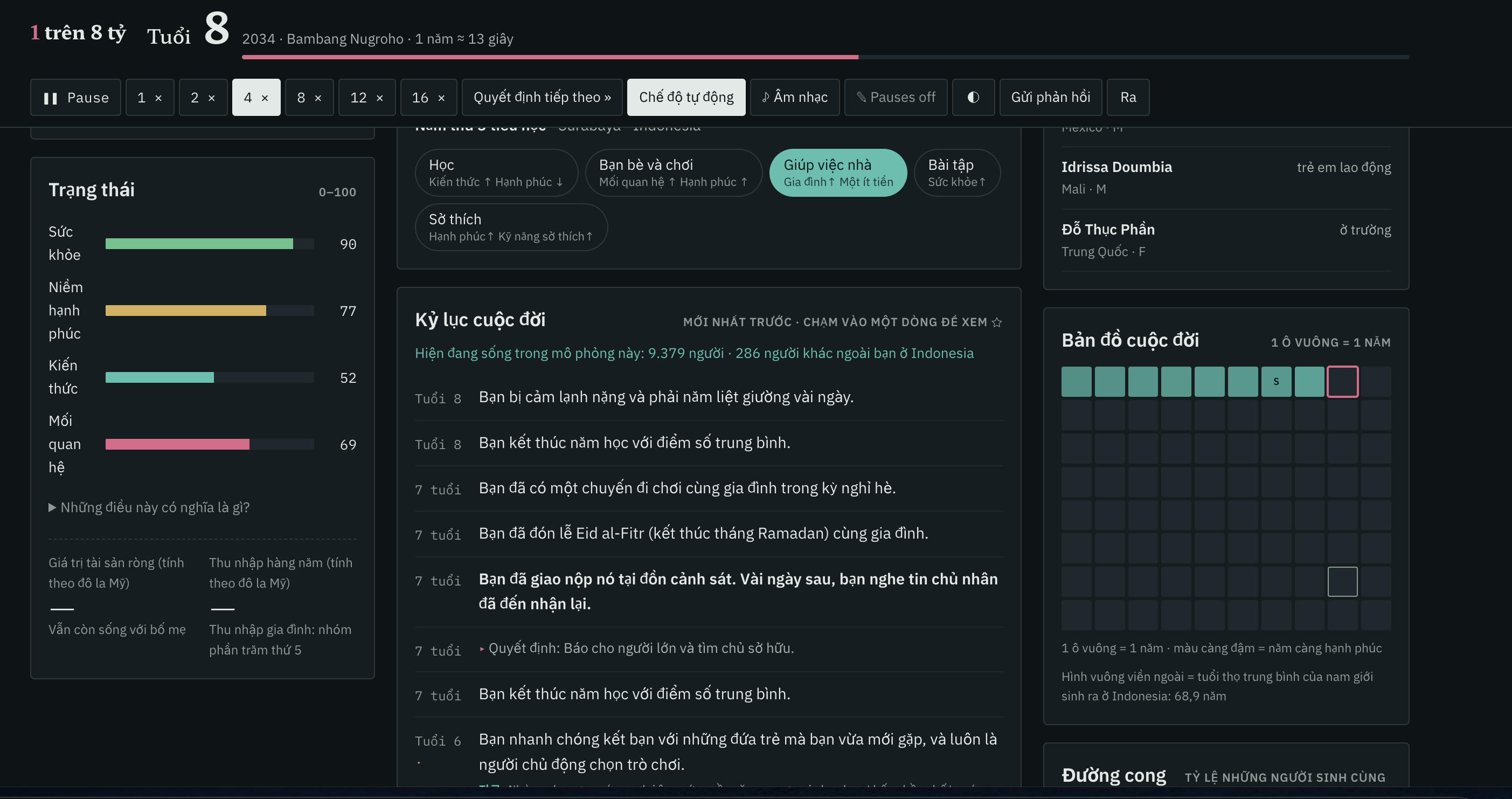
After pressing the start button, the interface turns into a life dashboard. The four indicators of health, happiness, knowledge and relationships are constantly changing. Players can choose to prioritize study, friends, work, hobbies or family at each stage.
Above are the speed levels 1x, 2x, 4x, 8x to 16x. You can let life run on autopilot, pause when needed, or move straight to the next important decision.
The website also has background music. The music, the dark interface, and the small pixelated characters create a rather special feeling: the player doesn't simply click a selection, but feels like he's sitting and watching a life pass before his eyes.
I was born into Bambang Nugroho
In my experience, the system created Bambang Nugroho, a baby boy born in July 2026 in Surabaya, Indonesia.
Bambang has a relatively favorable starting point. He was born into a family that is in the 20% richest group in Indonesia. Mother is 22 years old, works as a nurse; Dad is 24 years old and is an engineer. The family is Muslim and lives in a rented house.


The average lifespan displayed by the system for a character is 68.9 years.
But Bambang ended up living much longer than that.
In the early years of life, players do not have much decision-making power. I mainly watched Bambang grow up: getting vaccinated, learning to walk, saying "Mommy", listening to his parents read picture books, playing with the neighborhood children.

At about 5-6 years old, life begins to have both happy and sad memories. Bambang learned to ride a bike, went to elementary school, had his own room, and became friends with Slamet, but there were times when he was beaten when he did something wrong. My grandfather passed away from chronic kidney disease.
The website doesn't just record major events. Very small details also become part of life's diary.
One of the first decisions I really remember was when Bambang was 9 years old.
The screen stops with the sentence: "I want a puppy."


The boy begged his parents many times after seeing his friend's dog. I had two choices: keep begging or give up. I choose to continue. Not long after, Rocky appeared in the family.
Among hundreds of events in a life spanning more than eight decades, the image of Rocky waiting for Bambang at the gate every time he returned from school became one of the most memorable memories.
The bigger Bambang gets, the more options it has.
Bambang can study engineering, nursing, business and economics, humanities or education. Each option is accompanied by information about careers and future opportunities.
I choose humanities.


Bambang graduated from college at the age of 21. Before that, he dreamed of becoming a nurse, had close friends, had a love affair with Rahmawati and then broke up. Rocky the dog also passed away during his college years.
From here, the game starts to resemble life as an adult a lot more.

Bambang struggled to find a job before taking up creative and artistic work. He dated Yuni Rahman, bought a motorbike in installments and got married at the age of 26. The two left their parents' house and bought a house with the support of their families.
Two years later, son Wahyu was born.
If you just look at the colored boxes on the "life map", this may be a seemingly stable period. But the diary shows more unpleasant events.
Simulation profile records domestic violence. At first, Bambang chose to stay silent. He then sought help but the situation did not change much.
At the age of 33, Bambang and Yuni divorced. Wahyu lives with his mother, and Bambang sees his children on weekends and vacations.

This is also when I realized a rather different point of the game: not every player's decision helps everything happen as desired. You have choices, but you don't have control over your entire life.
Second marriage, another child and the decision to leave
At the age of 35, Bambang started dating Tri Firmansyah. The two married a year later and had daughter Eka when Bambang was 38 years old.
But the second marriage continued to have problems.
At the age of 40, Bambang decided to leave home and get a divorce. Unlike last time, this time Eka lives with her father.

A small detail in the file that caught my attention happened next. When Eka makes a mistake, Bambang is faced with a choice about how to raise his children. Instead of repeating the way he was treated as a child, he chose to sit down and explain and agree on rules with his child.
The father and son also had a twisted promise.
In a game where age can pass very quickly at 8x or 16x speed, such details make players feel like they are actually watching the changes of a person, not just watching the stat bars increase or decrease.
A person's life does not go in a straight line
Bambang's career is also not a story of steady advancement.
He used to work in creative work, then became a civil servant for about 12 years. When he was older, Bambang opened an online store with his savings but failed within a year.
He had to find a job again, switched to being a cleaning staff, and then was promoted to cleaning supervisor. After the contract ended, Bambang once again lost his job and ended up working as a salesman.


At the age of 46, he made the pilgrimage to Mecca and became known as Haji. The trip causes savings to drop significantly.
At the age of 60, Bambang chose to retire.
During that time, the two children also gradually matured. Wahyu attended college, later became a small businessman, got married and had children. Eka did not go to university but chose to work. Bambang was initially disappointed but then supported his daughter's decision.

The older years happen more slowly in a different way.
There aren't too many options left for career or love. Instead go for walks, read books, help neighbors, see old friends and spend time with grandchildren.
At the age of 73, Bambang moved in with Eka. The dining table is crowded every night.
Live 83 years in a few hours
Bambang celebrated his 80th birthday with his family. The simulated photo shows him standing among his children and grandchildren, the same way he once stood among his parents and siblings as a child.
Old friends passed away one after another. Health decline. At age 81, Bambang stopped driving.
But life still has small joys.
At the age of 83, the grandson received his first salary and invited him to dinner.

Not long after, Bambang died in his sleep of a stroke in Surabaya.
He lived to be 83 years old, significantly higher than the average life expectancy of 68.9 years displayed at birth.
Records at the end of his life show that Bambang had two children and two grandchildren. Net worth is approximately $74,000 USD according to in-game conversions, mostly a house and some savings.


But after going through all 403 lines of "The Complete Life Record", those numbers are not what I remember the most.
I remember Rocky waiting outside the gate. I miss my mother's nasi goreng. Remembering the dog Charlie leaning on Bambang during a difficult year. Remember the finger-twisting words with Eka. I remember the pilgrimage to Mecca, the lessons I taught my grandchild to knit, and the dinner at the end of his life that my grandson paid for with his first month's salary.
Not a game to win
1 in 8 Billion still has limitations. The interface contains a lot of information, sometimes making new users overwhelmed. The browser's automatic translation may also cause gender or some labels to be wrong. More importantly, this is still just a simulation; Bambang's life cannot be considered a model for a real Indonesian.
However, what the website does quite well is make seemingly dry data familiar.
Life expectancy is no longer just 68.9 years. The rate of children dying before the age of 5 is no longer just one percent on the statistical table. Income, education, family conditions or place of birth begin to be placed next to very everyday choices.
Players can decide what to study, what profession to have, who to love or how to spend time with family. But illness, death of loved ones, economic recession or unexpected events can still happen.
Maybe that's why, after living through 83 years of Bambang Nugroho, I don't feel like I just "cleared" a game.
Instead, there is a question: If we were reborn as one of more than 8 billion people in the world, in another country, in another family and with a completely different starting point, where would our lives go?